




With the stabilization of the Los Gallardos (Almería) fire, on the third day of fighting the fire, it was time to carry out the large sweep in search of any trace of life or death. The toll of 12 dead, eight injured (four very seriously), eight official missing person reports, and 23 people unlocated, after the passage of voracious flames that devoured 7,000 hectares at a speed greater than that of the wind itself, also remained stable.
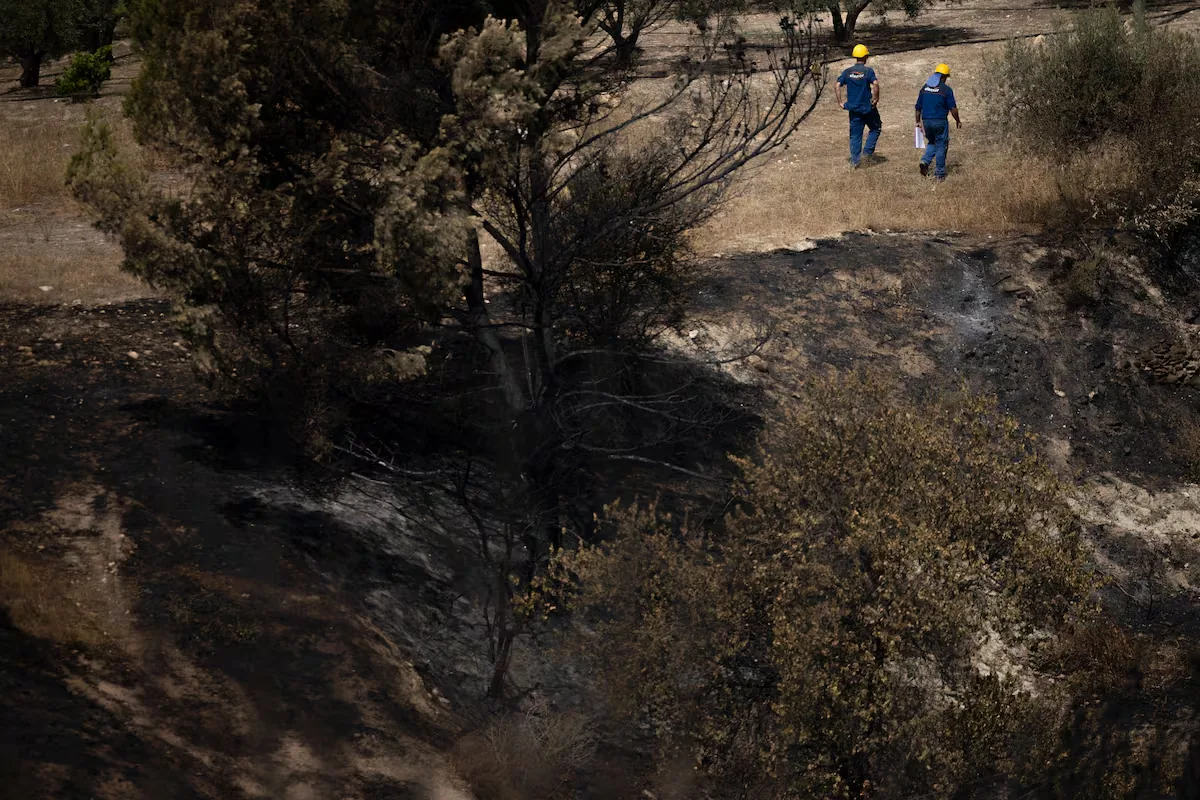
The fire, which devastated the beautiful oasis of the Cabrera-Bédar mountain range, had already become one of the deadliest in Spain’s history. And at nine in the morning this Sunday, ten mixed groups of volunteers from Civil Protection, Civil Guard, and UME (Military Emergency Unit) set out from the advanced command post in Turre (a municipality of more than 4,300 inhabitants, in Almería) ready to comb through 217 hectares of burned land and to dispel a collective fear: that there were more deaths among the missing.
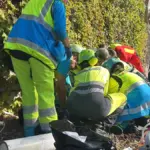
“Eighteen zones have been established, after perimetering the most affected area, where the greatest number of victims was found,” explained the director of Civil Protection, Virginia Barcones, who has remained at the disaster site almost from the beginning and who came early this Sunday to encourage the 61 Civil Protection volunteers, “the orange vests,” the main force of a search device made up of a total of one hundred people.
They combed the area by grids well into the afternoon. “The most complicated thing is the rough terrain and that everything is burned, there are even still hot spots,” noted one of the Civil Guard canine service officers while giving water to his dog, specialized in locating life. “Nothing, nothing has been found, neither alive nor dead,” confirmed official sources from the Armed Institute at the beginning of the afternoon, with the return of the operation.
Fears were fading as they advanced over the rugged charred terrain. “We trust that no new deceased will appear after the sweeps,” said the president of the Junta of Andalusia, Juan Manuel Moreno, in the morning. “We have firm confidence that no more victims will appear,” he added.
“We can categorically affirm that in the three sweeps that have been done in the houses no one was found, but we cannot rule out that someone might be found in new searches,” warned Eduardo Díaz Monje, emergency technician of the GREA (Andalusia Emergency Group).
The technique applied in this meticulous and surgical inspection of the territory is similar to that used when searching for a missing person in rural areas. “The curious thing in this case is that normally we want to find the person but, in this case, we were searching not wanting to find anyone,” he comments.
The starting point for searching for a missing person is usually the place where they were last seen. “On this occasion, we have been guided by the two points where the bodies of the deceased were found, those of the tourists and those of the cars,” he explained. The reason is that it makes more sense to search in the areas where the fire first started to arrive and where it could have caught people, rather than in those where it arrived later.
“Once we have those reference points, natural corridors are marked, where someone would intuitively move from one point to another, that is, paths and trails, rather than through the forest,” he indicates. And he points out that steep slopes are usually ruled out for that same reason, prioritizing corridors where people can walk. Areas of housing and agricultural installations where someone might have gone to take refuge are also marked. And with all that marked, they see areas closing and delimiting the search. All groups carry their own geolocation to be able to come to the rescue of whoever is necessary.
Read more Monaco Grand Prix live | Red flag with 10 laps to go
A total of 250 homes were inspected. “We had a scare in one of them, which had a collapsed garage, but finally the owner was found and was alive,” said Virginia Barcones. Most of the houses have remained intact, even though they were besieged by flames. “Cases of burned homes are isolated,” Moreno also pointed out.
During these days, that number of 23 unlocated people, along with the eight missing person reports filed at the Garrucha Civil Guard command, foretold the worst. “The search is not over,” said a Civil Guard spokesperson, who this Sunday also incorporated drones and a helicopter into the large sweep. “Searches will continue in the coming days, but of a different kind,” they explained.
“Unlocated”
Local and national political leaders insisted these days on calling the possible missing persons “unlocated people,” since in many cases they could be neighbors who had not been at their homes for some time, as many of those living in the scattered farmhouses in the mountains were English and Belgian.
However, at least one relative of the deceased, of foreign origin, already appeared this Sunday at the Civil Guard facilities to offer their DNA, so that it can be compared with the bodies found in the early hours of last Friday, in the worst of this deadly fire, precisely in the Bédar area (950 inhabitants), where the greatest number of fatalities occurred.
While aerial means continue to cool the terrain to prevent new outbreaks, between Saturday afternoon and Sunday the staggered return of more than 1,600 evacuees to their homes began, after spending two days sheltered in shelters and hotels in the area. “Important notice. The residents of Las Pastoras, from 4:00 p.m. can return to their homes,” circulated through the WhatsApps of the inhabitants of that small hamlet.
In the coming days, efforts are expected to focus on consolidating control of the fire, which reached a perimeter of 40 kilometers, and beginning to assess the damage. The President of the Government, Pedro Sánchez, will visit the area this Monday, while the identification of the bodies of the 12 deceased and the eight injured, four of them “stable but extremely serious,” who are recovering in hospitals, continues.
At the same time, the investigation into the origin of the fire continues, carried out by technicians from Seprona (the Nature Protection Service) of the Civil Guard. The main hypothesis maintained by the investigators so far is the fall of an old electric pole in the hamlet of Almocáizar, next to the A-7, although the electric company Endesa assures that it no longer had power.
Eyewitnesses at the time of the accident, around 4:30 p.m. last Friday, say they saw the cable that caused the fire “sparking,” which also remained crossed on the road and caused the flames to jump from one side to the other, and the subsequent uncontrollable fire propelled uphill by strong gusts of wind. Part of that cable was already cut and removed by investigators for analysis, but the rest could still be seen hanging on the side of the hill where the flames quickly climbed.