






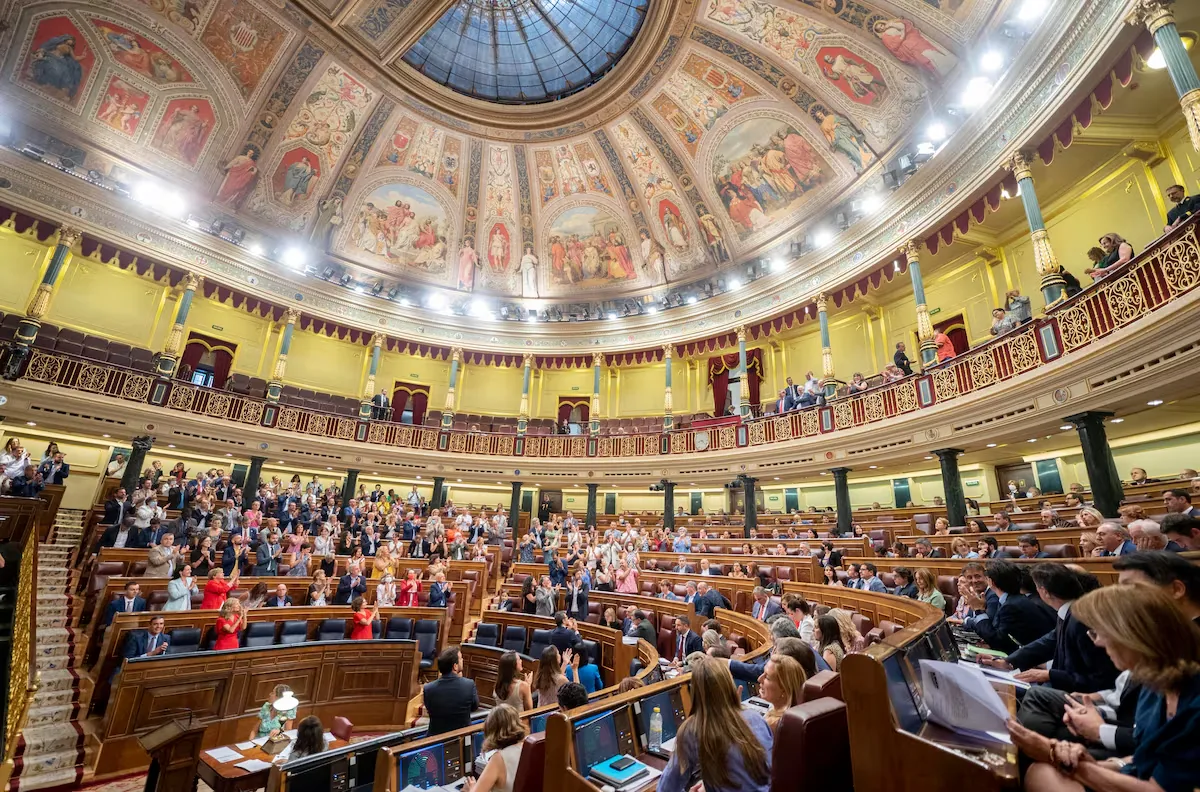
The grandchildren law, that is, the section of the Democratic Memory Law updated five years ago to facilitate nationality for the descendants of Spaniards exiled due to Francoism, has since gone through 32 parliamentary procedures or steps: from nine debates in plenary and committees in the Congress and the Senate to 16 publications in the Official Bulletin of the General Courts, five in the Session Diary, and two in the Official State Bulletin (BOE). The PP, after questioning the Government’s decision as a possible attempt at “electoral engineering,” has softened its criticisms and directed them at the alleged haste and opacity of the process. The authors of the initiative in the Government deny this with data: the law has been approved for four years after multiple debates and after receiving 469 amendments, 93 from the PP; furthermore, the controversial instruction clarifying its impact was published in the BOE in October 2022.
Read more Ayuso ends the self-government of La Hiruela, the last rebellious town in the Community of Madrid
The historic Manuel Fraga, then president of the Xunta de Galicia, Alberto Núñez Feijóo, the current Galician leader, Alfonso Rueda, and even the then PP senator and now its spokesperson in Congress, Ester Muñoz, promised in various forums and electoral campaigns, in Buenos Aires and Spain, that they would do everything possible so that “all the grandchildren of those Spanish citizens who had to or wanted to leave Spain into exile can now access the full nationality that is in their origins.” They considered it “justice” that they recover what they should never have lost: Spanish nationality. They neither asked beforehand if those grandchildren or exiled relatives had ever set foot in Galicia or the rest of Spain nor speculated on what their vote might be if they could ever regain it. The PP, in fact, has governed Galicia for 37 years in this democratic stage, and the external vote was always electorally tempting but scarce and not very relevant.
After Feijóo himself launched the idea of possible “electoral engineering” regarding the Government’s intentions with that provision of the Democratic Memory Law, the PP tried to amend its statements and clarify that what it questioned was the procedure of “opacity and haste” with which it had been carried out, as expressed by the spokesperson in Congress, who announced that they would initiate actions to review all granted files, enabled contracts, and involved officials.
The process of the current Democratic Memory Law was the same followed with this type of regulations, which usually take many months and procedures. The first step reached Congress with its publication on August 25, 2021, in the Constitutional Commission. Then a period was given for submitting amendments, from the 30th of that month until November 11. These were qualified, later debated. That commission then took seven months to prepare a report, whose conclusions were taken to a corresponding opinion between June and July 2022. The Congress plenary debated it between July 4 and 14 of that year, it was sent to the Senate until October 5, and returned to the lower house for final approval with modifications on November 14, 2022.
Along the way, 469 amendments were submitted to the law, 93 of them from the PP. In amendment number 430, signed by the then popular spokesperson now sidelined, Cuca Gamarra, a wording was proposed for the now controversial eighth additional provision on the acquisition of Spanish nationality: “Those born outside Spain of a father or mother, grandfather or grandmother, who were originally Spanish, and who, as a consequence of having suffered exile for political, ideological, or religious belief reasons, had lost or renounced Spanish nationality, may opt for Spanish nationality, for the purposes of article 20 of the Civil Code.” There did not seem to be much debate about that wording, and it remained as such.
An instruction four years ago
Since neither the original Historical Memory Law nor the revamped Democratic Memory Law clearly specified the guidelines on the exercise and scope of this right, as well as the necessary procedural rules to expedite the processing of these requests, the Directorate General of Legal Security and Public Faith of the Ministry of Justice issued an instruction published in the BOE on October 26, 2022, to clarify these possible doubts of those in charge of the Civil Registry Offices. That was almost four years ago.
Read more The New Delta: the conquest of the desert that is redefining Egypt’s agriculture
This is where the focus has now been placed because the instruction interprets that this paragraph is not directed “only to the sons, daughters, grandchildren, and granddaughters of exiles who were born after their parents and/or grandparents lost Spanish nationality” but that “it is possible to find an interpretation more in line with the true will of the legislator and the spirit of the law.” It adds that descendants of Spaniards who suffered exile for reasons of sexual orientation and identity and “children born abroad of Spanish women who lost their nationality by marrying foreigners before the entry into force of the 1978 Constitution” could also benefit.
These added reparations also did not generate any controversy at the time and were only challenged by the ultras of the Association for Reconciliation and Historical Truth, who contested the decision of the director who signed the instruction, Sofía Puente, a prosecutor, sister of the Minister of Transport, Óscar Puente, and with a long professional career in the justice world. The challenge filed by that entity was not admitted by the Superior Court of Justice of Madrid. The ultra organization Hazte Oír has taken advantage of the commotion these days with the grandchildren law to file a complaint for administrative prevarication against the director general of Justice.
In Justice and throughout the Government, they understand all this controversy as part of the general strategy of the PP and Vox, now increasingly in unison, to question, doubt, and put under suspicion any action of the Executive, even if it proposes, as this regulation does, the same that the popular party has been defending for years throughout Latin America. The text under scrutiny is not an order, it is an instruction so that officials or contractors in consulates can know what to expect. The theoretical avalanche of possible registrations has not only not been rushed but follows a pace that theoretically should be manageable, despite some problems in some specific points.
The Ministry of Territorial Policy and Democratic Memory has specified that, until last March 31, a total of 2.4 million people had requested an appointment at consular offices to submit their application for nationality under that law, which has been in force for four years. 1.2 million applications were officially submitted at those offices, and 544,722 have already been approved, of which 306,000 are already registered. To illustrate the scale of the process and deny the “haste” that the PP denounces, Justice points out that only in 2025 they already processed more than 296,000 nationality applications by residence — that is, outside the procedure enabled by the Democratic Memory Law — of which more than 221,000 were approved. “It’s not that [nationalizations under the grandchildren law] are not fast, it’s that they are very slow,” explains Justice.
Read more Europe drags its feet again on sanctions against Israel for the massacre in Gaza and the West Bank