









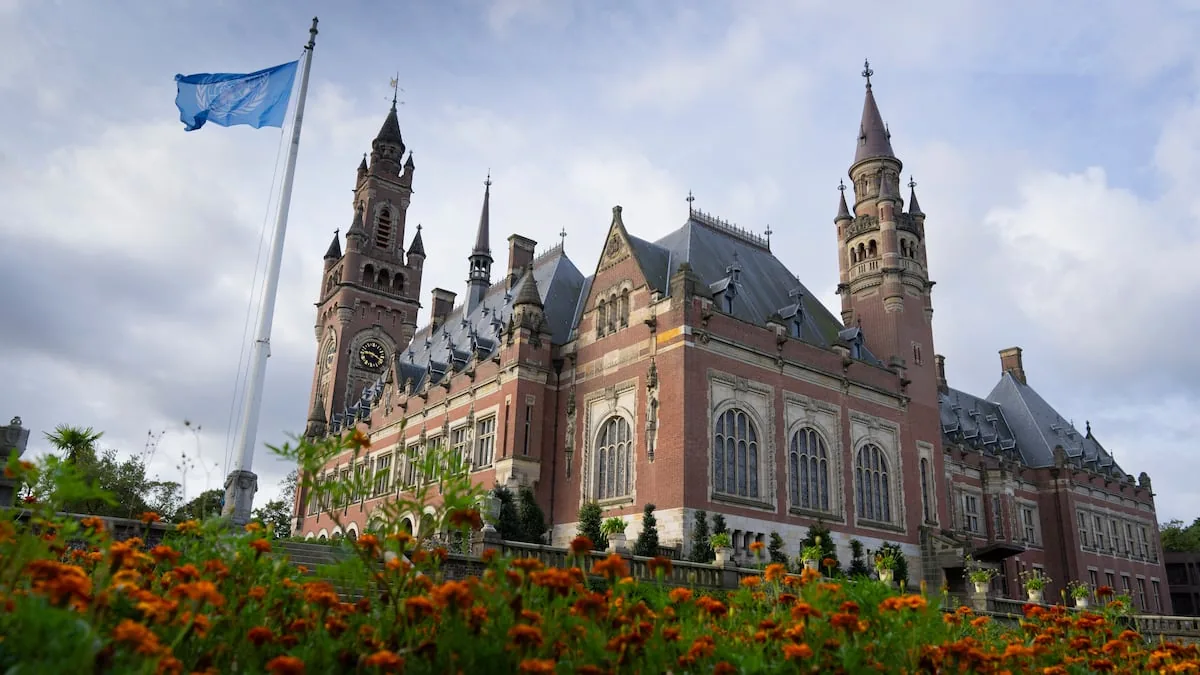
The inaugural session of the United Nations International Court of Justice (ICJ) was held on April 18, 1946, after World War II, at the Peace Palace in The Hague. The institution commemorates this Friday, on the eve of the anniversary, its 80 years with a ceremony attended by the UN Secretary-General, António Guterres, and King Willem of the Netherlands. It has been nearly 30,000 days of work for States to resolve their differences peacefully. The anniversary takes place in a context where countries like the United States and Israel have blatantly ignored the court’s resolutions.
In these 80 years, the ICJ has ruled on approximately 170 disputes between States and has issued a total of 30 advisory opinions. The institution was not born in a vacuum but with the experience of a previous one, the Permanent Court of International Justice. Established after World War I, it failed due to the inability of the then League of Nations to maintain peace. Since 1946, the ICJ has been the main judicial body for the United Nations and its 193 member States. To date, however, only 75 accept its compulsory jurisdiction.
The judges’ work has two aspects: resolving disputes between States in contentious proceedings whose decisions are binding and advising on International Law to United Nations bodies, mainly the General Assembly and the Security Council. In the second case, advisory opinions are issued that are not binding. Ensuring compliance would correspond to the body that requested them, but it is not easy to reach agreement within the UN.
This latter task has produced two notable examples in 2025: regarding Israel’s obligations to allow humanitarian aid in the occupied Palestinian territories and on States’ duty to act on the climate crisis. With more work than ever, the decisions of its 15 judges must inspire confidence at a time of great global political tensions.
“It says something that remains valuable”
Both binding rulings and non-binding opinions carry a high political charge. Spanish jurist Asier Garrido Muñoz, who has served as legal counsel to the court, recalls the current repercussions of the first dispute resolved by the ICJ. It confronted, between 1947 and 1949, the United Kingdom and Albania over several incidents in the Corfu Strait, which separates the coasts of Albania and Greece. British ships suffered human losses and damage from mines in Albanian waters, and the judges emphasized the unconditional prohibition of the unilateral use of force, especially in an international strait. “We are talking about 1949, but from its inception this court says something that remains valuable 80 years later,” he explains over the phone.
Another ruling, which appears in diplomatic law manuals, was issued in relation to the crisis of the American hostages at the beginning of the revolution in Iran in 1979. Iranian students held 52 American diplomats in Tehran for 444 days and demanded that the US return the Shah, Mohammad Reza Pahlavi, to be tried. “Washington took the case to the ICJ and Iran lost spectacularly,” says Garrido Muñoz. “The court established numerous foundations regarding the obligations of all States, not only not to interfere with the diplomatic or consular rights of other countries but to take measures to prevent individuals or groups from violating them.” The hostages were only released in January 1981, as Ronald Reagan arrived at the White House.
“In the case of Israel and the US it does not seem to work”
Nico Schrijver, Dutch emeritus professor of International Law at Leiden University, who has also acted as legal advisor in several cases brought before the ICJ, indicates that “there are 24 pending, the highest number recorded in the general list.” He admits that law and politics are not completely separate. “But I believe the court has made clear things as valuable as that acts of war must comply with International Law.” And he recalls that the body “has declared several times that self-defense is limited to situations of armed attack.” “We already know this from the United Nations Charter, but it is important that the international community has a kind of common radar to interpret the law,” he says. Then he asserts: “Although, of course, in the case of the United States and Israel it does not seem to work when International Law is not on their side.”
Read more Rethinking the University: between inherited inertia and the urgency of the future
Schrijver defends the importance of also issuing advisory opinions and mentions the climate ruling announced on July 23, 2025. He considers that the judges “not only offered a firm legal interpretation but went even beyond the Paris Agreement [adopted in 2015 to limit global warming], by considering that there is an existential threat to the planet.” On that occasion, the initial request came from Vanuatu, a Pacific island State whose survival depends on rising sea levels. It ended up reaching the UN General Assembly, which requested the judges’ opinion.
The occupation of Palestinian territories, illegal
In the case of Israel, in July 2024, and on a request from the General Assembly prior to the war in the Gaza Strip, the judges’ advisory opinion declared the occupation of the Palestinian territories, including Gaza, the West Bank, and East Jerusalem, illegal. It was not to the liking of the government of Prime Minister Benjamin Netanyahu. In December of the same year, the General Assembly again requested the judges to assess Israel’s duties towards the Gaza population. And in October 2025, they stated that Israel was “obliged to accept and facilitate” humanitarian aid to the Strip to ensure the basic needs of the population. That “security considerations could not be placed above humanitarian law.” The legal, diplomatic, and political weight of the judicial opinion “has a lot of influence because it offers the most authoritative interpretation of the law,” says Schrijver.
How has international law adapted to the Court’s resolutions? Garrido Muñoz assures that today “it is absolutely impossible to understand it without the ICJ’s decisions.” “Anyone reading an international law manual for the first time will find countless references to the ICJ,” he adds. And in the case of incitement to genocide in Gaza, which is South Africa’s accusation against Israel in 2024?
For this expert, there are two aspects. On the one hand, “the question is to determine whether genocide has occurred or not.” In the case of the Bosnian city of Srebrenica, for example, the Court concluded in 2007 that one had been committed in 1995, but the question was whether it should be attributed to Serbia, which, in the end, was not done “because it was not, let’s say, directly the one who perpetrated it,” explains Garrido Muñoz. In Israel’s case, the jurist thinks this problem does not arise. “Because all acts in Gaza are clearly attributable to Israel,” he points out. And here appears the second factor mentioned by Garrido Muñoz. “If it is concluded that there has been genocide in Gaza, there is a State that interprets international law to its convenience and is supported by the United States.”
Has the ICJ then earned the trust of States? Nico Schrijver believes so. He recalls that “history and politics evolve, and conventions like the one that prevents and punishes genocide, which dates from 1948, began to be invoked after the Cold War.” Before, “the court thought that human rights were a matter for the United Nations in its political aspect, but that has changed.” The 15 judges are elected by majority of the General Assembly and the UN Security Council, and today there are five women. Both scholars agree that this is a figure that can be improved. Spain has had only one, Federico de Castro y Bravo, between 1970 and 1979.