





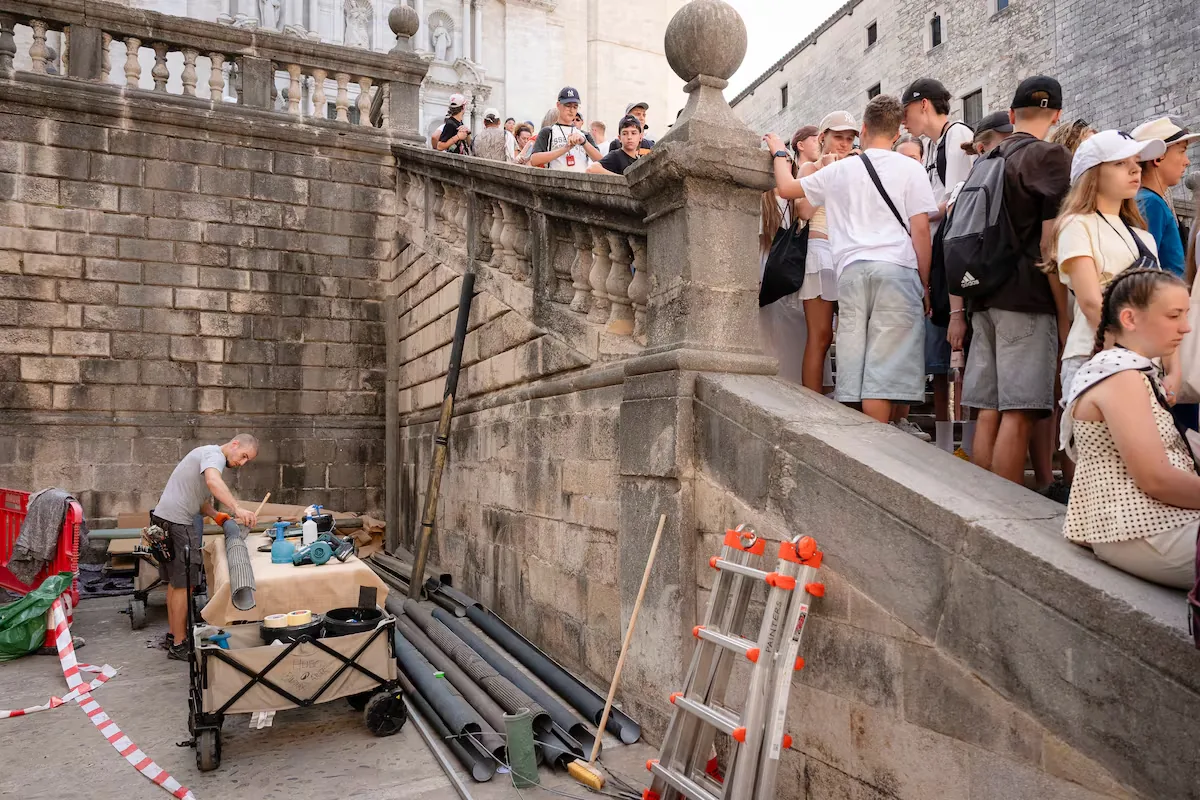
The stairs of Girona Cathedral are transforming again. This time it’s not the White Walkers from Game of Thrones or the archaeologist Lara Croft from the new Tomb Raider series. Now it’s the sets of Tangled, the live-action version that Disney is preparing about the story of Rapunzel, that occupy the heart of the Barri Vell. While a team of about 500 people works among draperies, platforms, and medieval scenery to turn some emblematic spaces of the city into a film set, other messages have started to appear on some balconies in the old town: “We are a neighborhood, not a set”, “Fewer filmings, more services” and “We want a neighborhood to live in, not to survive in”.
Read more A jeweler who shot dead two robbers, new hero of the Italian right
The mobilization, promoted by the Barri Vell-Mercadal Residents’ Association, wants to make it clear that the discomfort does not stem solely from the latest Disney filming. Residents explain that the protest responds to an accumulation of situations that have occurred over recent years: audiovisual productions, festivals, large events, and growing tourism that, in their opinion, have transformed the daily life of the neighborhood.
The residents are preparing a citizen motion to present to the Girona City Council plenary session with a specific request: that production companies occupying public spaces in the Barri Vell resume paying the municipal fee for using this space. In parallel, sources from the City Council’s Culture department have explained that they will study the proposal, as the decision not to charge came from the previous municipal team.
The residents’ association demands a modification of the tax ordinance to eliminate current bonuses and exemptions for film shoots, videos, and television recordings. Residents believe that productions obtain a private benefit by using a public space and that, in contrast, citizens bear part of the costs derived from these activities, such as impacts on mobility, security deployments, cleaning, or wear and tear on urban space.
According to the draft motion accessed by this newspaper, the Barri Vell is not only Girona’s main historical and cultural heritage but also a neighborhood where 4,096 people live. The association argues that any use of public space must be conditioned by the general interest and proposes that the income obtained from these fees be allocated to heritage conservation, public space improvement, and compensation for the affected neighborhood and commercial fabric.
The proposal also suggests setting limits on the filming schedule: establishing a maximum number of filming days per year, creating rest periods between productions, and avoiding commercial filming on weekends, holidays, or periods of high event concentration. Additionally, it calls for measures to protect residents’ acoustic and light rest.
Supporters and detractors
The filming of Tangled has served as the trigger for a debate that many residents consider long overdue. Eva, a resident of Ballesteries street, summarizes this feeling with a strong image: “It seems like the neighborhood has turned into Eurodisney.” She explains that she doesn’t question Girona attracting visitors or the city being the setting for major international productions, but she believes that the pressure on the Barri Vell has increased. “Everything seems designed for cyclists and for people from outside,” she laments. She recalls that for years the old town was a residential neighborhood, with local shops and spaces designed for those who lived there. “Every time there’s a shoot, they close off streets, it’s hard to unload groceries or simply live a normal life,” she states.
Margarita, a resident of Ciutadans street, shares a similar perception. “When it’s not a filming, it’s Temps de Flors; when it’s not the bicycles, it’s something else,” she explains. “It’s good that visitors come, but residents also need to be able to access our homes, go to work, and live our daily lives,” she adds.
The controversy comes at a time when Girona is once again on the international map thanks to the audiovisual industry. The Barri Vell has been the setting for national and international productions for years due to its medieval heritage and historic streets. The City Council defends that filmings are part of a strategy to project Girona internationally and generate economic activity in the city. Municipal sources highlight that these productions also have a cultural impact, involving professionals from the audiovisual sector, students, and local entities, in addition to benefiting small and medium-sized businesses and the service sector. The last major filming, that of Tomb Raider for Amazon Prime Video, generated an estimated economic impact of 1.4 million euros.
The council admits, however, that these recordings disrupt the routine of Barri Vell residents. Therefore, they assure, they work to “minimize the impact” and strengthen prior communication with residents. As they explain, before filming, they inform about the impacts through posters and leaflet distribution in the neighborhood, emails, contact with residents’ and merchants’ associations, and open meetings with residents.
Part of the tourism sector also highlights the value of these productions for projecting Girona internationally. Some guides acknowledge that filmings require modifying routes and adapting to restrictions, especially during high season, but they believe that they turn the city into a showcase that can attract new visitors.
The debate, therefore, lies in the balance between two realities: a city that wants to leverage its heritage to attract tourism and major productions, and residents who demand that this success does not mean losing their everyday space.