








The government of far-right Giorgia Meloni continues to tighten the screws of the penal code in Italy with new security regulations. It has already approved seven decrees and laws in this area, and this time the target is minors who commit crimes, especially youth gangs that have emerged in recent years: the Council of Ministers gave the green light this Thursday to a new rule establishing that the age at which a young person can be automatically criminally charged for an alleged crime drops from 18 to 14 years. The minimum criminal age remains the same, it is 14 years, but until now a minor was only charged if it was proven that they knew what they were doing and had a clear capacity to understand and decide on the criminal act. The judge evaluated case by case. Now it will be the other way around and they will be equated with adults; the burden of proof is reversed, so it will be the minor’s defense that will have to prove that they were not aware of the scope of their actions.
“Whoever makes a mistake must answer for their own actions. Even when they are a minor,” Meloni said in a video circulated on social media. “It is a principle that we are trying to assert in all areas: whoever assaults, steals, or destroys must always pay. Even if they are 15 or 16 years old. Before, incapacity was presumed; today, responsibility is presumed.”
The opposition and organizations working with marginalized youth, including chaplains from juvenile prisons, have strongly criticized the initiative, which still needs to pass through Parliament. The left accuses the Executive of merely engaging in propaganda and not addressing the real problems of citizens, and believes that repressive measures are not the answer to the problem of youth violence. The Union of Criminal Chambers, which brings together 10,000 criminal lawyers, has expressed in a statement its concern about “a worrying cultural regression” and points out possible risks of unconstitutionality.
The bill that includes this rule has already been dubbed anti-maranza. The term refers to members of youth gangs from peripheral neighborhoods, sometimes children of immigrants, who in recent years have been involved in violent criminal episodes, some of them gratuitous violence. But, in addition, it also affects minors arrested in street riots during demonstrations, which is why the opposition claims that the aim is to criminalize protesting youth.
Meloni explained that the measure “is primarily aimed at those who believe themselves untouchable and exploit minors as labor for their own businesses, but it also serves to punish those young people who think they can do whatever they want because they know nothing will happen to them.”
The same bill contains other articles that already emerged weeks ago. Minors can be preventively detained with founded reasons, for example, if they carry weapons or dangerous objects. Police chiefs can also prohibit groups of five or more people who display intimidating behavior, and even ban certain individuals from gathering in groups.
Save the Children, which has also criticized the new law, noted in its latest report this year that Italy is one of the countries with the lowest juvenile delinquency rate in Europe, but it does indicate that it is a growing problem: the number of arrests of minors has increased significantly in recent years. In 2024, 3,968 minors were arrested for robbery, more than double that in 2014. For injuries, there were 4,653, also almost double. And arrests for fights have skyrocketed by almost 100% in five years. Another worrying phenomenon is that carrying knives and bladed weapons has become normalized. On this aspect, the Government already intervened in February with another rule that toughened the penalty for their possession: from six months to three and a half years if a knife longer than eight centimeters is carried.
“Weak with the strong and strong with the weak”
This repressive line is highly debated by the opposition and was adopted by Meloni’s government immediately upon coming to power in 2023, with the so-called Caivano decree. This is the name of a town near Naples where a terrible incident occurred in a highly degraded area: the rape of two girls by a group of minors. Its critics, including writer Roberto Saviano, believe that it only filled prisons with young people.
Read more LeBron James surprises everyone with his next NBA team: he will play for the Philadelphia 76ers
“Weak with the strong and strong with the weak, this is Meloni’s motto,” said Chiara Braga, head of the Democratic Party (PD) group in the Chamber of Deputies, the main opposition party, about the new law. “Yesterday with immigrants, today with minors. There is no limit to the desire to present a scapegoat instead of solving the problem. (…) It is the worst Italian right, and the worst European right,” she stated.
The PD’s head of childhood affairs, Michela Di Biase, stated that minors “cannot be considered miniature adults.” “Criminal responsibility must consider their maturity and capabilities. The risk of automatisms is that they replace the assessment of the person with only a repressive response,” she explained. In her opinion, the causes of the problem should be addressed with prevention, education, and family support, not by “anticipating the adult penal model.”
The proposed law must pass through Parliament, but the mere fact of announcing it has its effect. It is yet another measure by the right-wing coalition (Brothers of Italy and the League, both far-right, and Forza Italia, right-wing) designed to appease its most angered electorate.
One year until the elections
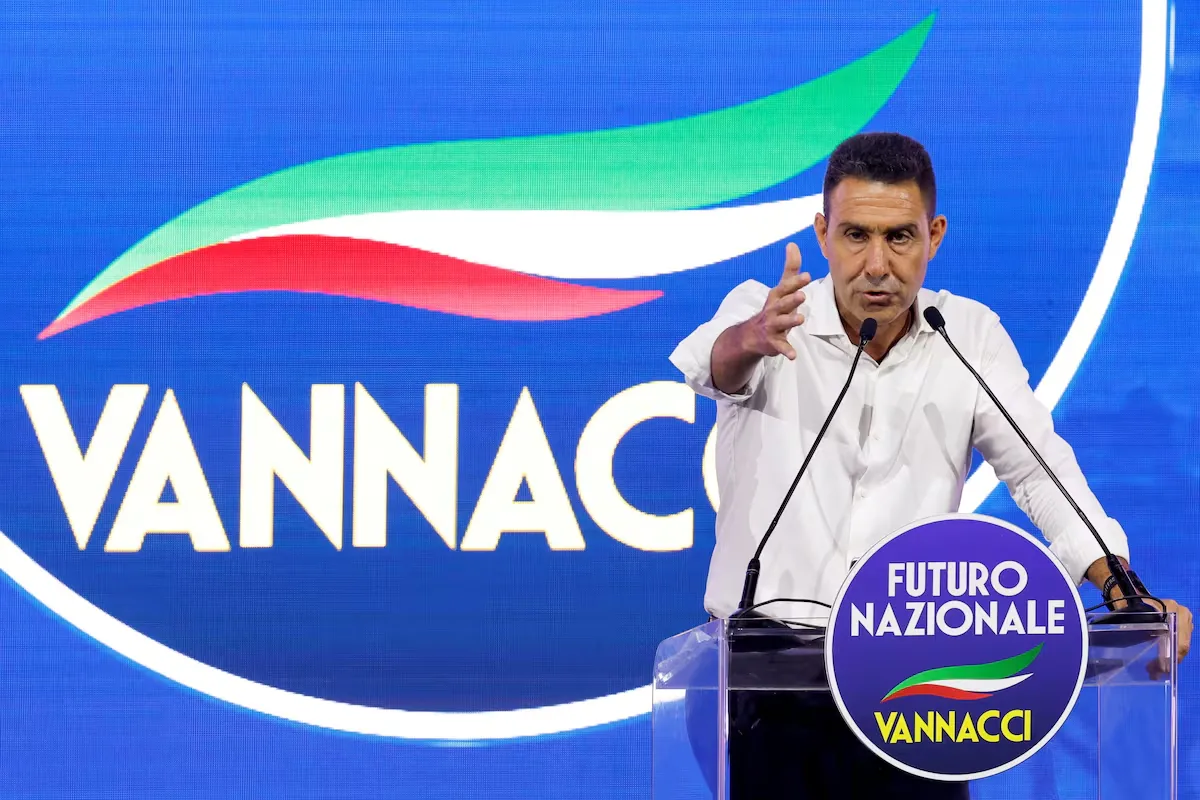
Meloni is accelerating because there is one year left until the general elections, unless she brings them forward to spring, and fear is growing due to the rapid rise of the new far-right party, National Future (FN). Its leader, former general Roberto Vannacci, accuses Meloni of having defrauded her voters and failed to keep her promises of a tough stance, and is eating into the votes of Matteo Salvini’s League. In the polls, FN is already around 7%. This is why the race between Vannacci and the Executive to formulate more extreme ideas first has accelerated.
As on other occasions, the Italian Prime Minister manages her timing well and moves with current events. This week was opportune because the issue of security has once again dominated public debate. Firstly, due to the definitive 14-year sentence and the imprisonment last Saturday of a jeweler from Piedmont who, in 2021, killed two robbers after chasing them in the street as they fled his establishment. The Court of Cassation, equivalent to the Supreme Court, confirmed that it was not legitimate self-defense because the threat had already ceased when he fired, but in recent years he has become a hero for the right. The entire government criticized the sentence, and the League presented a bill to extend legitimate self-defense to moments after a crime. “Whoever enters my house renounces their right to life,” said Vannacci.
On the other hand, on Sunday, a man of Moroccan origin with signs of mental imbalance died in Bologna at the hands of two officers who had immobilized him. It was adding insult to injury, as in recent years there have been deaths of citizens due to excessive police violence after being arrested. There was a protest demonstration in the city that degenerated into serious incidents with violent groups at night.
The government’s response whenever disturbances have occurred during mobilizations has been to accuse the left-wing opposition of promoting a climate of violence, followed by new, increasingly severe security measures. This already happened after the damage caused at Milan station last September, during a general strike against Israel’s offensive in Gaza. And in February, after another protest in Turin over the closure of a social center.