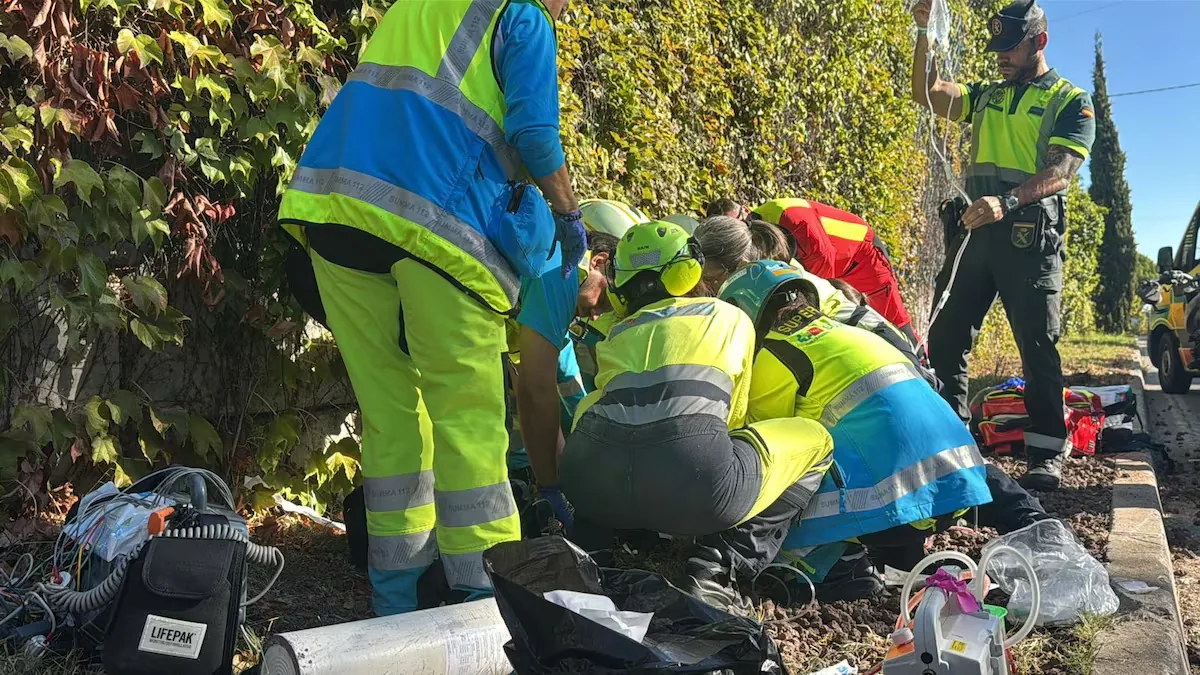







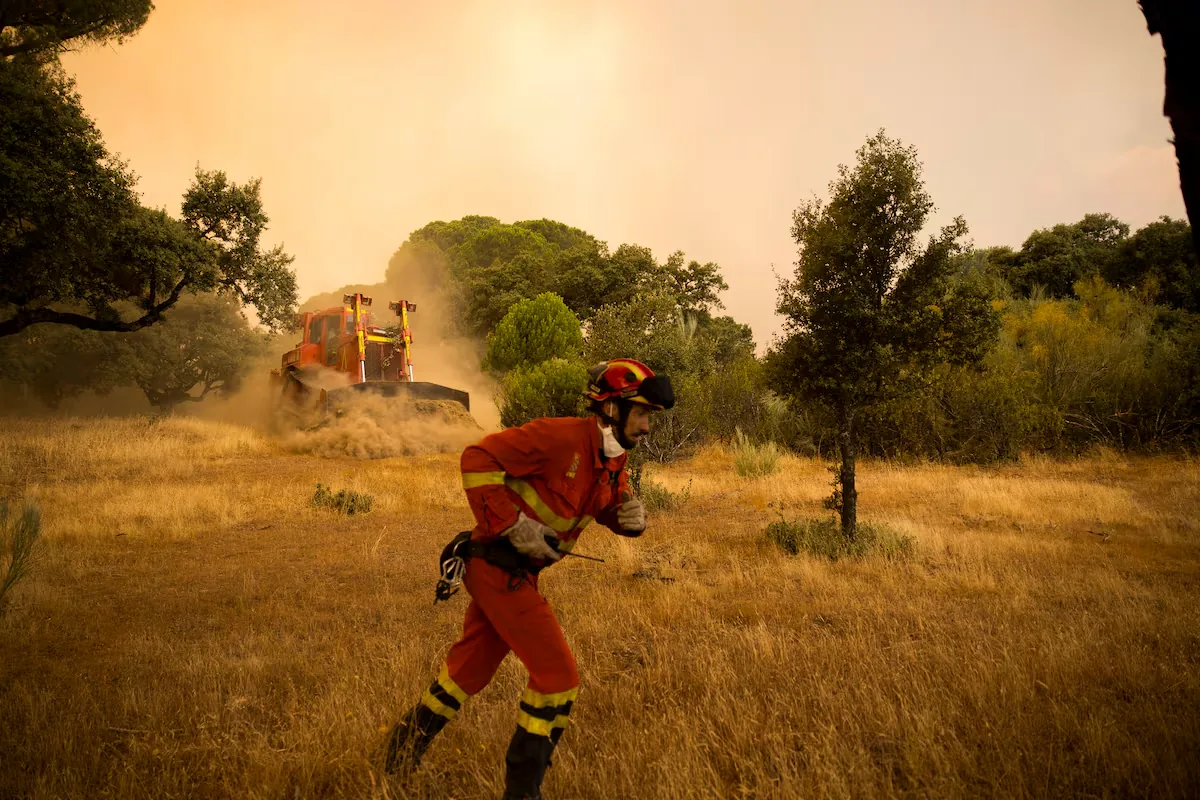
The operation fighting in the province of Toledo against the advance of the fires in Ávila and Madrid is racing against time so that the new heat wave arriving on Wednesday does not worsen the flanks of the swarm of fires ravaging the Tiétar Valley and the Sierra Oeste of Madrid. On the fronts bordering Toledo, the affected hectares, according to the Government of Spain, are around 2,000, although other sources lower that figure to 850. On the Toledo flank of the Tiétar, between La Iglesuela and La Adrada, work to contain the fire is progressing. “Only about 200 meters remain to perimeter it,” assured the Government delegate in Castilla-La Mancha, José Pablo Sabrido, after attending a CECOPI in Toledo. In the Almorox area, reinforcements from the UME arrive to prevent the wind from rekindling the fire that on Wednesday jumped from there to several residential areas of Villa del Prado.
In that triangle is where the Infocam resources and the rest of the operation focus their work with heavy machinery, manual tools, and widening burns. Sabrido emphasizes that “under no circumstances” can one yet speak of “control.” “The goal is twofold: to support Ávila and Madrid and to establish a defensive line so that those fires stop in the south. Something that, roughly speaking, we are achieving in a very satisfactory way,” stated this Monday, from the Advanced Command Post in La Iglesuela, the president of Castilla-La Mancha, Emiliano García-Page. “So far, a lot of burned surface and many things impacted, but human lives and the bulk of the populations are being very well protected,” Page stressed, pleased with the level of coordination and collaboration between administrations. “Much more than the political noise sometimes conveys.”
The residents of the 11 municipalities of the Sierra de San Vicente and the Toledo Tiétar evacuated since Saturday live in tense waiting. “We know people can be nervous because they want to return to their homes, but I would ask them for caution and a lot of trust,” Sabrido stresses. García-Page points to a possible de-escalation in the coming hours for “some families from some municipalities” if conditions allow. In Talavera de la Reina, there are about 2,000 evacuees from Toledo and Ávila, around 1,300 in its fairgrounds. “It is a bleak scenario. It will be very hard for us, but we will get through it in the end,” says David, a resident of the Ávila town of Santa María del Tiétar, relocated with his family and pets in one of its pavilions. Others, like Miguel, a taxi driver from La Iglesuela, prefer to sleep in his nine-seat van. “It is a very tough situation,” he states.
The fires are indeed giving a break to the livestock farmers, more relieved after being able to access their farms for four hours to feed their herds in a device coordinated by the Civil Guard, which also patrols the area to prevent possible looting. “The animals are fine, they are not very affected by the smoke,” says David Agüero, a 40-year-old livestock farmer with about 200 cows in Castillo de Bayuela and San Román de los Montes. The farmers evacuated in these 11 villages number around five hundred. “The fire source is far away, but the first day there was a lot of smoke and I arrived home from work with quite a headache,” Agüero points out, who is spending these days in his home in Talavera and shows understanding, despite everything, with the evacuation order. “On Sunday morning, the smoke was impassable,” he recounts.
But not everyone has left their homes. In Pelahustán, with about 400 inhabitants, about twenty neighbors remain, along with their mayor, Roberto García, including several livestock farmers. “No matter what they say, I am not going to leave. The priority was to save the lives of my neighbors and then protect my town in case the worst part of the fire arrives, still at a considerable distance,” García acknowledges. “I believe the conditions are now met to gradually and orderly return, with some temporary or hourly confinement if necessary. The situation is already good enough for people to be able and should return to their homes,” he defends. This is what Carmen, one of the neighbors of Pelahustán who will spend her third night at Talavera Fairgrounds, most implores. “The mayor gives us hope and tells us that we might be able to return this Tuesday.”
In Escalona, in a sports pavilion, about a hundred neighbors from two residential areas of Almorox remain, but also from Cenicientos and Cadalso de los Vidrios, evacuated on Saturday due to the Villa del Prado fire. The fire also led David, owner of a dog hotel in Almorox, to evacuate his animals to another center in Illescas. “They are dogs with difficult behavior. The help was nil and we made the transfer with our own means,” he denounces. “They take very good care of us, but we want to be in our home,” sighs Juan Manuel, a 73-year-old resident of El Tiemblo, the only Ávila resident in Escalona among Toledo and Madrid residents. From the cool nights of the Tiétar, he has moved to the Toledo heatwave: “I take pills to be able to sleep, but I am not used to this heat,” he confesses. “It is just killing time until I can return.” Something he will still have to wait for.
Read more Brazil calls back Argentine ambassador after Milei’s attacks on Lula