




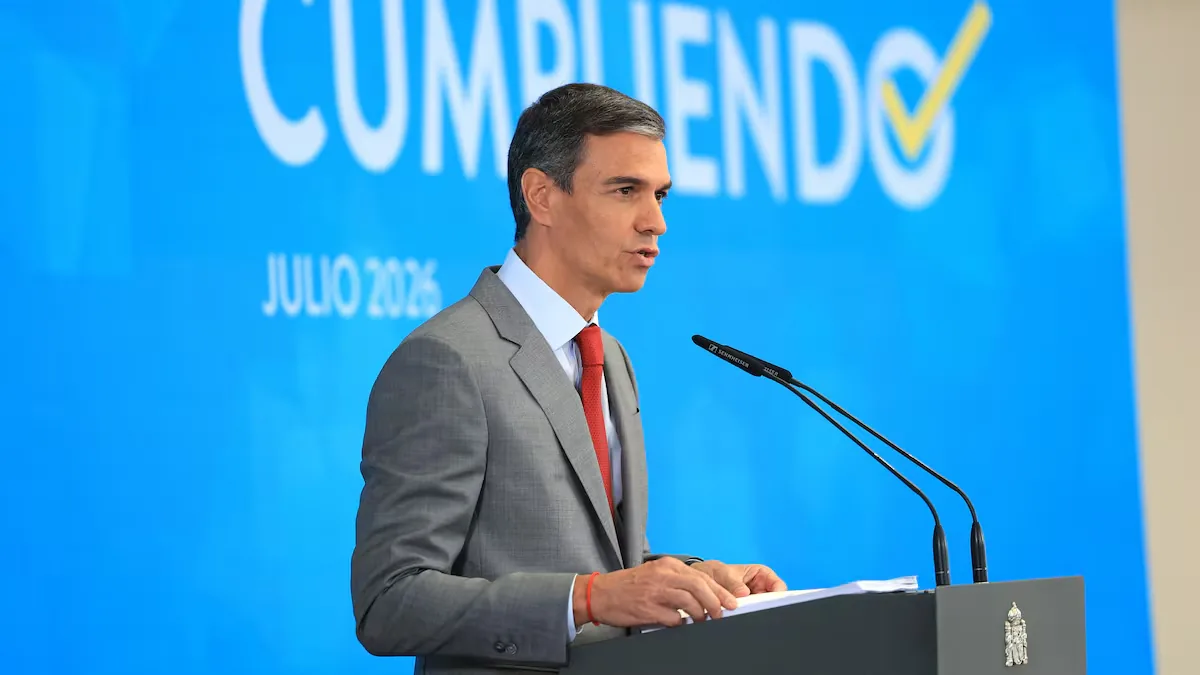
The wildfires ravaging Madrid, Ávila, Toledo, and Castellón shape Pedro Sánchez’s traditional political course review this Tuesday at the Palacio de La Moncloa. Sánchez began his appearance by referring precisely to this issue and called for unity among administrations for reconstruction after the fires. The head of the Executive made a new call to form a state pact for the climate emergency and criticized the “climate denialism of the right.” Additionally, he expressed his “recognition to all the workers fighting the fire on the front lines” and warned of a new heat wave that will hinder the extinguishing of active fires and increase the risk of new ones.
This Tuesday, the Government declared in the last Council of Ministers before the summer break the areas affected by the forest fires as severely damaged and will approve an extraordinary benefit for workers affected by the fires, which will amount to 70% of the regulatory base and can be collected for up to a maximum of four months.
Judicial front
The judicial front is the Government’s great Achilles’ heel. Last week, José Luis Rodríguez Zapatero denied his involvement in the rescue of 53 million euros of the airline Plus Ultra and did not clarify the origin of the jewels valued at 1.3 million euros that he kept in a safe in his office, provided by the PSOE opposite its headquarters in Ferraz. Sánchez insisted this Tuesday, in response to journalists’ questions, that he supports the “presumption of innocence” of the former socialist leader. “I am not the spokesperson for President Zapatero,” he stressed, however, and recalled that it will be up to the former president to provide the corresponding explanations.
In a different tone, the head of Government addressed the judicial cases affecting his wife and brother. Regarding the case of David Sánchez, recently convicted, he defended his extensive resume: “He is a person who has dedicated his life to working”: “He is not just my brother, he is David Sánchez.” About his wife, Begoña Gómez, charged with influence peddling and embezzlement, the head of Government recalled that his wife gave up her company when he entered La Moncloa to avoid any conflict of interest: “She was a professional before I met her,” he concluded. “She is not my wife, she is Begoña Gómez. With these kinds of strategies, what is done is to dehumanize people,” he insisted. “Does the partner of a head of Government have to give up their professional career? Is that the Spain we want?” he asked.
Already in an end-of-course review key, Sánchez boasted about the good performance of the economy and bragged that, despite everything (the energy, commercial, and geopolitical crises), Spain is the fastest-growing country within the eurozone. Regarding purely political matters, somewhat less buoyant, the head of the Executive also recalled that they have achieved the approval of “26 regulations with the force of law,” in a difficult parliamentary context. And in a legislature in which the Government has not been able to pass a Budget: “Our intention is to present the Budget and approve it,” he stressed.
In this vein, the head of the Executive highlighted, for example, the good employment performance, the execution of European funds, a “record” investment in R&D, or the competitive price of electricity in Spain, thanks to an energy mix marked by renewables. Sánchez stated he has made “brave decisions that have upset a few.” In that sense, the president recalled the latest measure to reduce fuel taxes due to the impact of the confrontation between the United States and Israel with Iran: “The question is: how would others have responded to these crises?” he concluded.
The good news Sánchez brought to the appearance is the unemployment rate of 9.87%, which has again fallen below 10% in the second quarter of the year and is the lowest since 2008. The number of people working in Spain marks a new record, nearing 22.8 million. In his appearance, in which he jumped from topic to topic, the head of Government highlighted the process of “deconcentration” (not decentralization) in which his Government is immersed and, in this sense, announced that the headquarters of the State Public Health Agency, whose creation was agreed upon in July last year, will be in Zaragoza.
Regarding housing, one of the most tricky issues—and one of the greatest concerns of the population, according to surveys—Sánchez insisted that “there is still a lot to do,” but that the effects of the housing law are beginning to be seen in those autonomous communities where rent price limits are applied in the so-called “tensioned zones.” “Put sectarianism aside,” the president warned the communities that, within their competencies, refuse to apply this measure. In this regard, Sánchez stated that, in the first quarter of this year, levels of public housing construction not seen in 18 years have been reached.
Read more What Kast’s project says about removing from office authorities who consume drugs in Chile