






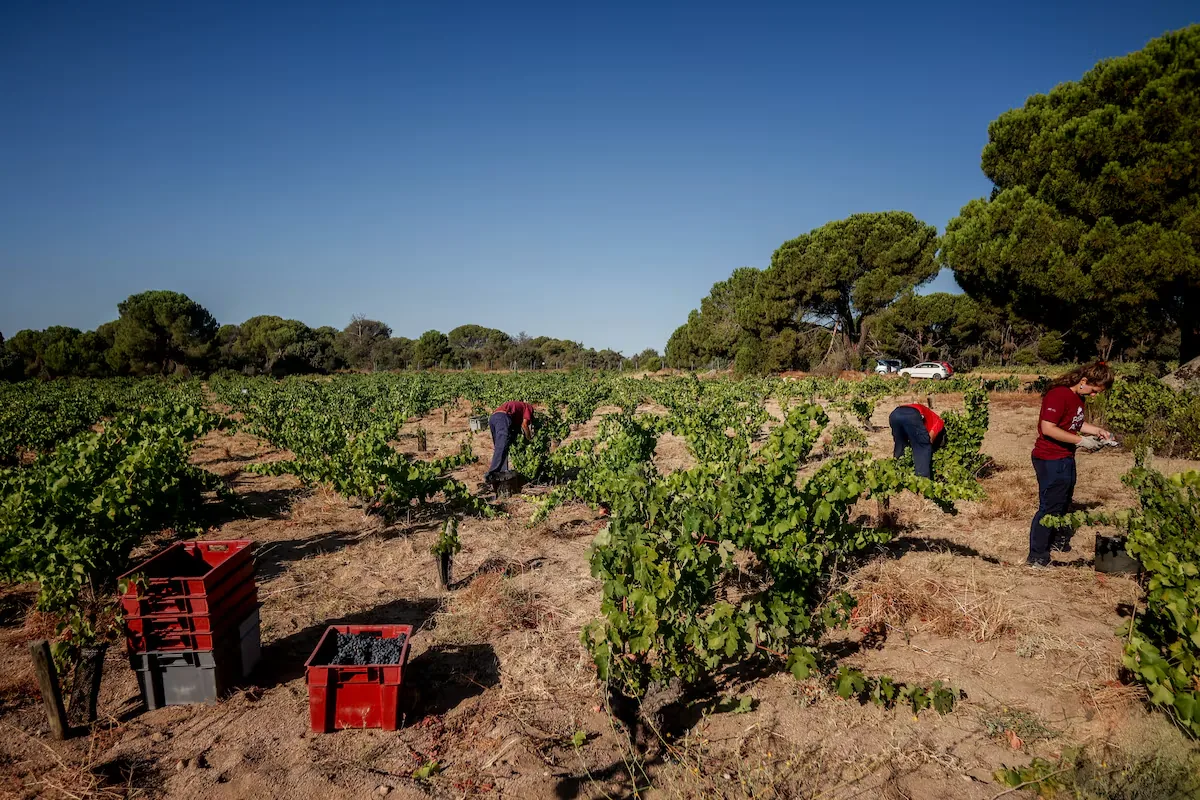
Fernando, from El Abuelo Wine, is an institution in Gredos. He is traveling in the car but cannot speak. He is very nervous. He knows he has lost fantastic vineyards and refers to two people who are on the ground. He cuts off early. His voice threatens to break. One of these landscapes is, or was, La Rinconada (Ávila). There were four plots: one of 7,000 square meters and another of 3,000. Both have disappeared. Of the remaining three: one has been saved, another is 40% affected, and another has been scorched (the vines burn at high temperatures). In that area, as in most of Madrid, they are usually grown as bush vines or on trellises, within small estates bordered by granite. The problem is that next to them there is wood, fallen trees, low scrub, and until June the European Union requires leaving a vegetative cover between the rows of vines, which, when dry, ends up being a pathway for fire.
Read more Chess analysis | The prodigious Sivanandan
Luis Opo, who has been selling to El Abuelo for some time and also has estates in Tiemblo (Ávila), tells this story. “I imagine everything is dead,” he laments. The vineyard, as the grandparents taught, must be cultivated, especially in Mediterranean climates. This also helps conserve water in clay soils, and if necessary, it is aided with hydration. Something inconceivable without climate change. But even France is protecting its vines this way.
The disaster will be enormous. It is already emerging through the smoke. These are small extensions of vineyards between 40 and 90 years old. Hugo González manages 19.4 hectares in Cebreros. Classic grapes in those lands: garnacha for red and albillo real for white. He does not produce, he sells. “The money, the effort, all lost,” he laments. He estimates he has even lost 30% of a 1808 plot. His vineyards were approaching one hundred years. Additionally, he marketed the jewels of his production.
In those latitudes, Jesús Soto, from Bodegas Soto y Manrique, has also planted 15 hectares. “Not only has the vineyard suffered, but the entire ecosystem,” he clarifies. The disaster spans from the Tiétar Valley (south of Gredos) to El Escorial. In his case, he produces 15 hectares in small operations in Cebreros. About five have been hit by fire. That is bearable when producing 120,000 bottles. He goes further and criticizes the abandonment of the countryside. He understands it is logical that burned land cannot be reused until 30 years have passed. It is a way to avoid speculators. But he does not understand that the Forestry Law also applies to an inactive estate next to a vineyard, and that during the decades only grass grows like kerosene. “Fires are put out in spring; sometimes all it takes is a machine to clear and clean the paths so they can be passed through. The members of the UME (Military Emergency Unit) take longer in that operation than in putting out a fire,” he complains.
One of the greats, the Comando G winery (Gredos), the one that accumulates points and recognitions, has saved its jewel, one hectare, Las Iruelas, despite the fire reaching the edges of the land. Daniel Landi, one of the founders, eagerly awaits to see it. “We are located at the epicenter of the fire, and the smoke will cause us to lose 50% of the harvest,” he estimates. It is a hard blow. And it opens the debate about the neglect of the primary sector: it stabilizes the population, creates employment—does anyone think they can feed themselves with artificial intelligence? The fire ignites questions that go beyond and demand answers.
Read more The United Kingdom declares much of the island officially in a state of “severe drought”
Luck, which is a very elusive science, seems to have fallen on San Martín de Valdeiglesias (Madrid). The technical director of Bodega Marañones (part of the Pago de Carraovejas group), Javier Blasco, can feel fortunate: his 35 hectares have not suffered damage. The fate of the other three in the area remains to be seen, but there are reasons to be optimistic. They release 60,000 bottles to the market, and garnacha and albillo real predominate. There is one important doubt. “We still do not know if the smoke will affect us or not,” warns the expert.
In the same situation, Bodegas y Viñedos Bernabeleva (a wine reference in the western Madrid mountains, saved thanks to the intervention of firefighters) stays up late. Because in San Martín they own 35 hectares at the foot of Cerro de Guisando, next to the Tórtolas Stream. They root between 600 and 800 meters in altitude. Days are still needed to map the real situation and for law enforcement to allow access to wineries like Las Moradas de San Martín (Valdeiglesias).
Maite Sánchez, winemaker at Arrayán, with estates near Almorox (Toledo) and San Martín, Cebreros, and Real de San Vicente (near the Tiétar valley), has generally had the wind in her favor. Only the albillo vineyard in Cebreros has been somewhat affected. For now, speculations arise. The expert is also concerned that the smoke might incorporate into the wine’s flavor. “Although there are systems that analyze to what extent it will affect [it is expensive] and even eliminate its negative organoleptic contributions,” acknowledges José Luis Benítez, general director of the Spanish Wine Federation. “It is also necessary to recognize the value of a well-cared-for vineyard as a firebreak,” he adds. Further away, in Albacete, Manuel Manzaneque and his well-known mil cepas wine have come out unscathed. These are embers over the ashes.
Read more Judge Pedraz asks the UCO to alert him if it feels «uneasy» in its investigations