






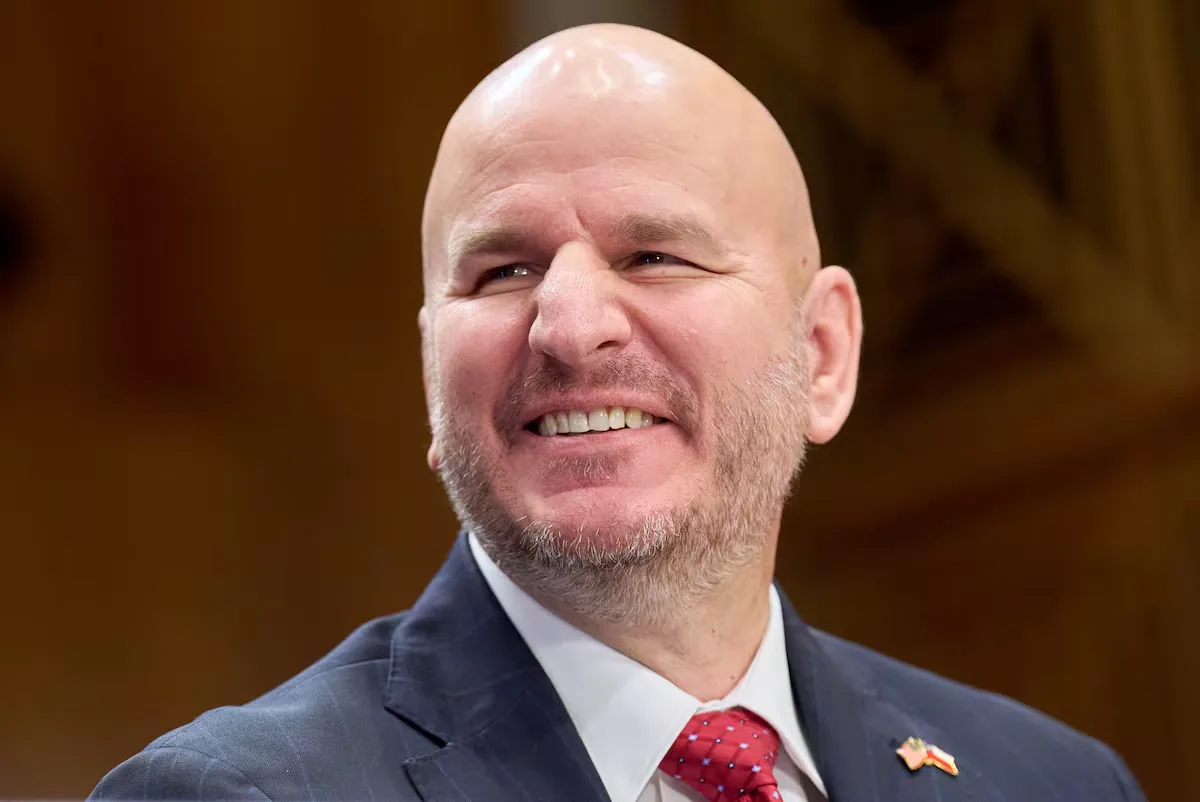
The criticisms from the Ministers of Agriculture, Jaime Campos, and Defense, Fernando Barros, regarding the 12.5% tariffs imposed by President Donald Trump on Chile have reached the ears of the United States ambassador to the South American country, Brandon Judd, who has reacted harshly. “It is very disappointing that, while negotiations are ongoing, ministers who have nothing to do with these negotiations are making comments, especially when they use words like ‘farce’,” said the diplomat.
The statements from Trump’s representative in Chile come a week after the President of the United States announced a new round of tariffs on 60 economies worldwide, including Chile, with rates between 10% and 12.5% that replaced the universal 10% tariff, which expired last Friday. The legal loophole Washington found to maintain its trade wall was to accuse the sanctioned countries of not having taken sufficient measures to control imports of goods produced through forced labor.
About 40% of Chile’s shipments to the US have been affected by the surcharge, which has fallen with dismay at the La Moneda Palace, where they hoped that the political closeness of President José Antonio Kast with Trump – both shared the Shield of the Americas summit in March – would translate into a less harsh treatment of the South American country. For this reason, the imposition of the highest tariffs on the Chilean economy has come as a surprise to the government, where the public reactions of its ministers have been varied.
The strongest criticisms have come from the Minister of Agriculture, who heads one of the portfolios coordinating one of the activities that will be most affected by the tariff imposition: the forestry-agricultural-livestock sector. On Tuesday, Campos said at a press conference that it was a terrible and regrettable measure. “What is being done to Chile is an arbitrary action by the US government, since it is violating the Free Trade Agreement that we had already signed,” he said.
Jorge Quiroz, Minister of Finance, joined the reactions, although with a measured tone: “Obviously it is a setback, obviously it is not positive. Chile favors free trade, multilateralism, having trade with all countries. We have other trading partners. The United States has been going in a somewhat different direction for some time and we hope this situation will be resolved later.”
However, the Minister of Defense, Fernando Barros, was the one who started the public questioning, at least publicly. “It is something unfair and it leaves us quite confused, because we are supposed to be very friendly, very close countries,” he said in an interview with Radio Infinita on Monday. He denied that forced labor practices existed in the country and directly referred to Judd: “There is an ambassador here, he travels around Chile, he knows us. So, applying a kind of sanction for an action or omission regarding such a relevant value issue as allowing abuse, not taking measures to prevent abuse, a kind of slavery, let’s say, seems unfair to me and raises doubts about the closeness and reliability of the relationship.”
In response to these questions, Judd replied that, upon reading the Free Trade Agreement between the two nations, there are provisions that allow the US to apply the measure if some aspects are not met. “So, again, I don’t think those ministers have really read the free trade agreement. It is always good to be informed about what the agreement really says,” he argued.
The Foreign Ministry, led by Francisco Pérez Mackenna, has maintained a cautious tone while advancing negotiations with representatives of the United States Trade Representative’s Office (USTR) – the department from which the investigation into forced labor originated – to try to mitigate the impact of the measure on Chilean products. In fact, one of the greatest expectations rests on the visit to Chile of Jeffrey Goettman, the second in command at the United States Trade Representative’s Office, at the end of August to continue negotiations in person.
But Judd has conditioned a possible understanding on the comments issued by the government: “As these negotiations usually go, there is potentially an agreement to be reached (…) There will be no agreement if there are people who talk about these negotiations and have nothing to do with them.”
Foreign Minister Pérez has tried to ease tensions. In an interview with T13 Radio, the Minister of Foreign Affairs stated that the important thing is to understand that his portfolio leads this negotiation and that they are “working with a cool head” to achieve favorable results for the Chilean economy. “Beyond the statements, the ambassador also said there is plenty of room to reach an agreement, and I hold on to that. I hold on to what really interests us: achieving that agreement. You always have to see the glass half full, because the truth is that this is what corresponds to do: go out and seek the results we need,” he added.
Leaders of the Broad Front (FA), the progressive formation that governed with President Boric, have defended the secretaries of state in Kast’s cabinet. “Mr. Judd, the ministers of Chile speak on behalf of the government elected by Chileans. It is not the ambassador of another country who defines what they can or cannot say. The explanations must come from the United States: we have a Free Trade Agreement and yet your government decided to impose a 12.5% tariff on Chile,” wrote FA deputy Gonzalo Winter on X.
Since the White House representative, who was a US Border Patrol agent and union leader, landed in Santiago de Chile in November 2025, he has been at the center of several controversies due to his outspoken style for diplomatic standards, to the point of stating at his first press conference in the country that President Gabriel Boric (2022-2026) “is harming Chileans” and defending the revocation of visas for then Minister of Transport Juan Carlos Muñoz and two of his main advisors as punishment after his portfolio reviewed a Chinese submarine fiber optic cable project that would connect Hong Kong with the Valparaíso Region on the Chilean coast. The State Department’s argument for applying these restrictions in February was that the project would “undermine regional security.”
When the controversy erupted, Judd lashed out at officials from Boric’s government, saying he found it “ridiculous” that Chilean authorities were surprised by the sanction.
Read more Arrested a former commissioner with ties to Los Ardillos for kidnapping officials in Guerrero