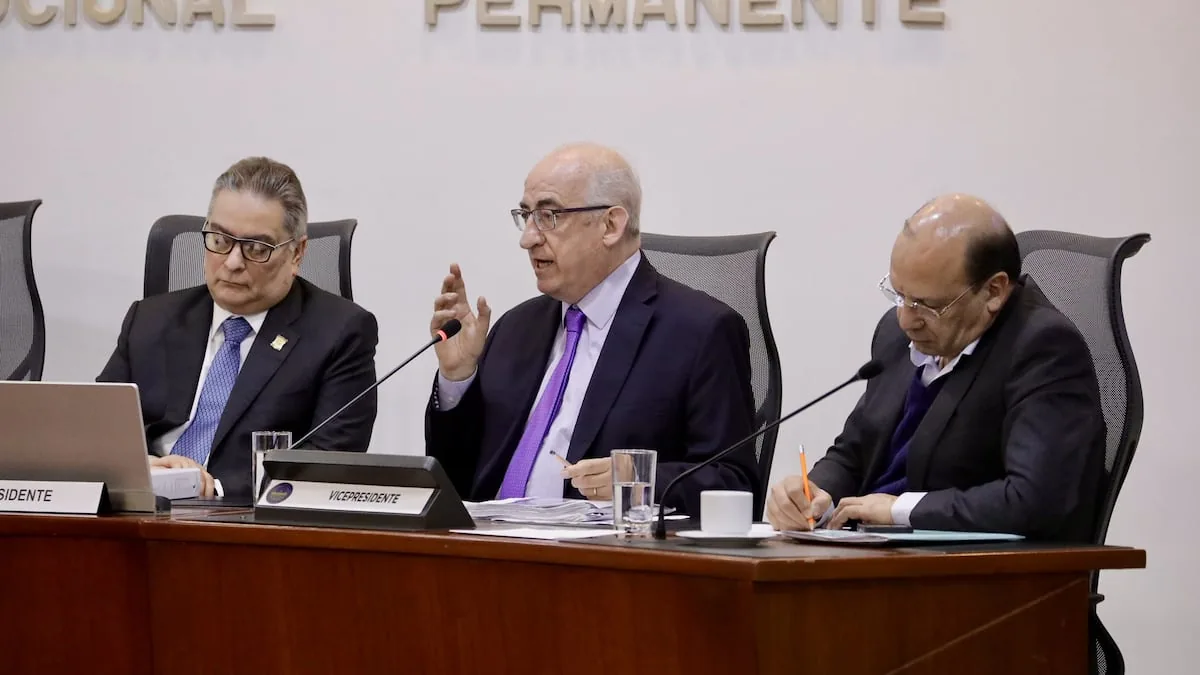









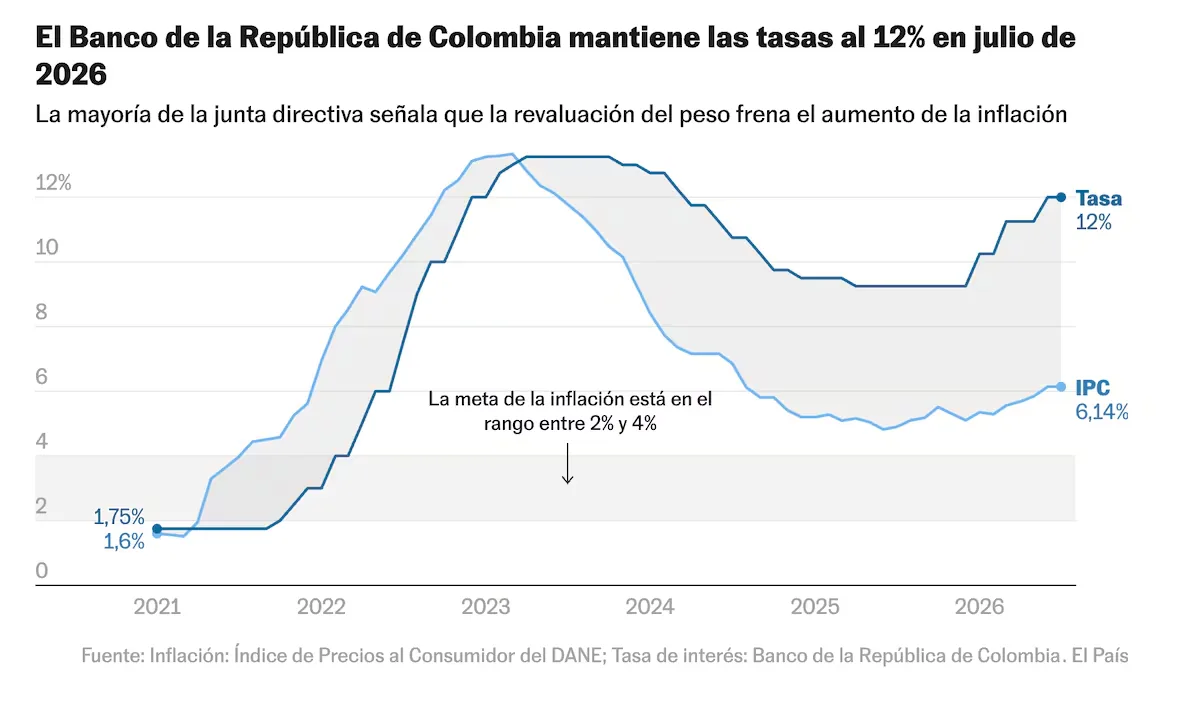
The Banco de la República surprised the market this Friday. The Board of Directors decided, by a majority of four votes to three, to keep the interest rate at 12%, pausing the upward cycle that had marked three of its four decisions this year. The three minority co-directors voted to raise it by 50 basis points, which was what most analysts consulted by Citi anticipated. The pause came due to the appreciation of the peso, which “helps to mitigate inflationary pressures.” It is a currency strength that, according to the Issuer, exceeds that of several comparable currencies. The Minister of Finance, Germán Ávila, bids farewell to his last meeting as a Board member with this pause. Previously, he had insisted on lowering the rate, but this time he joined the majority that opted to keep it steady. “We believe a prudent decision has been made,” he said at the press conference.
Read more Morocco orders halt to the exodus of 50,000 migrants towards Ceuta
Juan David Ballén, Director of Economics and Market at Aval Asset Management, assesses what happened: “The best decision the Banco de la República could have made was to keep the interest rate stable.” His analysis firm expected a 50 basis point increase but considered it would not be the best. The reason is a strong peso, which helps contain inflation by making imports cheaper, and because raising the rate further would have exacerbated the phenomenon, hitting exporters who are experiencing a 16% revaluation so far this year. This is due to the logic of carry trade —borrowing in cheap dollars to invest in pesos with higher rates—. The wider the differential with the United States, the more profitable the bet and the greater the revaluation of the peso.
The statement reveals why the decision was divided: June inflation rose to 6.14%, driven by food (6.8%) and regulated items (5.9%), while the economy accelerates (the Economic Monitoring Indicator grew 4.1% year-on-year in May) and unemployment falls to 8% (data from this Friday, according to DANE). These are arguments to continue raising the rate. Leonardo Villar made it clear that future decisions will depend on the data that becomes available. But the Board saw the strength of the peso as a sufficient buffer, for now, and warned that the Middle East conflict and a possible El Niño phenomenon could again pressure prices.
Shielding the reserves
Minutes later, the Bank announced a program to gradually accumulate up to 4 billion dollars in international reserves, buying dollars only when the peso is strong — that is, when the TRM falls below its average of the previous 20 days —. The mechanism was already tested in 2024, when it allowed accumulating nearly 1.5 billion dollars; the first auction of this round, for up to 400 million dollars, will be on Monday, August 3, four days before the new Government’s inauguration.
This was what economist Marc Hofstetter had proposed on X: taking advantage of the revaluation to strengthen reserves. Regarding the underlying risk, the same expert had warned that raising rates “would add fuel to the revaluation” — the argument that found resonance in the Board —. Ballén agrees, though with a nuance: for him, the Bank takes advantage of “an exchange rate below its long-term equilibrium value,” and insists that the goal is not to change the peso’s course but to shield the country’s external position.
Hernando Zuleta, Dean of Economics at Universidad de los Andes, goes further: buying dollars now is not only a preventive cushion, it is also a perspective that the peso — which he considers “overvalued by different metrics” — will devalue later, strengthening the Bank’s assets; unlike what the official statement suggests, he argues that the program does moderate the revaluation in the short term by increasing the demand for dollars.
The DXY index, which measures the dollar against the euro, yen, or pound, rises 1.85% this year and 4.04% in six months: against strong currencies, the greenback gains advantage. The Colombian peso is out of sync: it strengthens almost 18% this year and this Friday reaches 2019 levels, below 3,200 pesos. Felipe Campos, Investment and Strategy Manager at Alianza Valores, attributes 80% of that appreciation to political factors and downplays the carry trade: if anything, he says, the Bank has used it to “prevent it [the dollar] from rising.”
But according to calculations by Aval Asset Management, Colombia had in 2026 the best carry trade return among the main emerging currencies followed by the firm, ahead of the Brazilian real and the Argentine peso — evidence that the revaluation is not a passive effect but an active bet by investors. Raising rates would have further widened the differential with the United States, where the Federal Reserve kept them unchanged this week, inflating the bet and pushing the peso further down.
There remains, however, an underlying risk: Colombia is still exposed to its twin deficits — fiscal and current account — the kind of imbalance that in the past has punished the peso when market sentiment changes. The reserve purchase is a partial policy against that. But the strength will depend on political sentiment translating, over time, into real fiscal figures.