








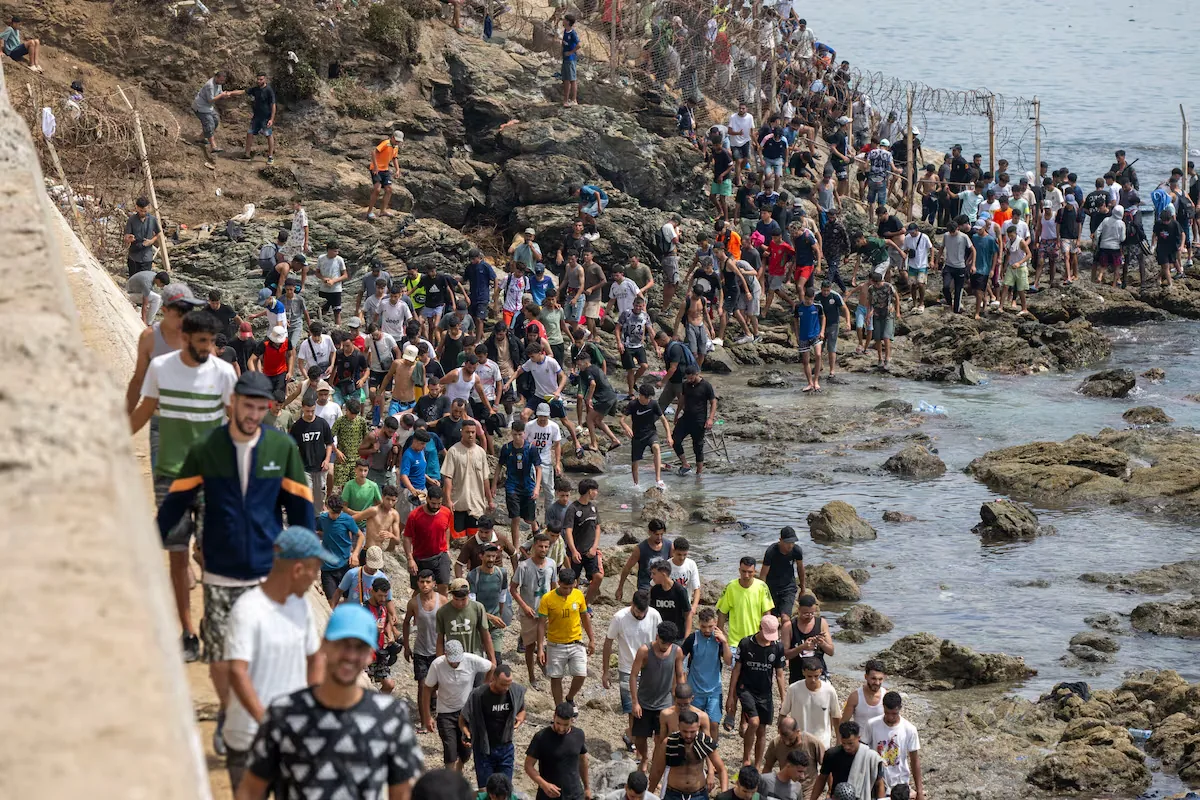
Rabat has ordered to stop this Friday the exodus of more than 50,000 irregular migrants, mostly young Moroccan men, triggered the day before in the Spanish autonomous city of Ceuta, in an almost complete return reflux at the end of the day at the Fnideq crossing (the former Castillejos), the part of the land border corresponding to the Maghreb country. The increasing arrival of hundreds of undocumented people swimming to the Ceuta coast accumulated until last Monday multiplied exponentially on Thursday, in the biggest diplomatic crisis with Morocco and five times larger than the one also recorded in Ceuta in May 2021 due to the secret hospitalization in Spain of the Polisario Front leader, Brahim Gali. This low-intensity Green March has occurred without a known command order or an explicit cause, at least for now. But it is clear that the initial obvious inhibition of the Moroccan security forces has amplified to worrying levels, whose impacts have been felt throughout Europe, the magnitude of a crisis apparently organized from the echo of social networks. This Friday, 48,500 of the 50,000 who had entered had returned.
The Moroccan security forces efficiently sealed the main accesses to the Ceuta border at Tarajal from Thursday afternoon to prevent a human flood over the border facilities. However, they tolerated the passage of tens of thousands of people along the breakwater that separates Ceuta from Castillejos, first swimming and then mostly along the beach and coastal rocks.
The Moroccan auxiliary forces, a paramilitary support body, were dedicated at the border and at the accesses to Castillejos to directing the steps of the crowd of irregular migrants, as in any other gathering that occurs in the Maghreb country. Police and gendarmes stood guard meanwhile.
The inhibition of the security forces in the migration crisis has been evident, particularly from Thursday noon until well into Friday morning, when they began to clear the crowd of young people at the border towards the urban center of Castillejos with tear gas and high-pressure water cannons.
The Rabat government has remained silent. The Moroccan ambassador to Spain, Karima Benyaich, has been the only official source to speak out, dissociating her country from the massive influx of migrants in Ceuta and attributing the exclusive responsibility for the new overflow of the Ceuta border to the “criminal mafias” that deal with human beings.
Benyaich, a diplomat close to King Mohammed VI, already held the same position in her country’s delegation in Madrid during the 2021 migration crisis, from which she was absent for nearly a year after being called to consultations in Rabat shortly after the public disclosure of the Polisario leader’s admission to a hospital in Logroño. She has now praised Morocco’s “exemplary collaboration” with Spain in solving the latest crisis.
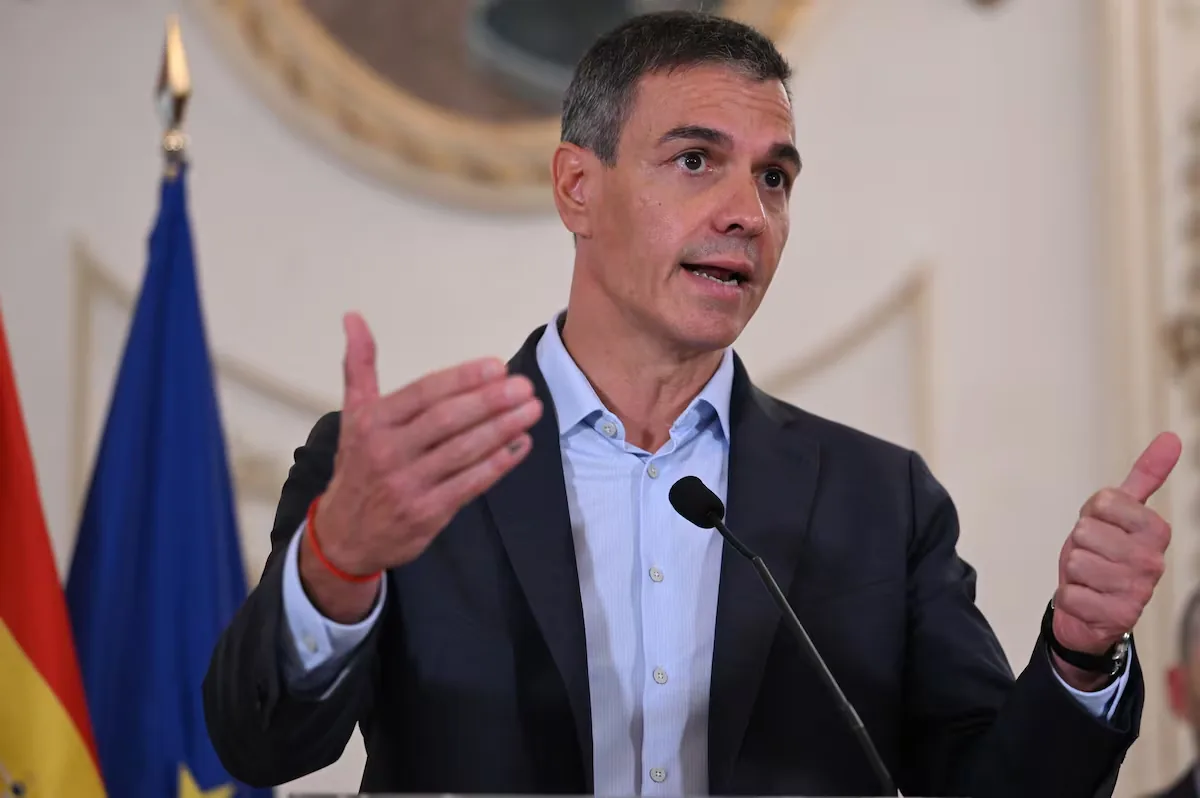
This coincides with the theses maintained this Friday by the Prime Minister, Pedro Sánchez, during his visit to Ceuta. He has also blamed the crisis on “mafias that traffic in human beings” and praised the “constant, fluid, and very reasonable [dialogue with Rabat], unlike what happened in 2021.”
Madrid and Rabat agree that the cause has been an “interested” interpretation by the mafias of the recent Supreme Court ruling, which determined that those who enter Ceuta and Melilla by swimming cannot be immediately returned. Criminal organizations control the maritime crossing of irregular migrants to Spain, which yields thousands of euros per passenger, but they do not seem to be as relevant when it comes to reaching the Ceuta border on foot in a chaotic exodus.
In Morocco, anonymous offers of carte blanche and proper papers were made through social networks for those who accessed the autonomous cities from the sea, without violating the land barriers. Although it is true that the hoax of ‘visa for all’ has circulated widely in Morocco, both on the favorite social networks of the youth and those of adults and in private messaging groups, it remains to be seen the monetary gain that the chain digital manipulation may have brought to the irregular migration mafias. Also the political, geostrategic, or diplomatic profit generated, as well as its possible beneficiaries. For Spain, the crisis only seems to yield red numbers.
The influx of tens of thousands of Moroccans into Ceuta has put the relations between Spain and Morocco, which seemed to be on track since 2022, in check, after the Spanish government abandoned its traditional position regarding the Sahara conflict, moving from neutrality to alignment with Morocco. Sánchez then aligned himself with the autonomy plan as the most viable political solution for the former Spanish colony dispute. Two years later, the French president, Emmanuel Macron, gave another diplomatic twist by considering Rabat’s plan as “the only possible solution” for the Sahara, whose future France now only contemplates “under the sovereignty of Morocco.” The step taken by Paris has since marked a noticeable distance from Madrid in the eyes of Rabat.
Government sources have told EL PAÍS that they attribute the migratory avalanche over Ceuta to the spread, through social networks, of the idea that those who managed to swim to the Spanish city could not be repatriated, in application of the recent Court ruling. They have also acknowledged that, without the passivity of the Moroccan security forces, such a massive entry of people would not have been possible. Despite this, the Spanish government has finally chosen to ignore the reproaches and focus on finding a quick solution to the crisis, without even the intelligence services knowing for sure the ultimate causes of the Moroccan attitude at the Ceuta border.
The recent rapprochement of Madrid to Algiers, Morocco’s regional archrival. The progress in the Spanish Parliament of legislation to grant Spanish nationality to those born in Western Sahara and their descendants. The new EU statute for Gibraltar, in its connection with Spain. Even the dispute over the stadium that will host the 2030 Football World Cup final, co-organized by both countries along with Portugal.
All these arguments are among the hypotheses handled by analysts in the effort to explain the migration crisis in Ceuta. Despite the urgent need to turn the page, about what has happened these days between Castillejos and Ceuta hangs, as happened in 2021, a question mark. It has indeed produced political and diplomatic pressure through the use of irregular immigration on a North African sovereignty plaza that, along with Melilla, is always defined by Morocco as “occupied prison.”