








The first half of the year has ended, and it is a good time to take stock of the economic performance so far in 2026. To do this, the first thing to define is where to start, because not all fronts have the same relevance. The Argentine economy has lived with high inflation and recurring devaluations of its currency for more than a decade. This led to the level of economic activity remaining stagnant and, due to population growth, the average income of the population decreasing by around 10%. For this reason, we maintain from here that any evaluation must start with the external and inflation fronts, the two main obstacles, since until they are corrected there is no possibility for the rest of the economy to improve.
A battle won
The performance on the external front was outstanding from any perspective. The trade balance recorded the highest surplus in recent history, driven by a very good oilseed campaign but, above all, by the marked improvement in the energy sector, which also benefited from the sharp increase in the international price of oil.
This generated a comfortable surplus of foreign currency in the exchange market, allowing the Central Bank to achieve record foreign currency purchases (almost 11.2 billion dollars), key to facing external debt payments and strengthening the monetary authority’s balance sheet.
This was only possible due to the Government’s change of course, since last year it explicitly rejected the Central Bank intervening in the exchange market to accumulate foreign currency, a decision that was heavily criticized by the vast majority of economic analysts.
The accumulation of reserves is a key element for the sustainability of the exchange rate and one of the main indicators that international markets look at when evaluating countries’ payment capacity. This allowed the country risk, the global indicator reflecting the capacity to pay public debt, to decrease steadily throughout the semester.
Improvement with ups and downs
Related to the above is the second favorable result: inflation. In June it recorded a 1.9% monthly increase and chained three consecutive months of decline. However, the inflation balance requires a nuance: currently, inflation is higher than a year ago. In between, there was a succession of strong increases in key prices: first the dollar during the midterm elections, then meat towards the end of last year, and finally fuel in the first months of the year. These movements explained this dynamic. Nevertheless, with those three driving elements dissipated, inflation is expected to continue declining in the coming months.
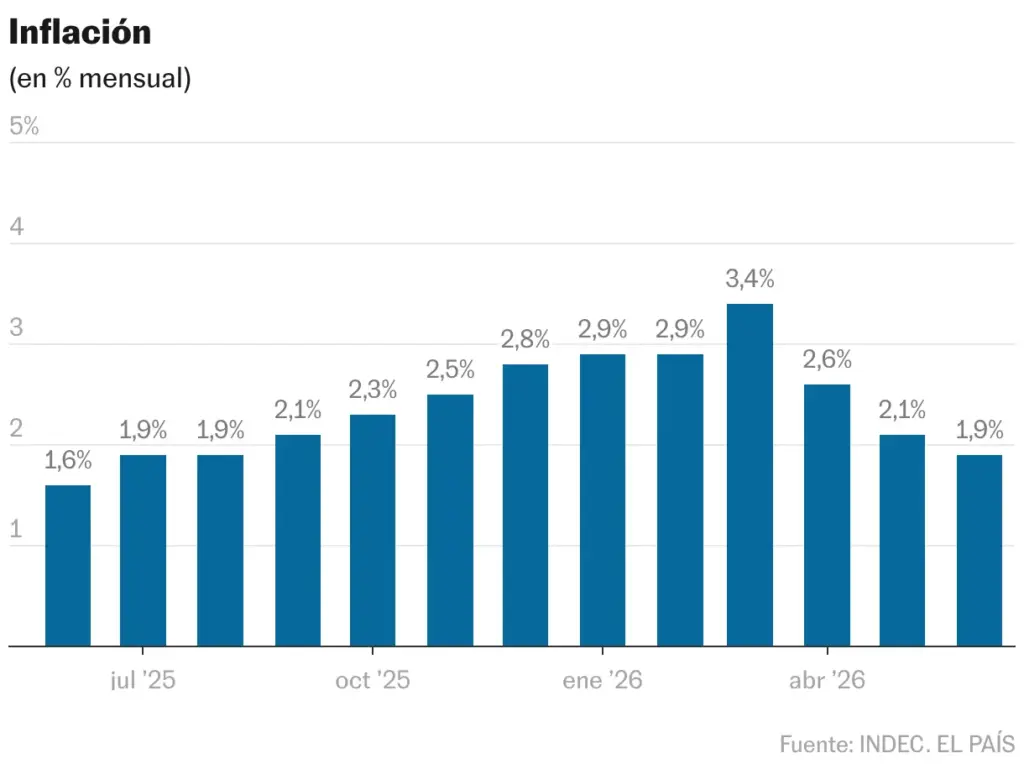
Added to the above, when we broaden the analysis horizon, the current data becomes even more relevant. In the last eight years (96 months in total), inflation was below 2% monthly in only 7% of the cases. Also, four of those eight months occurred during this government. However, inflation remains quite high by regional standards. As a reference, the average inflation of Brazil, Chile, and Uruguay in recent months was 0.5% monthly. Reaching those levels will take a long time.
Stagnation with winners and losers
Economic activity is, at best, stagnant. The latest official data available is from May and shows a contraction of 1.5% so far this year. Sectoral indicators for June were also not good, so a rebound in that month is unlikely.
The main difference compared to last year, when activity was growing, was the halt in bank credit. As analyzed in a previous note, this was explained by the increase in the interest rate to record levels during the second half of last year, in the context of the midterm elections. That increase could have been stopped by the Central Bank, but the monetary authority decided not to do so under the libertarian logic of not intervening in the markets.
Besides stagnation, the outlook is highly heterogeneous. Considering the entire Milei administration, the exporting sectors (agriculture, mining, and energy), along with the banking sector, were the big winners and those that drove economic activity. In contrast, those associated with domestic activity (industry, commerce, and construction) were the big losers.
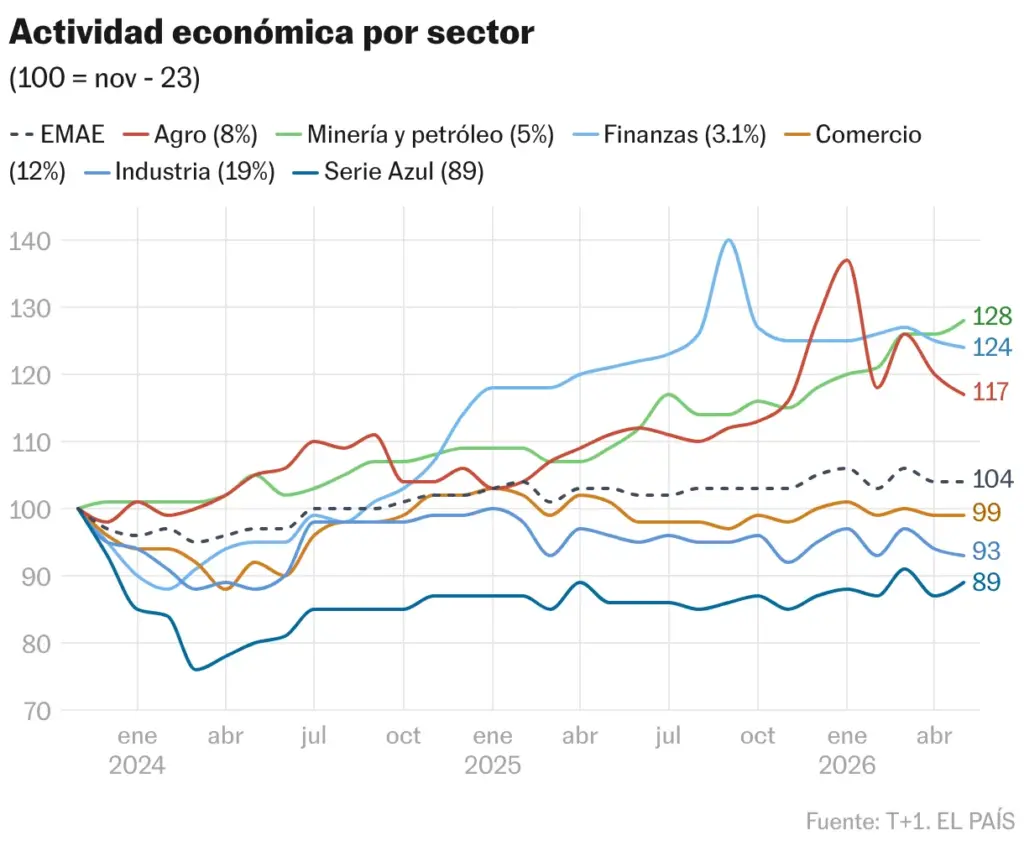
The issue, as we will see below, is that this heterogeneity had negative effects both on employment and wages. Export sectors were key to generating foreign currency but are not labor-intensive, exactly the opposite of what happens with industry, construction, and commerce.
An increasingly fragile labor market
The halt in activity did not have a significant impact on unemployment. In the first quarter, the latest official data available, the rate was 7.8%: it increased by 0.3 percentage points compared to the previous quarter, when it was 7.5%. However, a clear effect was observed in informality, which increased by 1.2 percentage points and reached 44.2%.
Indeed, there is a very significant reduction in people employed in formal jobs (almost 200,000 fewer), practically offset by the increase in informal jobs (about 147,000). The difference explains the moderate increase in unemployment.
Here the heterogeneity of economic activity mentioned earlier becomes relevant: the most affected sectors were, obviously, those where more jobs were destroyed. Industry and commerce explain half of the drop in formal employment.
Although it is noteworthy that, despite the drop in activity, unemployment remained practically unchanged, there is no doubt that the labor market has become more deteriorated. Informal jobs, besides not being covered by labor rights and benefits, are more unstable and have incomes that, on average, are lower than those in the formal sector.
Lower income and higher fixed expenses
With activity slightly declining and an increase in jobs with lower wages, people’s income also decreased. Added to this is the increase in public services above inflation, within a policy of tariff updating and adjustment. It is worth noting that these have a subsidized component, paid by the State and therefore important within public spending.
This can be clearly seen in the following chart, which shows the average real and disposable income between 2023 and May 2026 (latest data available). Real income shows how much people can buy after discounting inflation. Disposable income also discounts fixed expenses: this is where public service tariffs impact. This second measure attempts to better approximate what actually remains in the pocket for consumption.
So far this year, real income decreased by 1.4%. As the government continues updating tariffs, disposable real income decreased even more (-2.8%). Compared to 2023, incomes are 10% and 16.5% lower, respectively.
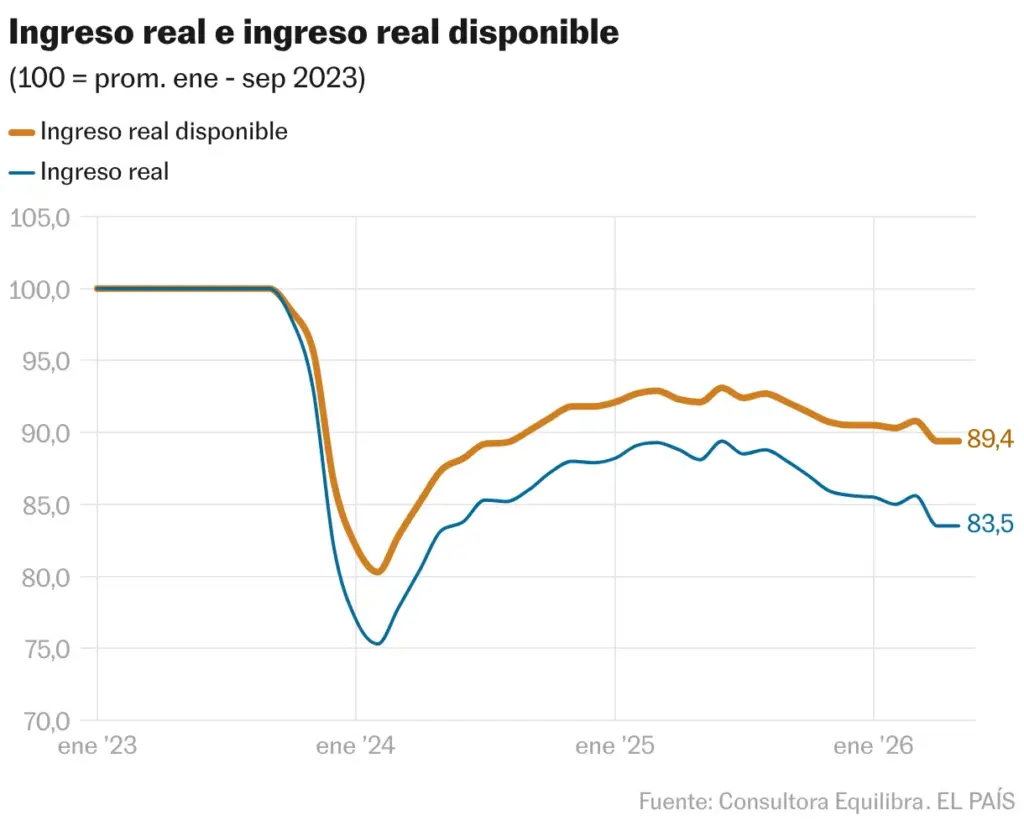
The comparison requires a clarification. In 2023, tariffs were heavily delayed. Public services and transport had very low prices, so disposable income at that time was favored by subsidies. The correction had to be made. However, the fact that the adjustment was necessary does not mean it did not affect purchasing power. A family that now allocates a larger portion of its salary to pay for electricity, gas, and transport has less money for the rest of its consumption. Both things can be true at the same time: tariffs were delayed and their update deteriorated disposable income and had an impact on economic activity through the drop in consumption.
Now, the tariff adjustment was not the only problem. Even if we set aside that effect and look only at real income, we notice it has been decreasing since August last year and is partly associated with the inflation acceleration process explained earlier. If the downward trend in inflation continues, incomes are expected to start recovering, although gradually and slowly.
Delinquency as a summary
The most worrying and novel data in recent months is the abrupt jump observed in household delinquency which, as can be seen in the chart, more than doubled compared to previous peak levels.
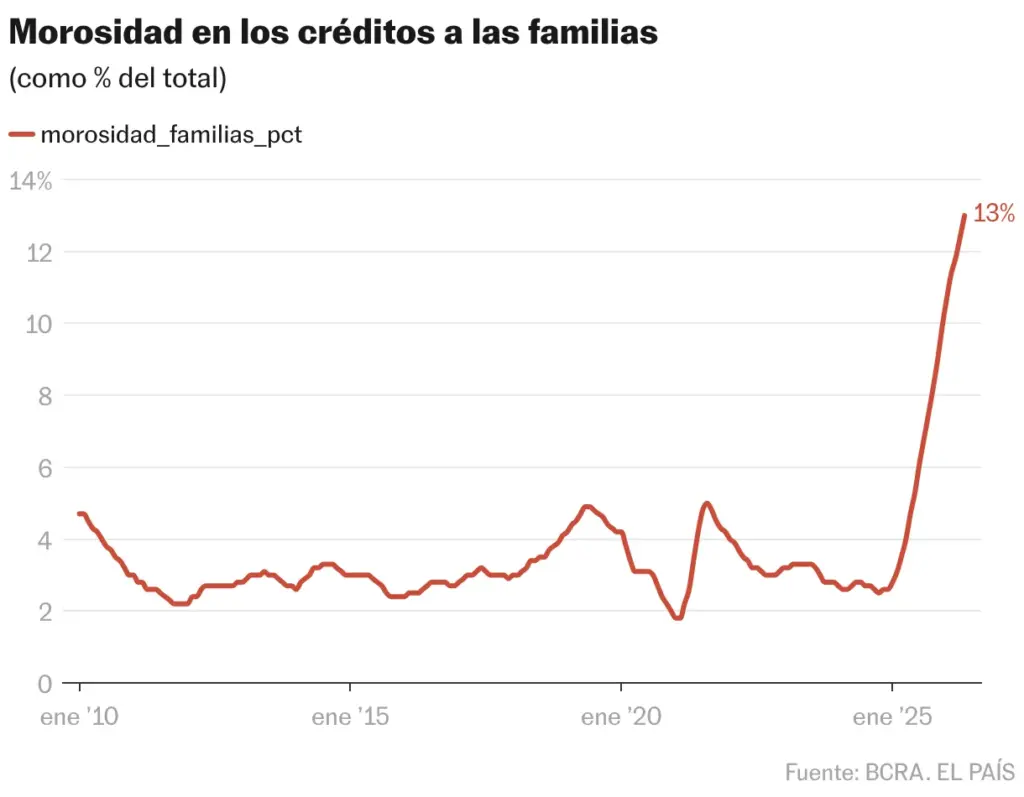
The very strong increase observed in credit between 2024 and mid-2025, combined with the increase to record rates observed from then on and, subsequently, the drop in incomes created a perfect storm to explain this abrupt jump in delinquency.
What is observed, then, is not only an incomplete recovery but an economy running at two speeds. The sectors that generate dollars show favorable results, while industry, construction, and commerce remain weakened. That difference is not minor: the former are fundamental to sustaining the external front, but the latter concentrate much of the employment and family incomes. Therefore, the problem is not solved by waiting for the growth of some to spill over to others. If heterogeneity consolidates, exchange rate stability can coexist for quite some time with informality, low wages, and stagnant consumption. It is not about denying the advances but putting them into perspective: stabilization was a necessary condition for growth, but it was never sufficient. The second half of the program will be much more demanding than the first. It is no longer enough to order macroeconomic variables: now the challenge is for that order to translate into more production, better jobs, and an effective recovery of purchasing power.