






EL PAÍS offers the América Futura section openly for its daily and global informative contribution on sustainable development. If you want to support our journalism, subscribe here.
Read more Milei’s economy: exchange rate stability and a recovery that ¿still? hasn’t reached everyone
While researching Andean sages and spiritual guides, the Kichwa poet and anthropologist Agustín Guambo ended up one day talking with a potato farmer in the historic center of Quito. Guambo’s books and poems circulate on the internet with titles that seem like hard-to-forget spells: Rhinoceros Ash, Andean Nuclear Spring, Machinehead [Urban Rite of Mestizaje]. But that farmer was unaware of the writer’s achievements, as his wisdom came from a place different from libraries.
“You, if you write and don’t work the land, you can’t call yourself an artist,” the farmer told the poet. “When hunger comes, what will you do with your words?” The message touched intimate chords in Guambo, not only because of the future it anticipated, but because his parents had also been farmers: his mother only needed to throw seeds in a pot for the plants to grow, and his father had died while pruning a tree. But unlike them, the writer son, raised in a neighborhood of indigenous migrants in the city, had not learned to produce his own food. What was the hidden lesson in this realization?
In times of artificial intelligence, talking about the ‘future’ feels like entering the private property of the Silicon Valley techno-oligarchs, those self-absorbed men who exhaust the planet’s resources to feed their dreams of colonizing Mars with the help of robots. In this new space race, an Andean farmer would seem the least suitable earthling to give advice about the future. But Guambo’s work consists of jumping over those false paradoxes. If the potato is a piece of Andean technology that has saved the world from hunger, aren’t precisely those engineers and philosophers who cultivate it the ones we should listen to more attentively?
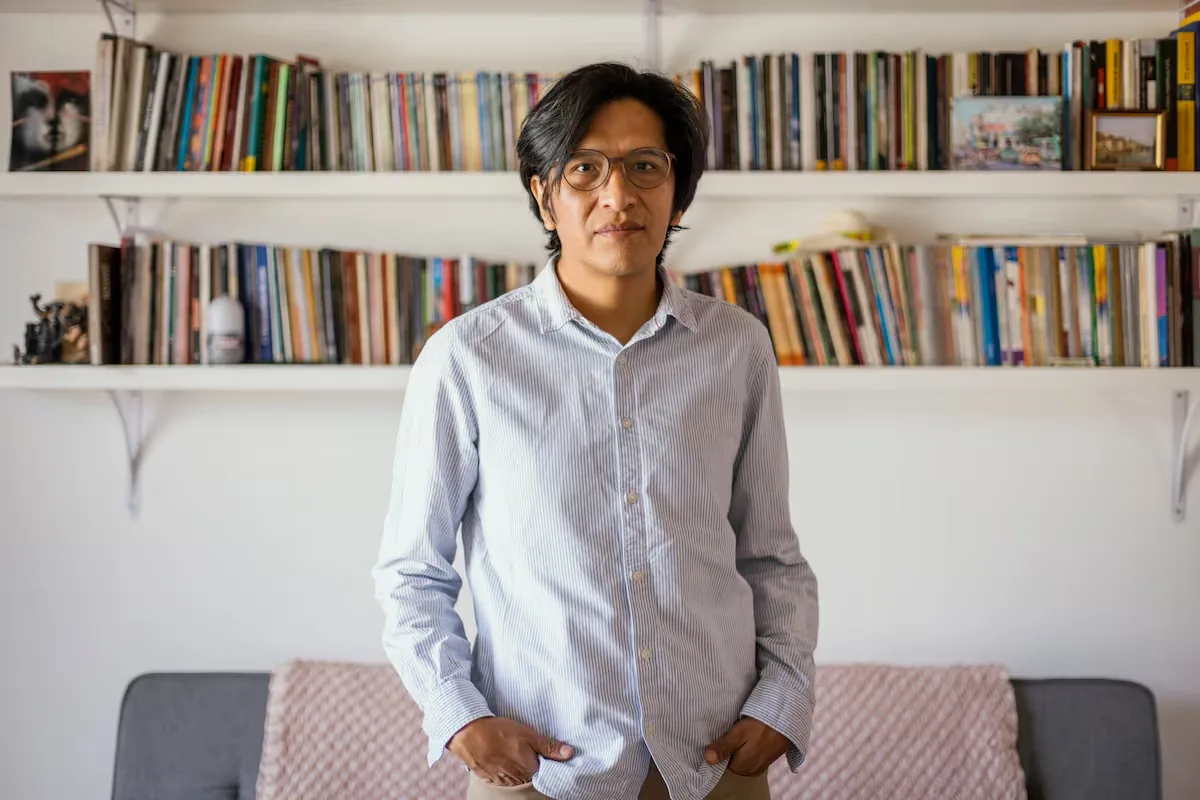
Guambo is 41 years old, with thick black hair over his reading glasses, and has spent at least two decades traveling the Andes and other indigenous territories to listen to the taitas (fathers in Kichwa), as he calls the sages. His poetry is partly made of these oral learnings; and in it, indigenous history (past, present, future) unfolds with a language that sometimes sounds like colonial cataclysm: “Here there is no poetry, only the pilgrimage of blood over the genocidal petals of time. Fragmentation of clay, a crazed nerve screaming over the cosmos. There was another world here!”. Other times it sounds like awareness: “Pachakamaq a new disease inhabits our DNA / we are infected with civilization / –urbanmadness–cannibalism–isolation–chaos”. And other times it recalls the maternal lullaby: “The soft fabric of the cosmos”.
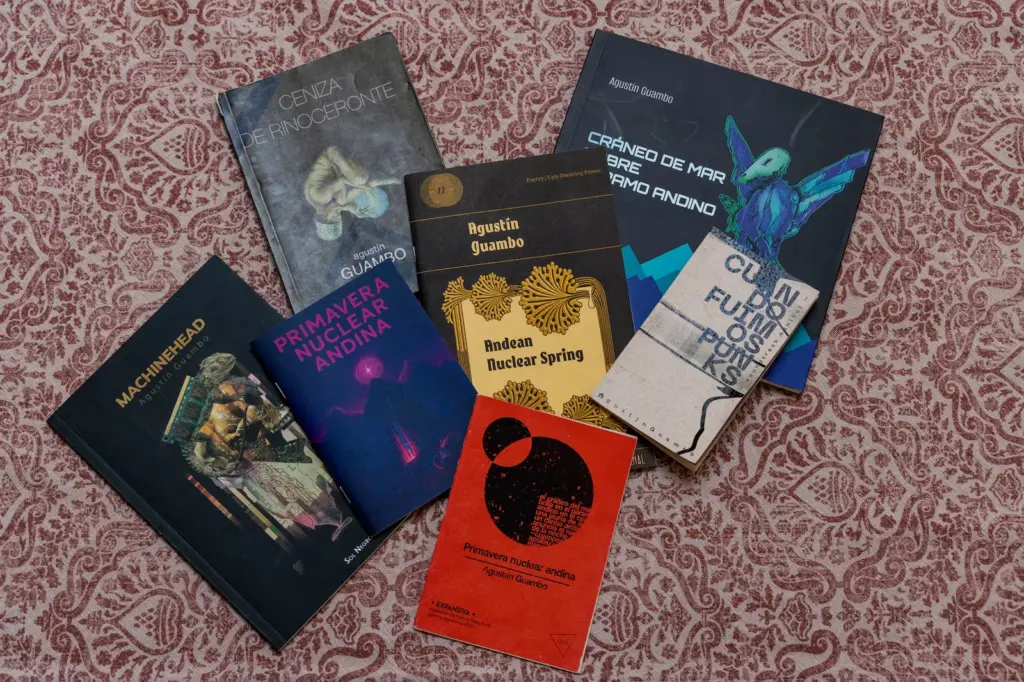
Towards the end of Machinehead (SolNegro, 2023), that verse floats in the center of a circular figure that evokes at the same time the Inca sun, the galaxy, and perhaps a cell or a microchip. When he was a child — Guambo explains to me from his home in Quito — his mother used to wrap him like a caterpillar in a blanket that had that same design now appearing in the book. I show him the page through the camera, with the excitement of someone who has just seen the light at the end of the poem. “That fabric was my cosmos,” he tells me with the naturalness of someone who has learned to synthesize the entire universe in a familiar image.
Guambo’s poetry, more than reading it, must be contemplated on the page. His most recent book, Sea Skull over Andean Páramo (2026), published in Peru by the Lliu Yawar publishing house, takes that visuality to a more sophisticated level. Thanks to the interventions of illustrators Yarush Yurivilca and Edgar Castellanos, the poems seem connected by a long electronic thread. In that spirit, the book gathers in a single volume the trilogy formed by his poetry collections Rhinoceros Ash, Andean Nuclear Spring, and Machinehead. Although they were written and published individually in different countries and editions over the last decade, Guambo assures that he always knew they should form a unit, as they represent the three interconnected Andean worlds: the hananpacha (above), the kaipacha (here), and the ukupacha (below).
Read more More than 100 days without water: the crisis hitting thousands in Puerto Rico, besides the blackouts
Guambo is one of the figures of the so-called Andean futurism, that constellation of artists who, placing this region at the center of their imagination, participate in the universal desire for other futures. From above, the Andes seem like an immense backbone in the South American universe. Its geography has been a tireless cradle of civilizations, science, and culture, but it was also the scene of the long colonial extermination and, currently, of the republican project of an empty Andean world, perhaps mystical, ideal for tourism and resource extraction. More than fantasizing about Transformers in Machu Picchu or about El Alto being the capital of cyberpunk with chicha music in the background, Andean futurism disputes the right of Andean people to exist, think, and imagine outside the suffocating Eurocentric box. It is a fight against the silencing of Andean worlds, which begins in our own homes and takes the form of national politics.
When he was going to school in Quito, Guambo began to receive the typical insults that labeled him as “Indian.” What did that word mean that was thrown at him with so much contempt? His mother avoided the subject and, to protect him, suggested he better not speak Kichwa. The school curriculum did not help: the authors who could have opened his eyes were not part of the teaching, not even at university. Guambo says that classmates who shared the desire to write were also not interested in the subject and seemed satisfied thinking of themselves as just mestizos. One day, he dropped out of medical school, packed his questions (What am I? What does it mean to be Indian? Where are the indigenous writers?) and set out to travel the Andes, from Quito to Tucumán, that indigenous Argentine city that does not resemble the postcards of Buenos Aires at all. And on that journey, in his solitude and conversations, he was understanding many things.
In those Andean territories that were on the margin — Guambo says — there was wisdom and, of course, technology, but this knowledge circulated in ways different from the centers of power. “Resistance is on the margin,” he explains to me, “not in marginality.” In recent articles, Guambo argues that there is a radical divorce between the exotic and mystical images that the publishing industry seeks in the Andes, as if “the Andean” were a wild resource ready to be harvested, and, on the other hand, the imaginative and political power of the same Andean populations, whose thoughts end up being silenced or ignored.

Guambo has been reflecting on the subject more regularly since late 2024, when he published that his compatriot Mónica Ojeda had used the book Andean Nuclear Spring as a resource to create the novel Electric Shamans at the Sun Festival, but without acknowledging this operation, which he called “literary extractivism.” In a statement on Instagram, the famous novelist denied acting in bad faith and assured that in a next edition she would include the list of books that had “accompanied” her during her writing. Ojeda’s message accumulated more than 3,000 likes and dozens of comments of solidarity from readers and figures in the literary industry. Faced with the slow circulation of Guambo’s essay, the massiveness of the post gave the wrong impression that the “Latin American author” was being baselessly attacked by the “local poet.” However, Guambo had only put on the table a recurring question in Andean history: Why the invisibilization?
When he was a child, he was obsessed with the deer from children’s stories that supposedly took place in the Andes. One day he asked his father if, please, they could take him to see those animals. “Deer? There are no deer here,” he remembers his father telling him. “If you want, we can go look for frogs.” Guambo believes that child he was had begun to sense the questions he can only now formulate.
Many years later, noticing him restless, a wise man from the Quero town in Cusco gave him advice. “Hey, do you know that sometimes there are questions you shouldn’t ask?” Guambo recalls that man telling him. “Because they have no answer. And looking for that answer that doesn’t exist will drive you crazy.” The wise man also told him that the questions he should ask would come. And when that happened, he himself would know. It is the moment Guambo seems to be living now. Why the invisibilization? Where are the indigenous voices in Ecuadorian literature? What does it mean to be Indian today? His work can be read as a cosmic journey in search of answers. On that journey, guided by the wisdom of his people, he says he is also learning to work the land. Besides poetry, he now cultivates basil, bell pepper, and hopes to have luck with avocado.