










Artist Mariela Sancari (Buenos Aires, 50 years old) likes movies in which a character is shown sweating in an extraordinary situation, not just in those moments when it is culturally accepted, such as sweating while working, playing sports, or having sex. “I love scenes where sweat causes embarrassment or gets someone into trouble, because that way we can think about it and discuss it,” says the author of Sweat (Comisura, 2026), a stimulating analysis that combines autobiographical narrative, essay, poetry, and photographic experimentation with her own sweat regarding that liquid that thermoregulates our body and has defined her existence.
Since childhood, Sancari has suffered from severe hyperhidrosis, a disease characterized by uncontrollable sweating that is estimated to affect between 1% and 5% of the world population. “Every single relationship in my life has been defined by sweat; until I wrote this book, I had only experienced it through trauma, frustration, suffering, sorrow, and discomfort in relationships,” she reveals.
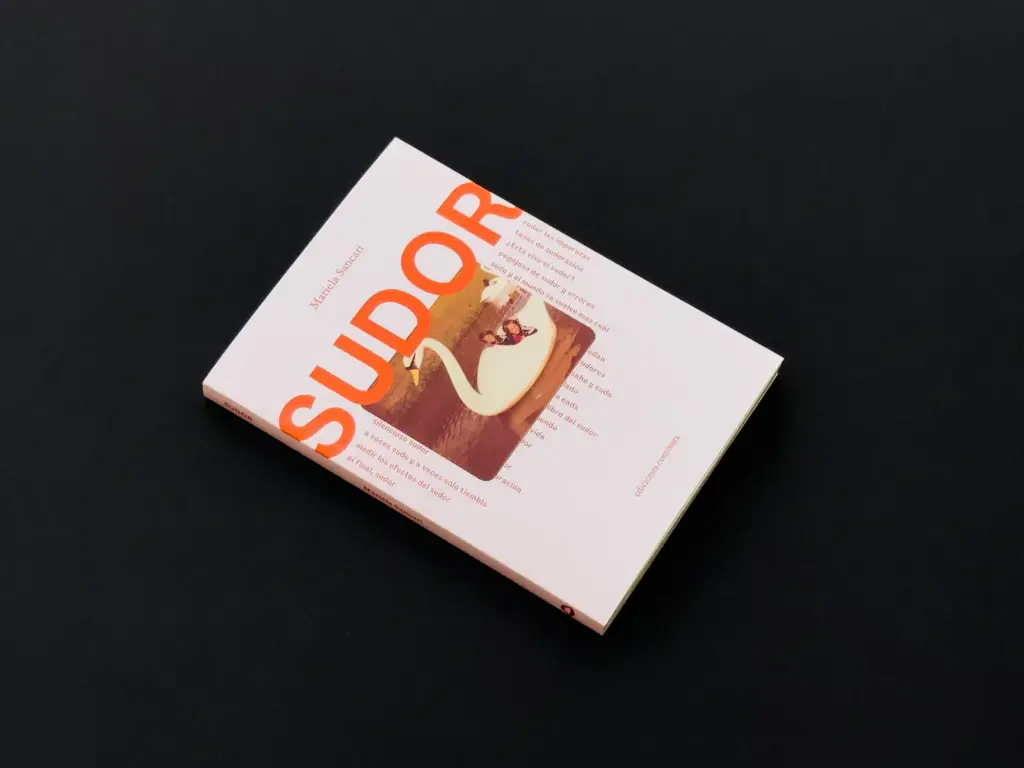
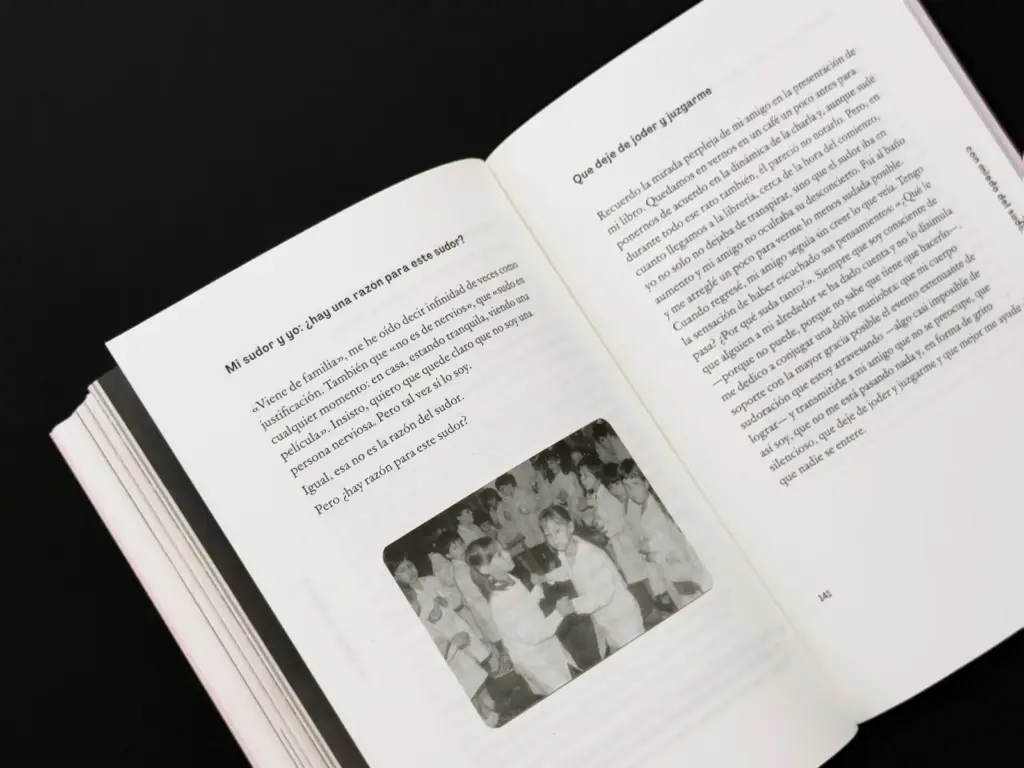
The artist — like her twin sister, her father, and her grandfather — has sweated her whole life, at all times. In yoga classes, presentations, school, and since she remembers her first children’s parties with her dress soaked. In her mind, her sweat always “had personality,” which is why she had a creative epiphany reading the ecology philosopher Bruno Latour. “When I discovered his definition of ‘actant’ and how any entity — human or non-human — that performs an action generates an effect or modifies the state of things, I knew I had to write about the constant presence of my sweat,” clarifies this artist who, beyond her book, has developed interdisciplinary work including photography, performance, and writing.
Sweating in the “religion of work”
From Christ’s shroud to 19th-century hygienists, through Zygmunt Bauman’s “liquid relationships” or biologically biased sweat as a “lie detector,” Sancari has researched for three years to trace an interesting sociological analysis of how that salty, colorless liquid our body emits has become a marker of gender and class and of biopolitical control.
The author traces back to “you shall earn your bread by the sweat of your brow,” taken from chapter 3 of Genesis, where sweat is mentioned as “the word of God,” or how in archaic Latin sweat has always been documented in relation to effort and labor. “Historically, sweat has naturalized exploitation in the religion of work, something later developed by Karl Marx and communism,” she recalls. In Capital, Marx wrote that the theological original sin condemned man to sweat to earn his bread, “but the history of economic original sin reveals why some people don’t need to sweat to eat.”
Communist thinkers connected the dots between sweat and the expropriation of lands, enslaved bodies, and legislation against the poor. A web of exploitation that would be named the so-called “sweating system,” the system developed during the English Industrial Revolution with labor precarization in which “sweaters” became synonymous with exhausted workers.
In the capitalist sphere, the rich don’t sweat. Others do it to multiply their accumulation of goods. “Sweat generates surplus value for the rich because it is what they extract from the body of the poor worker. In a way, it is something that still works: wealth and cleanliness continue to operate as they did in the past,” highlights the author.
Read more Priscilla Presley: “Being next to Elvis was a real life lesson”
Deodorant: decency before hygiene
Sweat as odor and stain was something that always terrified Sancari. If for the Egyptians the fragrance of the blue lotus flower represented the smell of the god Ra’s sweat, why is sweating so stigmatized for humans? The artist recalls that the sanitization of the colonial space implied that sweat became a marker of racial difference and toward the lower classes. But it is through the history of deodorant and its advertising messages aimed at female shame that she exemplifies how socially the idea of decency before hygiene has spread and how the sense of smell has been instrumentalized as a social problem, especially for women.
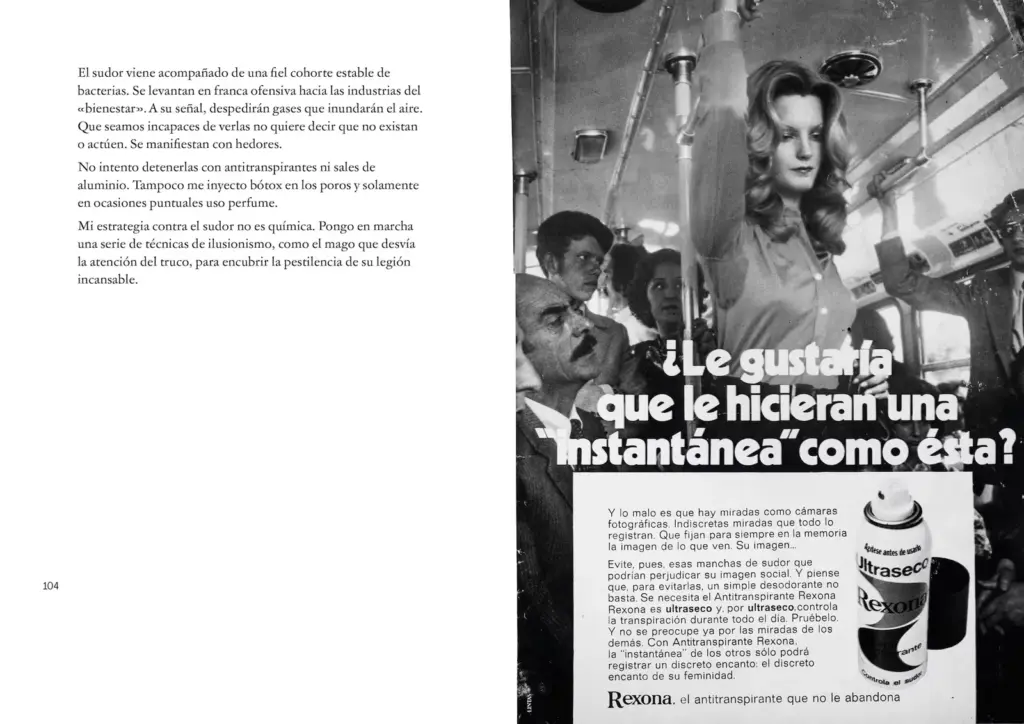
We have changed little since those ads from the seventies that ridiculed women with shirts stained under the armpit on the bus. Just open Instagram and see how the so-called “clean girls,” clean, neat, and polished girls through a routine defined by the use of products and disciplining their bodies, triumph. “Beauty technologies present themselves as forms of care, but they respond to violent logics in personal wellness discourses,” explains Sancari.
In that supposed care, there is also a gender bias between male and female sweat. “My father never lived his hyperhidrosis with as much anxiety as my sister and I have felt. Just look at photos of him, happy and relaxed with his stained shirt,” recalls the author, highlighting a recent ad for a male deodorant whose slogan is “Success is either sweated or not.” “The poster shows a muscular guy leaving the gym because for them the idea of personal improvement through sweat has to be sold, and for us, they sell shame. The rhetoric changes, but the idea is the same.” That is why she experiments in the book with her sweat on frames. “They are my shrouds, a way to try to open a little hole in the visual representation regime of sweat, especially for women.”
People who sweat
“The bourgeoisie will remember my carbuncles until the day they die,” Marx wrote to Engels in 1867. The German may have theorized about proletarian sweat, but he himself suffered from excessive sweating on his body. The thinker spent much of his life plagued by unbearable boils, joint pain, and skin lesions. “Most likely, it was hidradenitis suppurativa, characterized by excessive pus abscesses,” points out Sancari.

Marx was not the only writer who suffered with his sweat. Hence the eternal bandana that covered David Foster Wallace’s head, who wrote the word “sweat” 73 times in Infinite Jest. Halle Berry won an Oscar sweating her hyperhidrosis, and comedian Hannah Berner continuously jokes about her sweat condition in her monologues. That does not mean Sancari stops suffering with hers. In the book, she recounts a real encounter with a writer with anhidrosis — the inability of the body to produce sweat — who, like her, experienced it as trauma. Despite the story, Sancari is clear: “I heard the suffering of my physiological and bodily reverse, but there I concluded again that, if I could choose, I would prefer not to sweat.”
Read more Cayetana Fitz-James Stuart vs Mar Flores: the day the duchess “knelt” before the model