







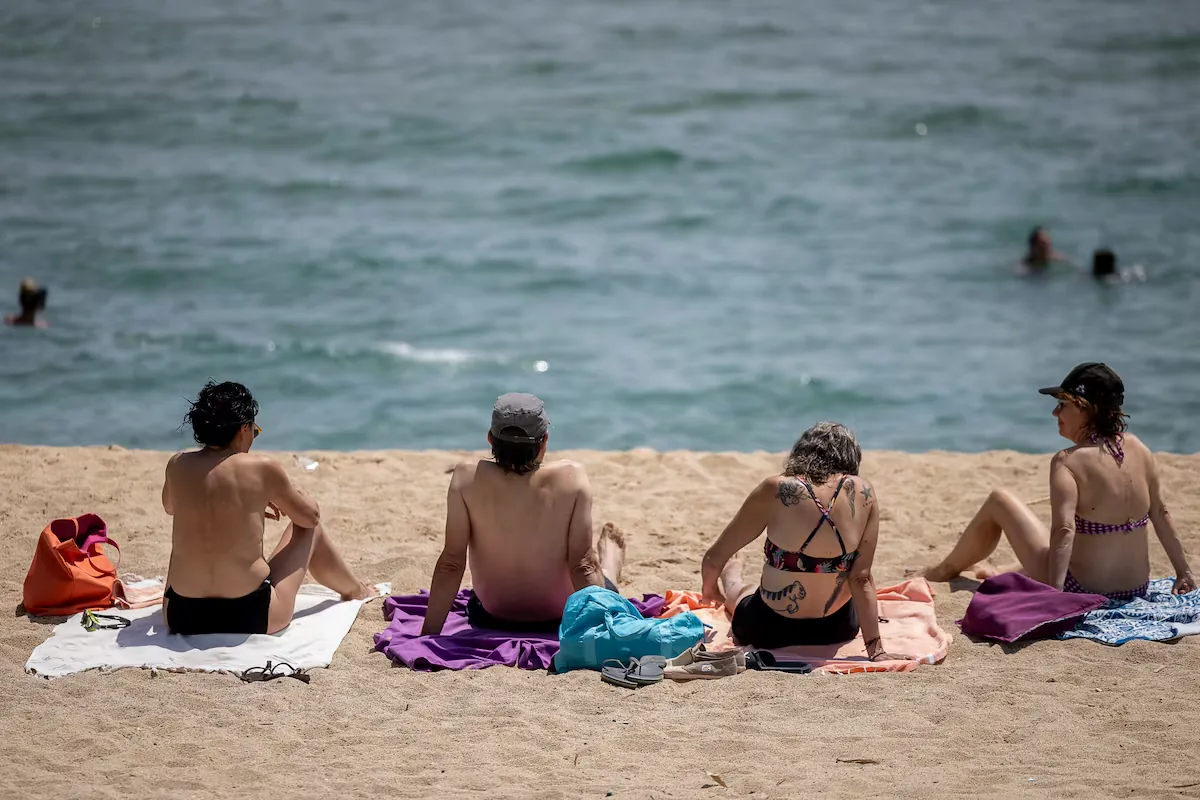
For several weeks now, there have been posts on social media, articles in the media, and various content about toplessness, about women stopping doing it, and about why. Among the most repeated reasons: fear, greater among younger women, of being recorded, photographed, and spread on the internet without their consent. There is talk of mobile phones, tiny cameras, even Meta’s “pervert glasses.” Is it happening? Yes and no. It cannot be stated that there is a significant decline in this practice in Spain: it is a feeling, but there is no data to support it. Nor can it be claimed that there are men with devices everywhere committing what could be a crime. But the fear is there, it is real, and it is not just about that. It is also about the reaction of those around and about not meeting increasingly high, widespread, and impossible aesthetic standards.
Read more Rafa Jódar reaches the final in Washington with a new comeback, where Taylor Fritz awaits him
What is happening with toplessness is a complex reality and involves responding to a social, cultural, and political issue. Here, four specialists and the stories of more than a hundred women who participated in this report do so.
Is it disappearing in Spain?
Almost every year, the end of toplessness is discussed in media across Europe, but despite this incessant buzz, there have been no studies over time in Spain that put numbers to this subjective but widespread perception. The most recent available data is from last year’s YouGov survey: it found that , 13% occasionally, 9% once or twice, and 40% never.
These figures are several points below those of a study from almost a decade earlier. The Ifop, the French Institute of Public Opinion, has been collecting data on this practice mainly within, but also outside, its borders. For Spain, the latest information is from 2017: eight countries were analyzed ―Italy, Spain, France, Germany, the Netherlands, the United Kingdom, the United States, and Canada― and Spanish women ranked at the top for toplessness, with 49% ―31% regularly and 18% occasionally―, well above the average (22%).
I feel there is a vicious circle: fewer women are going topless because they feel more insecure, and other women see fewer doing it and are less encouragedMaría, 44 years old
The following updates of that barometer, from 2021 and 2023, pointed to a generalized decline in Europe and that it had become something mainly done by women over 40. Mar, from Catalonia, lives in Argentina and has recently returned to spend a few weeks with her family. Her observation is very different from that of a couple of decades ago: “All of us who do it are over 35 or 40.”
She is not the only one who believes this. More than half of the 117 women who responded for this report share that perception. And more than half also referred to what is positioned in the media as the main reason for not taking off the top half of the bikini: that someone might take a photo of them, record them.
Meta glasses and mobile phones
Meta glasses are at the center of the debate, perhaps because they have only been on sale for a few weeks and perhaps because they represent a concrete object to explain a fear that is not new. Dozens of women have answered that they have been thinking about it for one, two, three years. “Since the rise of cameras in mobile phones,” says Neus. But does it happen massively?
I go topless but the thought crosses my mind that some idiot might take a photo of me and share it with his friendsAndrea, 29 years old
On one hand, there are no figures indicating that this is a widespread practice. The Ministry of the Interior explains that “in the crime statistics system, it cannot be specified that complaints filed for images captured and spread without consent are linked to specific cases on beaches or pools.” At least, for now, there is no internal or public alert about this.
However, when an idea starts to circulate on social media, especially when picked up by influencers or communicators, it begins to take on the appearance of an indisputable fact, generating a fear that, while as legitimate as reasonable, does not quite fit reality, at least not with the data available so far. Many of the women in this report have explained that they only “heard about the glasses on the beaches” “recently” because it went viral on social media.
Does this mean it doesn’t happen? No. It does happen. This newspaper has received a dozen testimonies from women who, over the years ―between 2008 and 2025― had a man take a photo of them while sunbathing and upload it online, or share it with coworkers or friends.
And beyond the specific cases of beaches or pools, sexpreading ―sharing sexualized images without consent― is one of the crimes that specialists and institutions have been most concerned about for several years. To mention some known cases, sociologist Rosa Cobo points out “groups of tens, hundreds, and even thousands of men who have been exposed and who had taken photos of their friends, neighbors, or girlfriends and uploaded them to private groups on various social networks. There is a kind of male obsession with filling the internet with female bodies, the raw material of pornography.”
If someone sexualizes my chest it’s not my fault, and if they are recording me without my consent they are committing a crimeLorena, 38 years old
Silvia Semenzin, also a sociologist, goes back to the 1980s: “Back then, going topless was an act of rebellion and sexual freedom. Today you have no control over your body, the gaze doesn’t stay on the beach, and that sexual freedom does not go hand in hand with a security that the internet does not offer us.”
Semenzin would like to know, like everyone else, the extent of all this. So does Eva Cruells, psychologist, researcher, and consultant in public gender policies, who insists that it is time to “have an in-depth investigation” on this.
She, one of the creators of Fembloc, the organization for assisting victims of digital gender violence, states that what they already perceive, “both in workshops and in practices with many young women,” is “that the sexual terror coined by Nerea Barjola is moving into the digital realm.”
Everything is increasingly scary. I know it’s counterproductive and that we restrict our own freedom. I also know what they intend by humiliating us. It’s very complicatedAna, 37 years old
In the book Sexist Microphysics of Power. The Alcàsser Case and the Construction of Sexual Terror (Virus, 2018), Barjola theorized about “that feeling of threat or danger that arises in certain circumstances where, a priori, nothing is happening, but which, nevertheless, triggers the alarm of sexual terror.” Which does not come from nowhere.
Cruells refers to the report Exposed Generation: Youth Facing Digital Sexual Violence (2024), which concluded that 60.6% of young people had suffered some form of digital sexual violence, including sexpreading; and 70% considered it important to learn to manage privacy, especially by becoming aware of the risks.
And here, she says, although “a direct correlation with daily practice has not yet been made, a social context of fear of losing control over one’s own image is described,” something the Government plans to regulate with specific legislation, but meanwhile, “it is beginning to have consequences on habits.”
Which ones? Self-censorship, and the expert believes that “a distinction must be made” between self-imposed censorship and awareness.
María Luisa is 64 years old and doesn’t think much about whether someone records her: “There have always been onlookers on the railing of La Concha [San Sebastián]. Maybe one day someone will tell me they saw me on the internet in the category of ‘fuckable grandmothers’ and I’ll have to tell them to live instead of looking.”
Read more The penthouses of Chamberí: the most erratic hours of Amador, Ayuso and their surroundings
But Mónica, 58, almost “imperceptibly” no longer takes off the top part: “At most on the towel, but I don’t walk or go into the water topless. My friends neither. Times have changed and there is awareness of the danger posed by social networks and the impunity of spies.”
“In the end,” Semenzin points out, “facing violence is left to an individual position: each one has to decide whether to confront it or self-censor, instead of seeking cultural or political solutions.” Cruells adds that this is “a transmission of rape culture from the physical to the digital plane.”
I’m going to keep going topless no matter what. I don’t want the possibility that someone might photograph me to ruin something I like so much and have always done, alone, with a partner, and with friends, and that is also a legacy from my mother.Irene, 36 years old
She says that “again, even from more leftist positions, there is a discourse in which the responsibility for what happens to women falls back on them, and their safety depends on their behavior.” “We cannot go back there after the long work done by feminism,” she emphasizes. And that statement also applies to that other long work done with beauty ideals. And which also never quite consolidates.
Aesthetic pressure: the impossible perfect breasts
“I don’t think men or the photos they might take of our breasts have anything to do with the equation. I think it’s something we have imposed on ourselves because we are generally ashamed of our bodies.” Nora, 27 years old, says this.
She talks about the constant aesthetic pressure with which her generation has practically grown up: “Constantly exposed to perfect bodies, stomachs, legs, and breasts. Just staying in a bikini already makes you feel vulnerable because you think you have to be perfect. Staying topless reveals something much harder to fix, not even in the gym can you.” Only in the operating room.
The Spanish Society of Plastic, Reconstructive, and Aesthetic Surgery estimates that around 85% of cosmetic surgeries in Spain are performed on women, and breast surgeries have been the most requested for years.
I don’t go topless for various reasons, the main and I would say most important is not having breasts I feel proud ofAurora, 67 years old
On the other side, Tatiana, already in her 40s, points out: “The shame of not having normative breasts, small or not so big. When you have very large breasts, THEY ALWAYS look at you,” she writes on Instagram. That pressure, with small, medium, or large breasts, is not new.
Ángela, 40, has never shown them because of “the absurd belief that perfection exists and the mistaken reading that one is not perfect”; Carmen, 43, “because I have breasts that reach my navel without a bra.” Others, like Alicia, keep doing it “so that new generations are aware that there are many types of bodies and breasts, and that all are perfect and valid.”
But who decides what perfection is? A “hegemonic canon” that, recalls theorist Rosa Cobo, “has historically been created by them. And to the extent that we have more insecurity, we need more validation.” One that will never come because the standard is practically impossible.
Even more so in certain circumstances, like those of Lucía (and the approximately 360,000 women who give birth every day worldwide). In her case, “complexes mix with hostility,” the hostility she received after “pregnancies and breastfeeding.” Those “bad looks” made her stop going topless “completely.” And those “bad looks” are the third thing most talked about by a large part of the women.
Who is around
Rafaela, in her mid-50s, states that “you feel the discomfort of those next to you or in front. Topless is increasingly scarce and more modest.” She has noticed this for three or four years, as if silently and dangerously walking towards the Republic of Gilead, the fictional country Margaret Atwood invented for The Handmaid’s Tale.
The same one referenced on Instagram a few days ago by director and playwright Marta Eguilior. At the RIU hotel pool in Chiclana, Cádiz, she was asked to cover up because topless was not allowed.
I don’t think it’s a coincidence that I was more comfortable 10 years ago with the last great wave of feminism than now with this prevailing air of conservatism and metaglasses.Merche, 40 years old
Ismael Rodrigo, president of the Spanish Federation of Naturism, recalls with some irony that the crime of public scandal ended in 1988 and that in Spain you can be “not only topless but naked on any public or community beach or pool.” Even so, dozens of women have described how “they look at you worse and worse,” talk about “inquisitorial looks” they didn’t see before, “whispers” they didn’t hear before, or directly those who “come up to tell you to cover up.”
Several, with professions such as doctors, judges, or high school or university teachers, add that they “believe” that if someone sees them it will “reduce their credibility” at work. Others say they are unable to go topless in their hometowns or cities of origin, but do so anywhere else. This factor, feeling under scrutiny, is what conditions many the most.
“More so if you are Latina, like me. For us, going topless is very rare; in many Latin American countries it is prohibited. I came from Mexico 12 years ago and I do it, but I always thought people looked badly and now I notice it’s not just my ideas,” says Margarita, just turned 30.
Many times I wonder to what extent that fear of being judged is mine and to what extent it has been imposed on me by others. It’s a silent judgment, but undoubtedly presentCristina, 46 years old
Cobo, the researcher, states that it is directly related to “the cultural and political wind blowing influenced by the far right, a return to certain puritanism,” which she believes “is not being sufficiently valued in the change of customs, in the hierarchy of some values and practices.”
Some so apparently trivial as going topless and which, however, speak of a change that, looked at closely, is not subtle. And that the 117 women who have shared their perception with this newspaper do not want to happen. One of them, Eva, sent a message with a postscript that goes exactly as is, including the heart:
Read more Trump says he is suspending attacks against Iran pending a quick agreement
I still see many women over 60 going topless at the municipal pool. I hope the world allows me to be them in 30 years 💜