




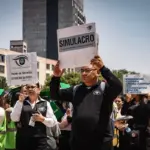
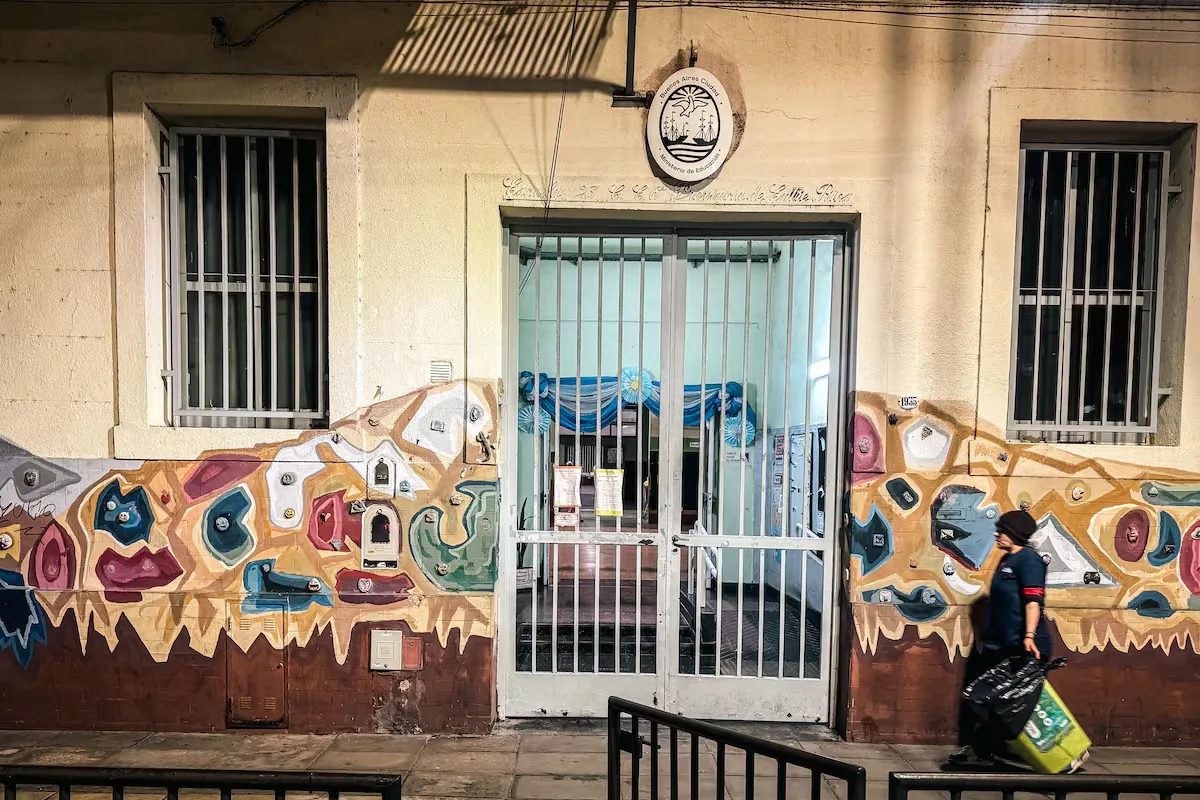
“Hunger wages,” “budget crisis,” “lack of dialogue,” “I can’t make ends meet.” These and similar phrases were the most heard during the national day of strike and protests led by teachers in Argentina this Monday. The government of Javier Milei responded to the demands for salary increases and educational budget with an operation to ensure that schools complied with the minimum services required, established by a recent labor law, approved in January, at 75%.
Read more Tense calm in Ceuta five days after the massive entry of immigrants
The 24-hour strike was called by the Confederation of Education Workers (Ctera), the largest union of school teachers. Other sector unions and also the federations that group university professors joined. Among other demands, they asked the government for “the urgent call to the national collective bargaining” (the negotiation space between unions and authorities), as well as “an increase that allows recovering the purchasing power of salaries.” They also demanded the restoration of the national fund that compensated salary differences between provinces (Fonid) and the implementation of a new education financing law.
The national minimum wage for teachers is currently 500,000 pesos (about 333 dollars). The government’s last offer was to raise it to 650,000, but it was rejected by the unions, who demanded double, to bring the stipend above the income required to surpass the poverty line.
Although the impact of the strike this Monday was uneven across the different Argentine provinces, the organizers celebrated the level of adherence. “The national strike has very high compliance throughout the country, despite the pressure and coercion from the government,” said Sonia Alesso, general secretary of Ctera, during the march that teachers made to Plaza de Mayo, in the heart of Buenos Aires. For the union leader, the adjustment applied by the executive is “brutal.” “In salary terms and educational investment, we are in the worst historical series of the last 30 years,” she detailed.
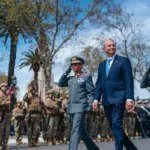
The executive, through its Ministry of Human Capital, carried out inspections in a representative sample of schools to demand compliance with 75% provision of educational service. This is a requirement established by law, at the behest of the far right, for certain activities considered essential for society. With this rule, Milei’s government intends to mitigate the protest capacity of the unions. Minister Sandra Pettovello pointed out that, in the case of education, the measure seeks “to safeguard students’ right to learn and offer predictability to families” in the face of strikes.
Read more Daily ONCE coupon: check Monday, August 3 draw
For the teachers’ unions, the regulation is “unconstitutional,” because it violates the right to strike, and they have challenged it before the courts and international bodies. Alesso recalled that, for months, teachers carried out multiple protest activities and demanded the official call to negotiate, without results. “Then the education problem was not essential, but when there is a strike all alarms go off and the pressures from the national government begin. From before classes start until this date, the government has done nothing. We are still waiting for them to call us.”
The unions that make up the General Confederation of Labor (CGT) did not participate in this Monday’s strike. “We will carry out protest days throughout August to explain the difficult situation we are going through,” announced Sergio Romero, from the Argentine Teachers Union. “We need the national government and provincial governments to react to put the education system in the place it deserves.”
Milei’s chainsaw has completed three uninterrupted years of cuts on funds allocated to finance education. According to a study conducted by the Institute of Political Economy of the UBA, in 2024 the adjustment for the education sector was 43.2% compared to the previous year; in 2025 there was “a new real drop of 7.9%” and this year, if the planned budget allocations are not increased, “it would again register a real reduction of 12.7%.” In the same period, investment in the education system went from representing 1.41% of GDP to being below 0.6% today.
Read more Eurodreams: check Monday, August 3 draw