








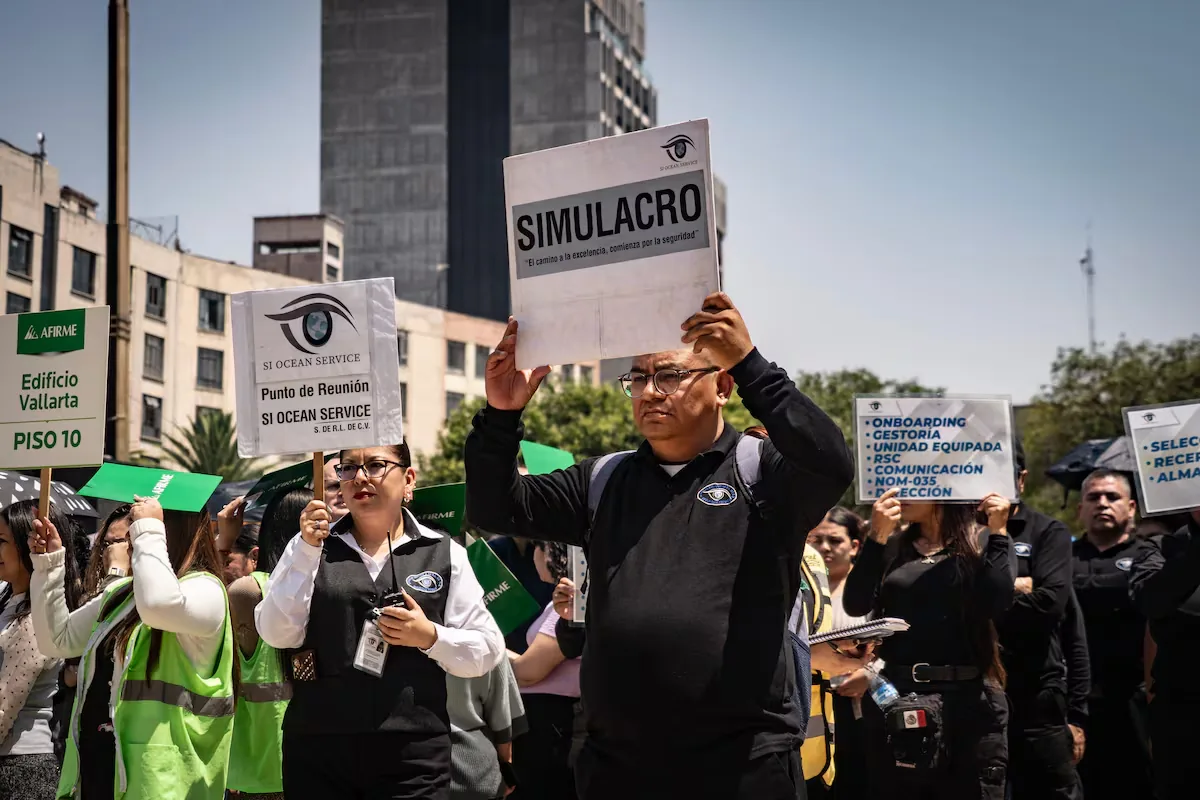
Next Saturday, September 19, at exactly 12:00 (Central Mexico time), the country will test its response capacity to earthquakes with the Second National Drill 2026. This is a preventive exercise aimed at strengthening preparation, government coordination, and active participation of civil society to reduce disaster risks.
Five earthquake hypotheses tailored to each region
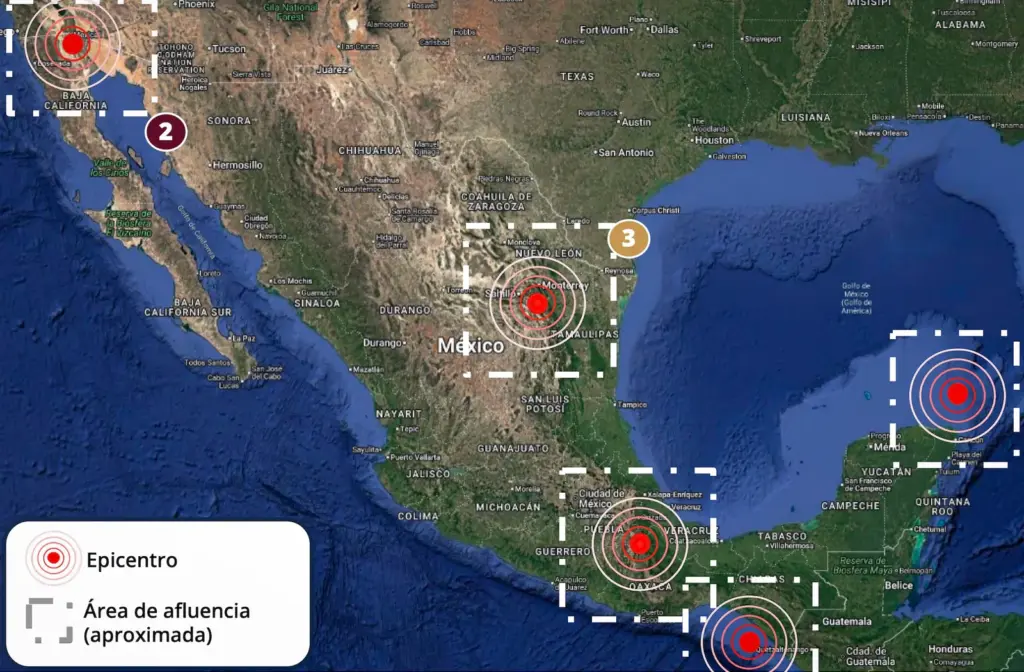
Various specialists from the National Center for Disaster Prevention (Cenapred) and the Geophysics Institute of UNAM have endorsed the design of five seismic scenarios that reflect the real conditions of each area of the national territory.
The main scenario has been established in the central zone of the country. In this region, an earthquake scenario of magnitude 7.7 is prepared with an epicenter 15 kilometers south-southwest of Tehuacán, Puebla, and at a depth of 67 kilometers.
This event is physically possible due to the interaction of the Cocos plate, and allows practicing the response in Mexico City under critical soft soil conditions and with less advance warning time.
Then, the northwest zone proposes a movement of magnitude 7.1 with an epicenter 26 kilometers southeast of Mexicali, Baja California, and 30 kilometers deep. The next hypothesis covers the northeast zone, where the exercise will prepare the population for an earthquake of magnitude 5.2 with an epicenter 8 kilometers west of Allende, Nuevo León, at a depth of 10 kilometers.
The fourth scenario corresponds to the Yucatán Peninsula, which has designed an earthquake exercise of magnitude 7.0 with an epicenter 110 kilometers northeast of Cabo Catoche, Quintana Roo, and 15 kilometers deep.
Finally, the scenario for the Gulf of Tehuantepec defines a tremor of magnitude 7.6 located 75 kilometers southwest of Tonalá, Chiapas, with a depth of 22 kilometers.
The seismic alert: from physical speakers to cellular technology
The Mexican Seismic Alert System (Sasmex) will activate physical speakers at exactly 12:00 in entities with higher earthquake risk, such as Mexico City, the State of Mexico, Oaxaca, Guerrero, Puebla, Michoacán, Morelos, and Chiapas. According to the president of Mexico, the same sound used in real situations will be employed so that the drill is “an effective prevention exercise.”
Likewise, 80 million cell phones will emit an alert sound throughout the Mexican Republic. The phone alert will reach compatible devices with signal. Along with the sound, it will have a vibration and a message clearly indicating that it is a drill. It is received free of charge and regardless of whether the device has balance or mobile data to facilitate the participation of the entire population.
Failures in the speaker system can be reported through Locatel, at 55 56 58 11 11 or *0311.
Commemorative acts and property registration
The preventive day will formally begin at 7:19 a.m. on September 19, when President Claudia Sheinbaum leads the half-mast raising of the National Flag in the capital’s Zócalo in memory of the victims of the 1985 and 2017 earthquakes.
Authorities urge registering homes, schools, and workplaces on the official drill platform to be able to download a free participation certificate after the exercise. Finally, once the 12:00 mobilization concludes, the National Emergency Committee will convene to evaluate the response to the drill.
Subscribe to EL PAÍS México’s newsletter and to the WhatsApp channel and receive all the key information about the current events of this country.
Read more Betis beats Getafe and grabs third place