






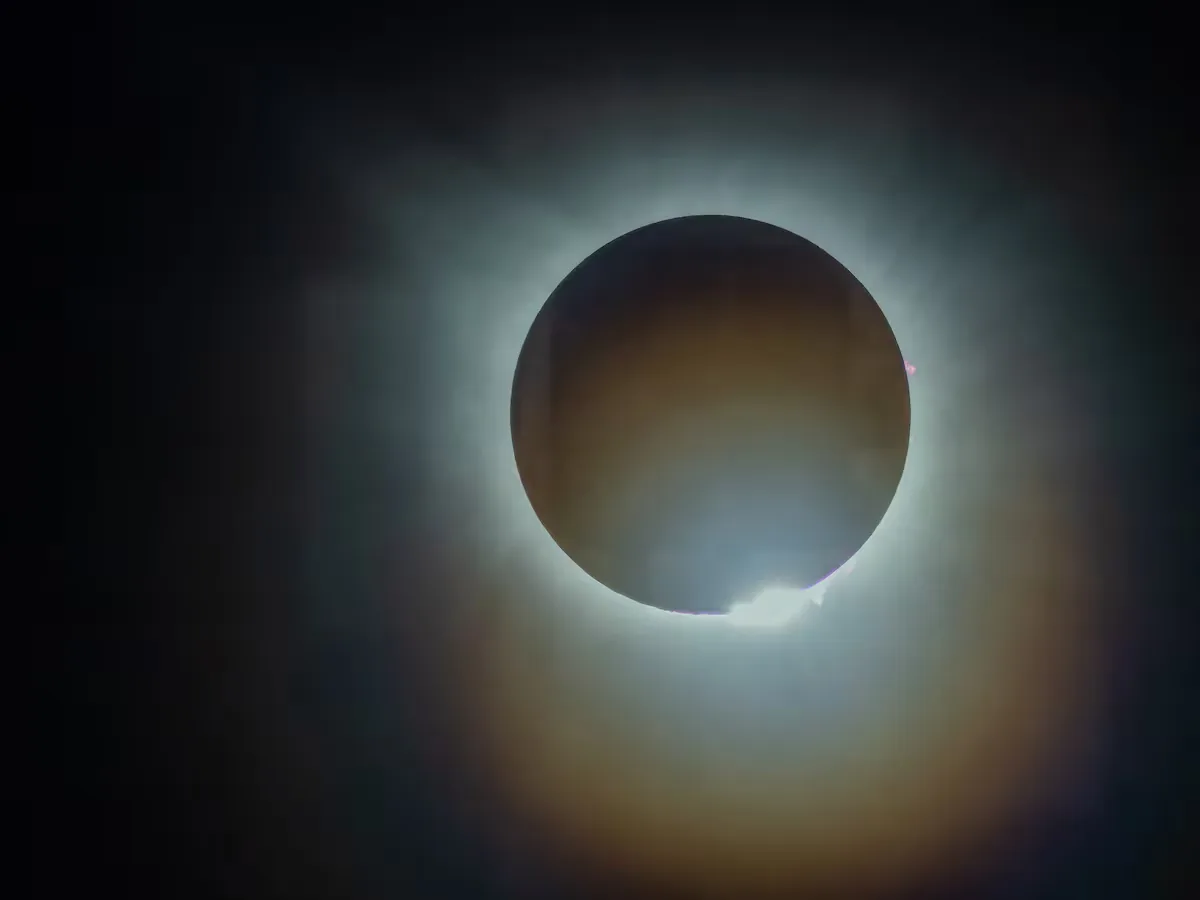
When choosing where to watch the astronomical phenomenon of the year ―actually, of the last 100 years, since a total solar eclipse has not been seen on the Peninsula since 1912― the weather will be the real key: you may have chosen the highest and best spot within the path of totality ―a band from west to east that goes from Galicia to the Balearic Islands― but if there are clouds, you won’t see a thing.
“Since it is an unprecedented spectacle, the Ministry of Science, Innovation and Universities has asked us to publish a special forecast,” Rubén del Campo, spokesperson for the State Meteorological Agency (Aemet), explained to EL PAÍS this Tuesday. This special forecast, on par with major occasions like Holy Week and Christmas, “will be updated daily starting Friday” and will include an interactive cloud viewer and maps with the best areas.
Within this bulletin, “the parameter of most interest, obviously, is whether it will be cloudy or not,” but it will also “contain information about temperatures, probability of rain, fire danger, adverse weather phenomena, and warnings when we are within the warning period ―which are issued three days in advance―.”
⌛️ Less than a week to one of the astronomical events of the century: the total solar eclipse visible from Spain.
Aemet will prepare, starting Friday the 7th, a special forecast for Wednesday, August 12, the day of the eclipse.
+ info 👉https://t.co/uYsmHP7thk pic.twitter.com/g5MGaqyCVi
— AEMET (@AEMET_Esp) August 4, 2026
And why starting Friday and not now, given the great interest the phenomenon generates and the need to start planning the destination to see it? The answer is very simple, yet sad: because it can’t be done. With the tools currently available, meteorological science can provide a forecast with a high probability of accuracy up to three days ahead. But from the fourth or fifth day onward, uncertainty increases, so trying to determine today if there will be clouds in Oviedo or Cuenca eight days ahead is like jumping into an Olympic pool.
“Right now it is impossible to make a realistic forecast. Making a cloud forecast today for the 12th has the same reliability as the climatological study we published in May, in which we explained in which areas it is more likely to be clear on August 12,” Del Campo puts into context. “Until five days before the event, we cannot provide precise information,” adds the expert.
It is still too early to be reasonably sure of the cloud cover along the path of totality during the #Eclipse on August 12. By the end of this week, a forecast with some guarantees can be offered. pic.twitter.com/JVOKqTKmIX
— José Miguel Viñas (@Divulgameteo) August 3, 2026
But this does not prevent some hints from being given. “For now, it looks good and hopefully it won’t change,” predicts Del Campo, detailing that “today’s forecasts point to an anticyclonic day ―stable, without clouds or wind― in most of the country, so it will be very visible.” The issue is that, depending on how that anticyclone is positioned, “it may be cloudy or not in Galicia or the Cantabrian region, or if the anticyclone is a little further away than it should be, there may be storms; although not strong, they can leave you cloudy right at the time of the eclipse,” clarifies the Aemet spokesperson.
For his part, Benito Fuentes, meteorologist at Aemet, ventures a bit further on X, where he published a traffic light report of the eclipse on Monday, which he updated this Tuesday. According to this report, most of Spain is in green, meaning where mostly clear skies are expected and where, as of today, there is a higher probability of getting better views of the eclipse. The Balearic Islands are also in green, and regarding the Canary Islands, there will be “predominance of the trade wind, with less probable cloudiness on the southern side of the islands.”
In blue, however, there is a narrow band where “clouds could develop after midday that would dissipate by late afternoon.” The problem is that “the extent of these developments is still to be determined.” In red is the entire Galician and Cantabrian coast, where it’s not that the weather will be bad, but there is “great uncertainty and nothing can be affirmed.” “Everything will depend on the position of the anticyclone, which will determine the wind direction in low layers and the possible affected areas,” Benito writes on X.
🟩 GREEN
Predominance of mostly clear skies.
As of today, it is the area with the highest probability of getting better views of the eclipse 👌 pic.twitter.com/YbpOuwvYdJ— Benito Fuentes (@metbeni) August 4, 2026
Meteorological models point to two very similar scenarios, in which the most favorable conditions are in the central-west of the Peninsula, while in the eastern half clouds typical of anticyclonic situations in mountainous systems like Cazorla and the Pyrenees may develop. The crux of the matter is whether these developments will generate storms, if they will be extensive, and if they will be long-lasting. And this, as of today, is unknown. The greatest uncertainty is precisely where the band of greatest visibility enters, the Cantabrian and Galician coast, where one model update shows clouds and the next they disappear.
In any case, and this is a fact few people know, Benito advises not to consult the weather forecast for the municipality where you are, but, according to his calculations, for somewhere between 20 and 70 kilometers to the west, since at the time of the climax, around 8:30 p.m., the sun will be very low, barely 5º above the horizon. “The clouds that bother won’t be over your head, but far away, looking west,” concludes this expert. Finally, besides clouds, there are other factors like haze or fires that can somewhat dull the view, but not cover the solar halo.