The bed meeting is the informal name given to the daily morning meeting between the management of Puerta de Hierro and the heads of service from the entire hospital. During this time, the most controversial cases are reviewed and attempts are made to solve any problems that have arisen. They discuss admissions and discharges in the Emergency Department with absolute precision: the computer knows the exact hours and minutes each patient has been admitted. They ensure that no one, as far as possible, stays there for more than 24 hours. They must send them home or transfer them to a ward to continue their treatment within the hospital—emergencies, by their nature, are a transit place. However, in the last two weeks, two people have become trapped in the system. Carmelo, a 72-year-old Bolivian man with an incurable tumor, and Ángel, an 18-year-old Peruvian boy with intellectual disabilities, have been stuck in the Emergency Department so long that they have become part of the scenery.
Their cases have quite a bit in common: they are of foreign origin and have no one to take care of them. They had nowhere to go. Carmelo was admitted on July 29 and was not transferred to a palliative care center where he could die with dignity until Tuesday. In total, he spent 143 hours alongside patients requiring urgent interventions. Exactly 5.9 days. Ángel has been there much longer, since July 21, about to reach two weeks. His record showed 335 hours in emergencies on Tuesday, and counting. The hospital did not offer Carmelo a room, where he would have been alone, with a TV and private bathroom, without the rush and chaos of an immediate care unit. Nor have they done so for Ángel, who is in a cubicle waiting to be granted a place in a center for people with intellectual disabilities in the Community of Madrid.
The matter has upset some hospital workers, who believe that the center’s management wants to save costs and that they keep them in these conditions because neither they are in a position to complain nor will anyone do so on their behalf. “They do it to save a bed,” laments a hospital worker who asks to remain anonymous to avoid reprisals from the management of this publicly managed private center. Healthcare management is public and free, while infrastructure and non-health services belong to a concessionaire. “In this case, the key is impunity. They are not Spanish, no one will find out, there will be no repercussions. The risk of having a problem for keeping them there is zero,” he adds.
A spokesperson for Puerta de Hierro, meanwhile, assures that the hospital has done nothing wrong. They argue that the clinical condition of neither required hospital admission and defend that they have been admitted in appropriate conditions, in a space separated from the rest with screens, with the necessary medical and nursing care. They acknowledge that both have spent a high number of hours in the Emergency Department, much more than usual, but attribute this to the fact that these are two patients with special circumstances. Attributing it to wanting to save costs, they say, is a “misinterpretation.”
Read more Minister Sira Rego will not be on the lists for the 2027 general elections
Some of the staff who have been around the two patients these days disagree and believe that nationality, as in all areas, plays a fundamental role in this case. “This is the national priority applied to the emergencies of a hospital,” says another worker, who says he has seen with his own eyes how terminally ill Spanish patients were taken upstairs. Carmelo, on the other hand, was born in Bolivia, is 72 years old, and worked as a laborer until a few weeks ago, when he began to suffer a very severe headache.
He has legal residency and receives a low monthly pension, the non-contributory one. He has had the misfortune of suffering a glioblastoma, a malignant and extremely aggressive brain tumor that grows very quickly. One of the worst diagnoses a person can receive. They told him, with all gentleness, that they could not operate on him and that he had very little time left, probably only days. He responded that he would like to die in Bolivia surrounded by his family. A friend, a lady who has been looking after him, bought him a flight to La Paz, but due to the relentless progression of the disease, he could not board the plane: he became blind, disoriented, and with a low level of consciousness—only the administration of corticosteroids partially relieved his pain. After his six days in the Emergency Department, he was taken to the La Fuenfría Palliative Care Hospital in Cercedilla, where he will spend his last days.
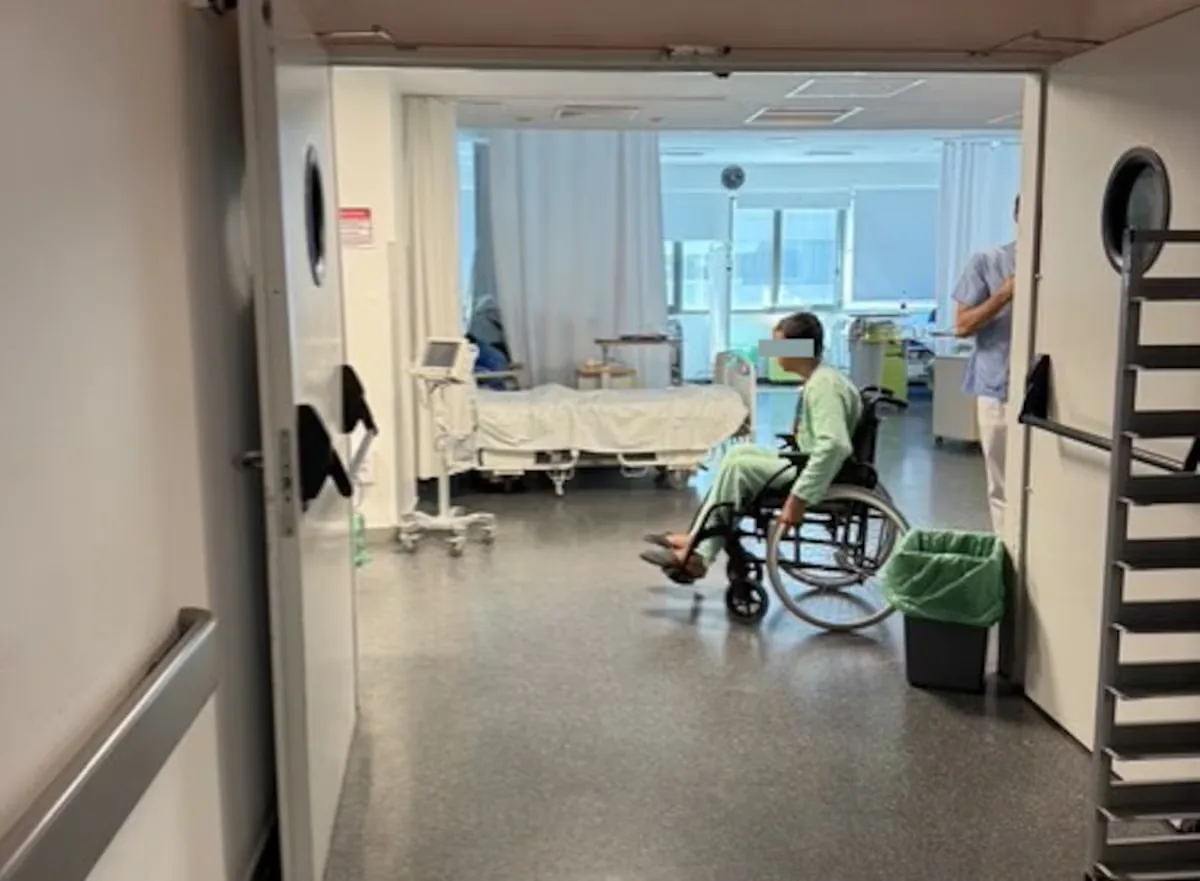
Ángel is still waiting for a solution. The hospital says that the Department of Social Affairs is working on it. He now moves around the unit in a wheelchair, but for days he had to be immobilized. His disability is accompanied by behavioral disorders that psychiatrists have managed to control this week. Upon turning 18, he could no longer stay in the center where he was interned and was brought to Puerta de Hierro, with the idea many people have that everything is solved in Emergency units. They did not give him a room, and he has been wandering here for two weeks until they take him out of this limbo. A boy alone and stranded in the Emergency Department.