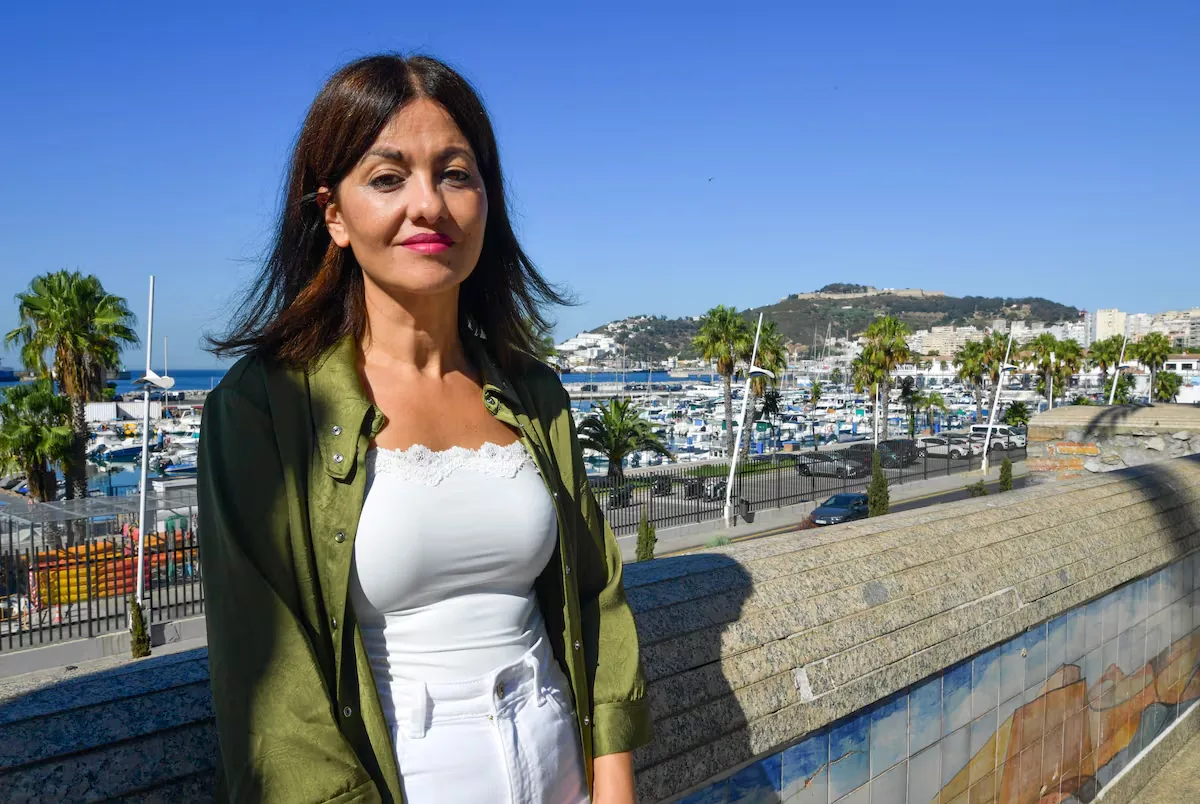
The Minister of Youth and Childhood, Sira Rego (52 years old, Valencia) arrived in Ceuta this Thursday to manage one of Spain’s largest migratory crises. Rego spoke to EL PAÍS by phone and announces that the transfer of migrant minors to the autonomous communities will take place in “a few weeks.” She acknowledges that she still does not have figures on how many children and adolescents have arrived in the autonomous city and criticizes the political management of the PP and Vox in recent hours.
Read more The Bank of Mexico maintains the interest rate at 6.5%
Question. What is the exact number of unaccompanied minors who have arrived in Ceuta in recent days?
Answer. Right now we are not in a position to give a definitive figure. Children who were hidden or whom we did not know were in Ceuta are appearing. We are now working on the entire process related to identification and especially on the analysis of the different cases and the humanitarian care of the children.
Q. Do you have any range? Local journalistic reports talk about between 5,000 and 6,000 minors.
A. Honestly, I don’t think we will reach that number, but I don’t want to be irresponsible and give a figure that I currently do not have the capacity to provide.
Q. What profiles do they have?
A. We are encountering a significant number of 12-year-old boys and also girls. It is a very diverse reality in terms of age and gender. And this poses a challenge because child care services, with the different realities that exist, have to adapt to this.
Q. Have they already been given age tests or will they be done on the peninsula?
A. Yes, I want to highlight that Ceuta will make a huge effort so that age determination tests are done here and this is good news. On the other hand, there are many children who are very young and do not need to have an age test. In these cases, we would process them immediately.
Q. What is the first solution?
A. Family reunification. For this, we need a good individualized interview with each child to understand their specific situation. This cannot be done superficially. Some express that they want to return to their families and here a delicate and very thorough job must be done. It is about connecting with the family and, logically, coordinating with Morocco to proceed with family reunification. And then, those whose return is not possible will be integrated into our country’s reception system with all guarantees.
Q. Is there any predominant country?
A. No, there are children coming from conflict zones, such as Sudan and other countries at war, who are asylum seekers due to being in war. Then there are also children from other places, mainly Morocco.
Q. In the case of Morocco, do we already know how many have been claimed by their parents?
A. No. We do not have that. The overflow situation has been so great that we are still in the process of registering minors and it is very complicated.
Q. How does the system work now then?
A. It is gradual. Many minors go to the police and register. And if there is any family that has sheltered and cared for them, they must facilitate that these children can reach care points to be properly registered. From there they enter the emergency reception service. And then we can start working with the specific situation of each minor and see their circumstances. We need a few days to see all the figures. On August 16, a ministry team will be transferred to work on protocols and reception options. We have allocated a budget of 25 million euros that will be taken to the last council of ministers this month.
Q. We have seen images of minors with soldiers being transferred to the border. What do you think of these videos and photos?
A. They are concerning. We will ask for any circumstance to be clarified. We have all devices in place to prevent any violation of fundamental rights. The overflow situation has been very large and, beyond these images which, I insist, are painful, we call for them to be avoided.
Q. Will you go to the prosecutor’s office if the images are perfectly documented?
A. We will first see the situation. From there, all guarantees to comply with the law.
Q. Regarding the transfer of these minors to other communities, do we know when it might start?
A. I don’t have a specific date, but we are talking about a few weeks. I cannot give a specific day. We are exploring several mechanisms given the exceptional situation. One is article 35 of the Immigration Law, which still allows us to generate more transfers to the peninsula for binding and supportive reception by all autonomous communities.
Q. However, the management of minors seeking asylum corresponds to the Government.
A. Yes, and therefore they have a differentiated treatment, but for these minors the transfer will also be done at the same times.
Q. The PP says it will comply with the law, but Vox refuses to host these minors. What could happen if they refuse?
A. They cannot refuse. There is a law and the law is followed, unless they want to commit wrongdoing. I cannot imagine that we will reach this situation, frankly. PP and Vox are making propagandistic use of what has happened here, something absolutely regrettable. We are talking about more than 140 deceased people. A moment of great tension, with an extraordinary human tragedy component and, therefore, what is needed now is a bit more understanding and, above all, not to use childhood as a tool for electoral or partisan gain.
Q. Some other communities also complain about the capacity to host these minors. Do you plan to review it?
A. Most communities have free places. We do not yet have feedback from them, but we have convened a sectoral commission for next week. The idea is to accelerate all procedures for this reception.
Q. What would you say to those citizens who see hosting as a problem?
A. To turn to truthful information and data. Over the past year, we have managed 2,000 cases of migrant children, mainly from the Canary Islands, Ceuta, and Melilla. We have had no incidents. It invites reflection. What would happen if they were our sons and daughters? What if we lived in a country that did not offer opportunities or was at war? There are Palestinian people among some of those who have arrived in Ceuta. No further explanation is needed. No one, no one throws themselves into the sea and puts themselves at risk unless what they leave on land is even worse than what they might face at sea. One must always try to approach people’s life stories.
Q. A week has passed and many citizens wonder how this could happen. How can more than 70,000 people enter a city of 80,000 in a few hours? The Government talks about mafias and a Supreme Court ruling and other experts point to Morocco…
A. I don’t think there is a single cause and I think it is important to investigate and clarify what has happened. The situation at the southern border and the central Mediterranean border in Europe are not recent migratory situations. We know what is happening at many external borders of the European Union and we know that a good part of what is happening is directly related to the European Union’s migration policy. This is the result of a failure of a migratory model, that of the European Union, which has insisted on externalizing borders and placing border management in third countries that in many cases have interests that are not shared with those of the European territories they border. We face the urgency of thinking about a different migratory model.
Q. Does cooperation with Morocco on childhood and child protection work?
A. On our part, we do not have a direct relationship. There are other mechanisms established more through the prosecutor’s office and the Ministry of Justice and other ministries.
Q. Do you think Morocco is a reliable partner?
A. Morocco has interests that are not necessarily shared with our country and I think placing migration policy in third countries is not a good idea.
Q. Sumar and Vox agree on excluding Morocco from organizing the 2030 World Cup alongside Spain and Portugal…
A. I have not had the opportunity to talk with the Minister of Sports about the matter, but I share my group’s (Sumar) position. Now we have the opportunity to open a broader debate, which has to do with the participation of countries that must meet a minimum of human rights when participating in international sporting events.
Q. A few hours ago we learned that you will not be on any electoral list next year. Are you retiring?
A. From institutional politics, yes, and I think it is very healthy. Now it is time to make a deep reflection about the moment of the left. The left has to rethink itself in terms of political project and strategic project.
Read more Luis Miguel reappears away from the stages as the star of advertising campaigns