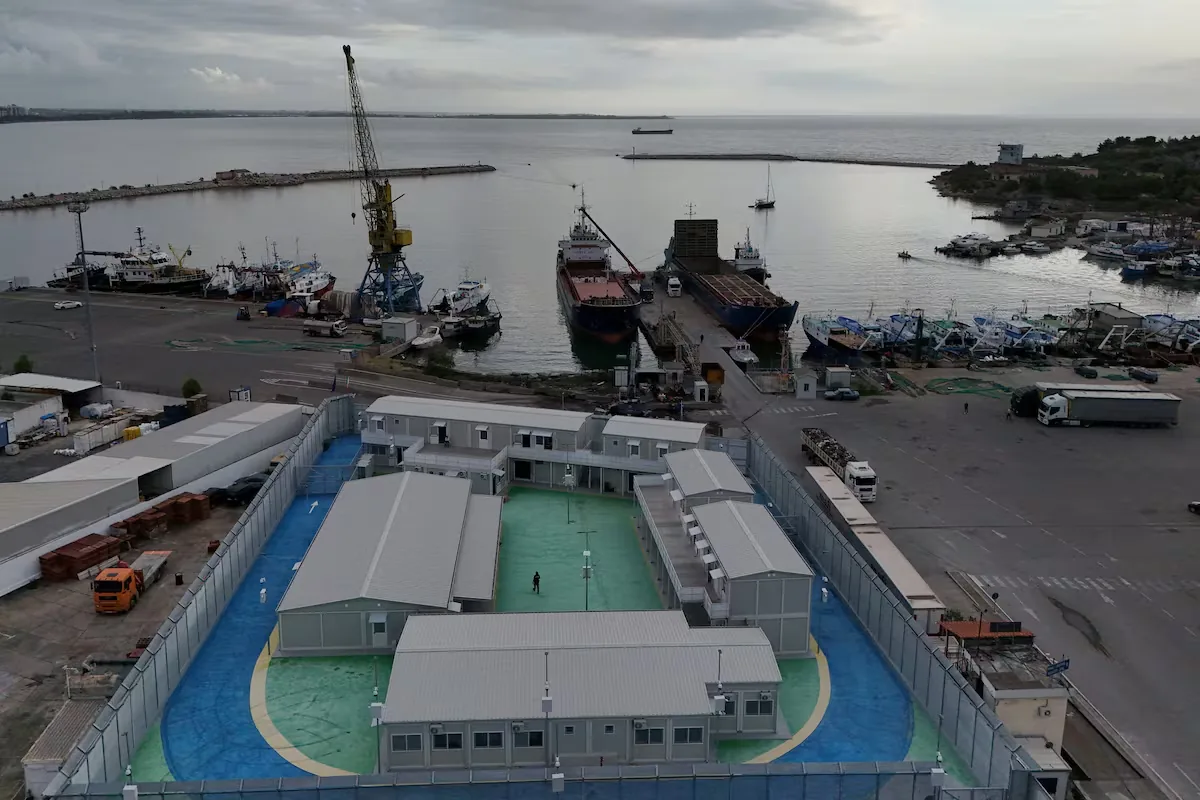
For the second consecutive year, the deportation center for asylum seekers that Italy built in Albania has been almost empty. During this time, these facilities built by Rome outside its territory have also accumulated judicial setbacks related to the asylum system and controversies over their excessive cost. And, on the other hand, when the images of the Ceuta avalanche spread like wildfire around the world, the Italian Interior Minister, Matteo Piantedosi, took advantage on Tuesday of the EU Council meeting that addressed the crisis in the North African Spanish city to raise the need for the EU to build this type of facility to combat irregular immigration. He called for “the courage to embark on the path of innovative solutions,” he said in his speech to his colleagues, using that aseptic language that seeks to avoid the controversial connotation of the initiative.
Read more Black armband and minute of silence in Argentine football for the death of Jorge Messi
He was not alone. He was supported by countries that defend this tough stance, with social-democratic Denmark at the forefront. “Yes, it was mentioned by the Member States that are negotiating with third countries about these return centers,” confirmed Commissioner Magnus Brunner at the end of the meeting, being very careful not to use the word “deportation,” which a journalist had used when asking. Supporters of this option received a key boost to their stance this June with the approval of the returns regulation, which legally opens the door to these centers to transfer rejected migrants or refugees, a step facilitated by the rise of the far-right in the European Parliament and the adoption of this path by traditional conservatives.
Brunner is Austrian, like the conservative Gerhard Karner, the Interior Minister of that country who, in light of what happened in Ceuta, highlighted this week that he had met by videoconference with that group of countries ―Austria, Greece, the Netherlands, Germany, and Denmark― that is discreetly negotiating with a non-EU state to locate this type of center, criticized by human rights NGOs, among others, and about which there were until recently great legal doubts. “The events of recent days highlight the need and importance of this group, which will meet again in early September,” Karner emphasized. Those who call themselves the “group of implementing countries” will intensify “even more the negotiations” with states “outside Europe” at that meeting and “a decision will be made before the end of the year on which countries these measures can be applied.”
For Denmark, especially, this project is crucial, a personal commitment of its Prime Minister, the social-democrat Mette Frederiksen. Her progressive affiliation has never stopped her from being a champion of these deportation centers. Already in 2021, she approved a law that allowed transferring asylum seekers outside the EU to process their applications there and signed an agreement with Rwanda. But the controversial project was suspended in 2023 and has not been restarted.
This failure, however, has not discouraged her. In Copenhagen, it is believed that what happened in Ceuta reminds of the importance of betting on “innovative solutions,” an aseptic expression that avoids all the negative connotations of a measure that has met strong opposition wherever it has been attempted. That is why, when just a few weeks ago the EU approved the returns regulation that seeks to accelerate expulsions and legally opens the door to these centers outside the EU, Frederiksen and Meloni promoted a letter ―just as both did a week ago with the events in Ceuta―. In it, along with 17 other countries, they encouraged “applying the new possibilities [of the newly approved regulation], including hubs in third countries.”
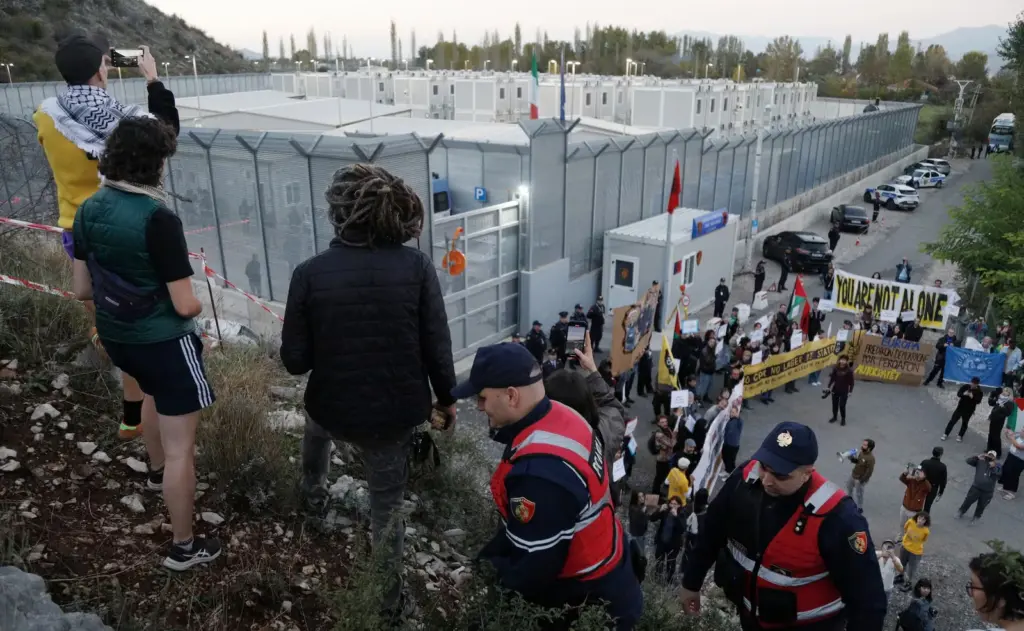
NGOs criticize that these movements in response “are nothing more than the latest excuse,” says Chiara Catelli, advisor to Picum, a network of organizations dedicated to defending migrants’ rights. “What happened in Ceuta has nothing to do with deportation centers outside the EU, but governments are using any excuse to impose them and give the image that they are tough on immigration. Border crossings have long been used to turn migrants into scapegoats and distract voters from the real problems we all face,” she points out.
Read more Araujo, loaned to Liverpool, dedicates himself to Anfield to forget Barça’s pain
Aware of the criticism and how controversial these deportation centers are, Brunner has been very careful these days not to link anything with the events in Ceuta. And when he has spoken about them, he has emphasized that they must be located “in a safe third country,” a concept that does not exist in the Geneva Convention but has been constructed in Europe for a state where it is presumed that the principle of non-refoulement to the place from which a refugee flees is respected, and life and freedom are guaranteed.
It is not yet known with which countries negotiations are underway to host these centers. Press reports in the states that make up the “group of implementing countries” point to Rwanda, Uganda, Uzbekistan, and even Montenegro, one of the countries soon to join the EU, as is Albania. The mystery will have to be resolved soon if, as also indicated from Germany, agreements are expected to be closed with states outside the EU “during this year,” following the words of the Interior Minister, Alexander Dobrindt.
In short, all these countries that, despite previous failures (there was also a failed attempt by the United Kingdom in Rwanda this decade) or the high cost of this bet judging by what happened in Italy, seek to tighten migration policies further, which in recent years have already hardened on the back of the rise of the far right and the adoption by the European PP of much of those postulates. This is also reflected in an article written this week by Kyriakos Mitsotakis, Prime Minister of Greece, another of the countries in the promoting group of deportation centers.
The conservative politician, on the same day that the Interior Ministers met to talk about Ceuta, published a text in Politico calling for “new tools to combat migration used as a weapon” in hybrid attacks. In the text, he does not talk about centers outside the EU; what he proposes is the creation of new tools to respond to situations like Ceuta or like the one his country experienced in 2020 in Evros, when Turkey opened its border to let migrants into Greece, which are not foreseen in the Migration and Asylum Pact, still not fully developed: “Europe must be honest about the limits of its accelerated asylum procedures. In exceptional and clearly defined situations of extreme and disproportionate pressure —whether at land borders or after mass arrivals by sea—, Member States should have the option, within the framework of a specific EU emergency regime, to temporarily suspend asylum applications from newly arrived persons,” he writes.
The logic behind this has also been explained by Commissioner Brunner. The tightening of migration policies has caused irregular migration to fall by 55% in two years in recent years and by 40% so far in 2026. “But, of course, the events in Ceuta —that is also quite clear— show that those dramatic images actually outweigh the best statistics, and that is also one of the lessons learned,” warned the Austrian.
Read more Vollering attacks on a climb, wins the Tour de France stage and takes the yellow jersey