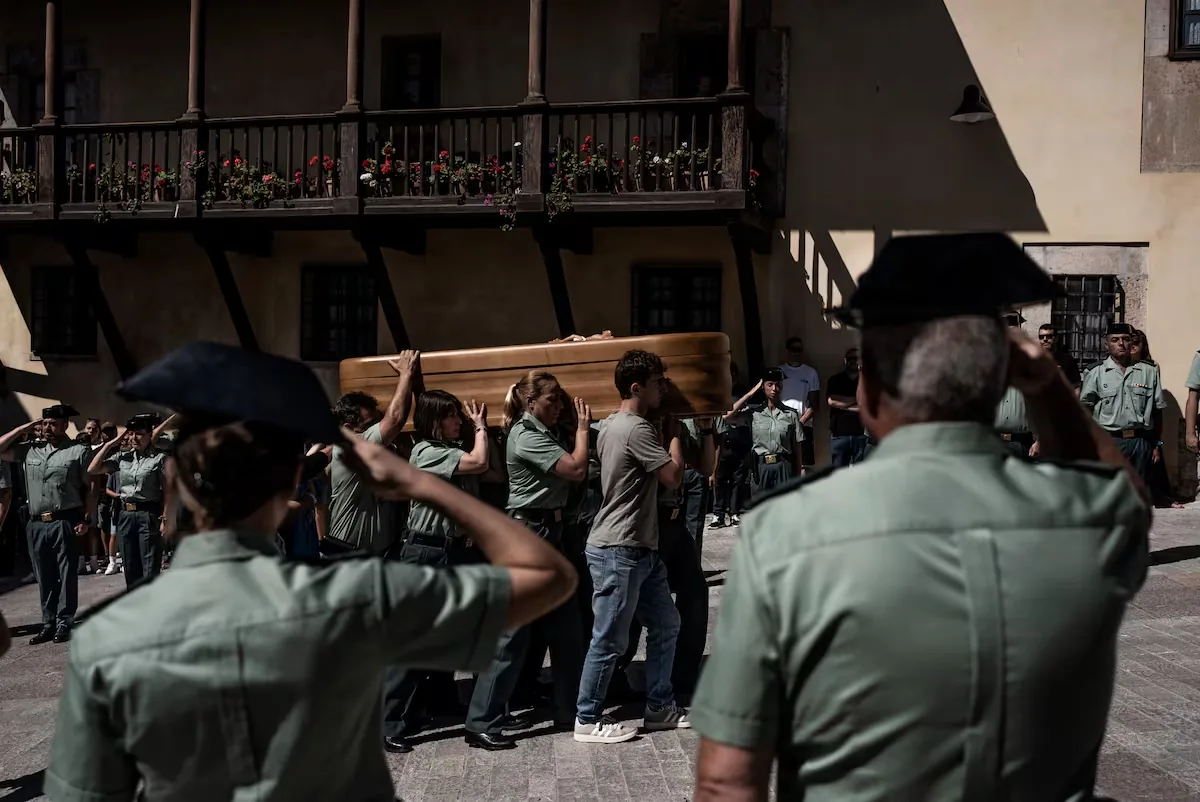
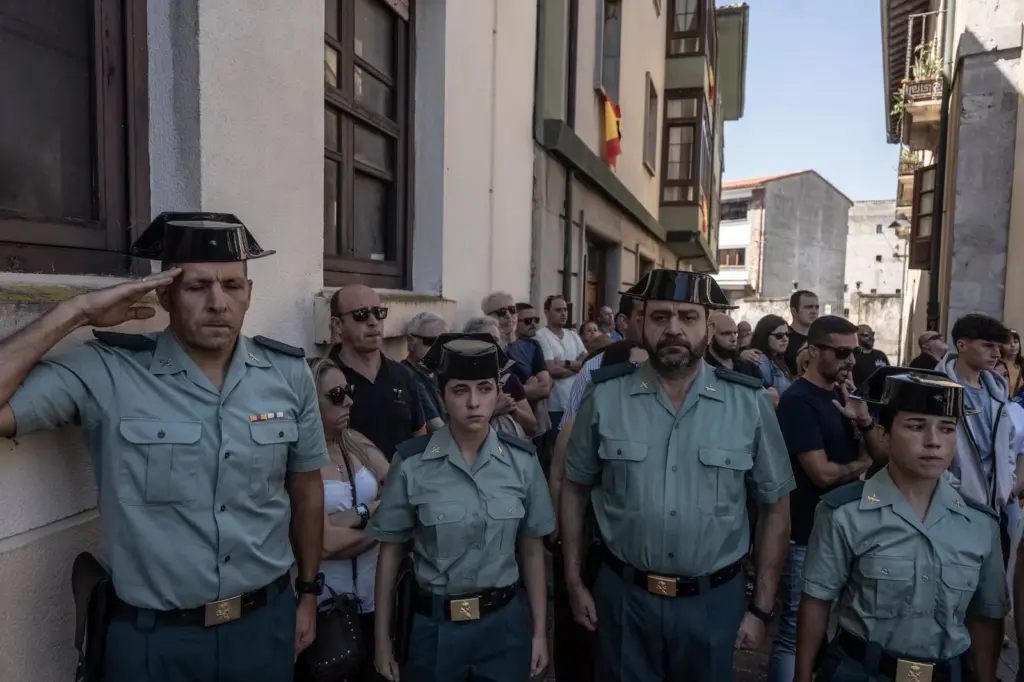
At twelve o’clock noon this Friday, a corridor of green shirts and tricorne hats stood at attention before Laura’s coffin. 66 agents, nine of them women, stood firm with their hands to their temples as the wooden box slowly made its way to the church to say goodbye to that colleague who exactly one year ago had gone to file the last complaint against the man who had exercised violence against her for years, Dámaso Fernández, now a former guard, her ex-partner and the father of her son who turns 19 this year, and her two daughters, twins, still 13. That day, August 5, 2025, at 11:47 a.m., Laura told the agents who took her statement: “I must clarify why I am so afraid of Dámaso, he doesn’t care who he takes down with him.” Months later she warned again that she was in danger, asked to have the anti-abuser bracelet reactivated that she had worn, knowing he would not stop until he destroyed her. The Justice system denied her that device on December 19, 2025, because it saw no elements of “objective risk.” And this Wednesday, August 5, 2026, Dámaso killed her.
Read more Genoa takes a step back in the controversy over Ayuso’s penthouse
That is why the bells of the Basilica of Santa María de Llanes rang the day before yesterday for more than an hour with the slow, sober tolling of the funeral mass. For Laura Cruz, 50 years old. Present were the president of the Principality of Asturias, the government delegate, and the mayor of Llanes. Meanwhile, her colleagues, clad in green, hugged each other, broken. “It’s as if something had broken, had exploded in that barracks,” describes someone who also explains that Laura had been there a long time, that she was loved. “They always protected her.”
On Wednesday they could not. Dámaso had spent three days brooding over the murder. Since Monday, when he learned he had been expelled from the Civil Guard precisely for the violence exercised against Laura. According to the reconstruction by one of the officers of the barracks, on Monday he found out about his dismissal, on Tuesday he attended a dog competition, at night he stole a colleague’s weapon, and on Wednesday morning he left Zamora for Llanes, ignoring the restraining order he had active, in the gray car that on Friday was behind the tape as part of the crime scene.
No one alerted Laura to this, even though it was an open secret that he wanted to kill her. “He won’t stop until he kills me,” she told Marisa Elviro. Marisa and Laura had become friends since the former became a councilor of VecinosXLlanes and was in charge of Social Services. She heard her say that phrase many times.
“She meant it seriously and we all knew she meant it seriously,” her friend said on Thursday next to several flowers and candles spontaneously placed in front of the Town Hall. The day before, shortly before 1:30 p.m., Dámaso entered the barracks taking advantage of the garage door opening. Outside he had left the car ready with the keys in it. Laura was working in a part of the offices and “probably didn’t even see him arrive because the computer screen was blocking her view,” said on Friday one of the colleagues who usually worked with her.
He approached and fired twice at her chest and when, a few tables away, the lieutenant went towards Laura, Dámaso shot him in the leg before running up the garage stairs. It was then that he crossed paths with two other civil guards whom he shot at two meters away. One was injured and the other managed to jump away. “It could have been a massacre,” recalls the officer who helped reconstruct this and prefers to remain anonymous.
Hearing the shots, two other agents ran through the garage where they caught up with Dámaso. “His surprise was to find them downstairs, one of them from the GAR” (the Civil Guard’s rapid action groups), who shot him in the chest. Two hours and seven bullets later, he died in the ambulance. The agents who attended the funeral in uniform prefer not to speak, but another colleague, in jeans and with red eyes from crying, says: “The pity is that the son of a bitch died,” she says. “And that he didn’t remain a quadriplegic for life,” she adds, squeezing the cigarette.
It was the end of violence that had lasted more than a decade, since 2014, when they separated and he began trying to prevent her from continuing her life; she always tried to keep going, always looked ahead. “Resistance” is the word that several people close to the case have used these days to describe her.
With three children and a demanding job receiving complaints of gender violence, Laura still found time to be involved in everything. Laura had managed to break the secrecy surrounding barracks life. “And always with a smile,” says one of her colleagues. On Friday she was bid farewell not only by dozens of uniformed officers, but also by teenagers wearing the basketball team shirts she coached, the girls from the rugby team, or the parents who remembered her from the AMPA assemblies. Also present were her parents, José Cruz and María Pilar Vega, her partner, Álvaro, and her two daughters.
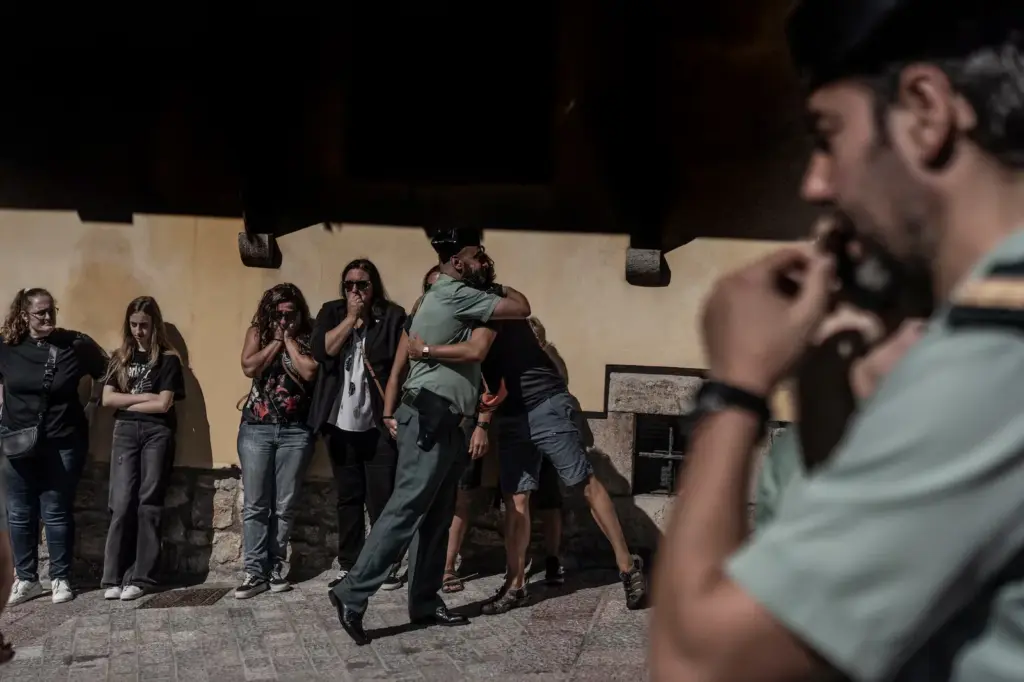
An intense silence accompanied Laura’s body as it left for the square until everyone sang the Civil Guard anthem: “Long live Spain, long live the King, long live order and the law.” Among the dozens of condolences accumulating in the book, someone writes: “I will never forget your example.” And another: “May your murder be the last.”
It was not. A few hours after Dámaso killed Laura, another man also violated his restraining order and murdered his ex-wife in the back room of a business in a shopping center in Murcia. Violence spreads every day as one of the greatest structural problems facing societies worldwide. In Spain alone, around 200,000 women report abuse annually, and it is estimated that only one in ten actually do. Sometimes because they are afraid, sometimes because they do not recognize themselves as victims, and sometimes also because they believe the system will not believe or protect them.
In the second row of the formation on the day of the burial, hidden among the imposing escort of civil guards, an agent cried inconsolably. Looking straight ahead, tears running down her cheeks, hand to her temple and tricorne hat on as her colleague passed by. When the formation dissolved, the civil guard stepped aside to continue crying in silence.
—Did something fail?
—Some things, she says uncomfortably before turning around.
Things had failed long before that day. For 12 years, the policeman, 29 times commended for training dogs and born in Ferrol, dedicated himself to making Laura Cruz’s life miserable and exercising many forms of violence against her, born in Madrid 50 years ago. He neither paid the mortgage on a flat they owned jointly, nor let her buy his share, nor let her breathe.
From time to time he reported her, and she reported him. He filed up to 45 complaints, always dismissed, for trivial things he knew were not crimes like not carrying the child’s seat or leaving dirty sheets in the house they had bought together. Until the 2019 beating, which left her bruised and with a broken tooth while enduring the blows of a man witnesses described as “out of control” and who, as he did again on Wednesday, had sneaked into the barracks through the garage door to give her that beating. He did not stop hitting until his colleagues threw themselves on him.
She reported him and it was not until July last year that the Provincial Court issued the last sentence of the case and confirmed the conviction of the Criminal Court number 4 of Oviedo, which sentenced Dámaso to one year in prison for abuse and another eight months for coercion; he was also convicted of a minor injury offense. But it dismissed the accusations repeatedly made by the Public Prosecutor’s Office for harassment and habitual gender violence that would have increased, although it is impossible to know by how much, the sentence.
He, throughout all these years, also appealed: he wanted to be acquitted. And he did the same within the force. He appealed repeatedly to stop his expulsion once there was a firm conviction in court. But this Monday he was informed he would be dismissed.
Although it can no longer be known, the perception of various sources close to the case is that he blamed her for the expulsion, without accepting that the only responsible was himself and the violence he had exercised for years against Laura. He sought a way to punish her and the theft of a colleague’s weapon is something that has also entered social debate. “The weapon is the responsibility of the agent, who can keep it in a desk drawer or a safe. In this case, it was in a locker,” explains the Sevillian captain in charge of information tasks.
Also in social conversation is the alert Laura gave to the authorities in December and the Justice system’s refusal to reactivate the bracelet because they did not see elements to do so at that time. In Oviedo, the president of the Superior Court of Justice of Asturias, Jesús María Chamorro, stated the day after the murder that system failures carry little weight in this case.
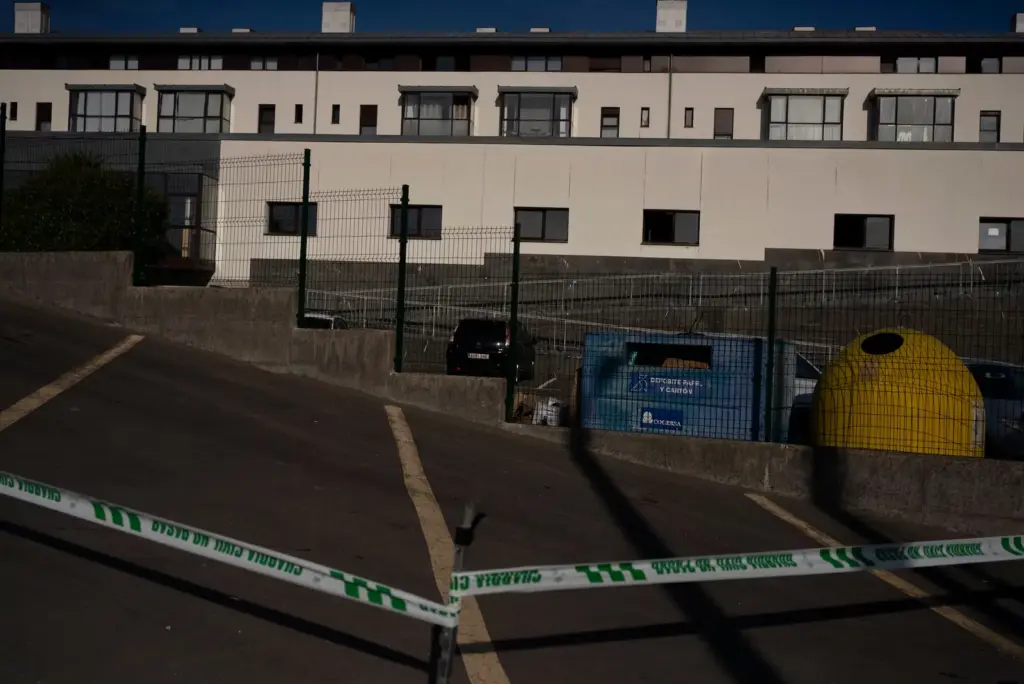
“In the end, the culprit is the one who commits the acts. The courts try to do everything possible to try to prevent these kinds of things,” he declared. The Chief Prosecutor for Violence against Women, María Eugenia Prendes, disagrees. Although she states in an interview with this newspaper that sometimes it is impossible to prevent a murder and that one must be aware of that, she believes that in this case there were decisions that could have been different because there was sufficient evidence for them to be so.
“Now,” says Prendes, “all we can do is learn from this case.” From it remains one victim, Laura Cruz, the killer’s own death, but many other victims. The friends, her father and mother. But above all, her daughters and her son.
He is seen at the funeral among a group of teenagers who stand out among dozens of uniformed officers. They are his friends, Rubén’s, 18 years old. He carried his mother’s coffin into the basilica and whispered outside the Civil Guard anthem he has heard since childhood in the barracks. Living there is like living in a Kiko Veneno song. The children know each other and the families share the iron, a ball, the console, or a suit. The boys grow up together, they are not just neighbors. Those friends hugged him this Friday, him, like his sisters, orphans since this Wednesday.
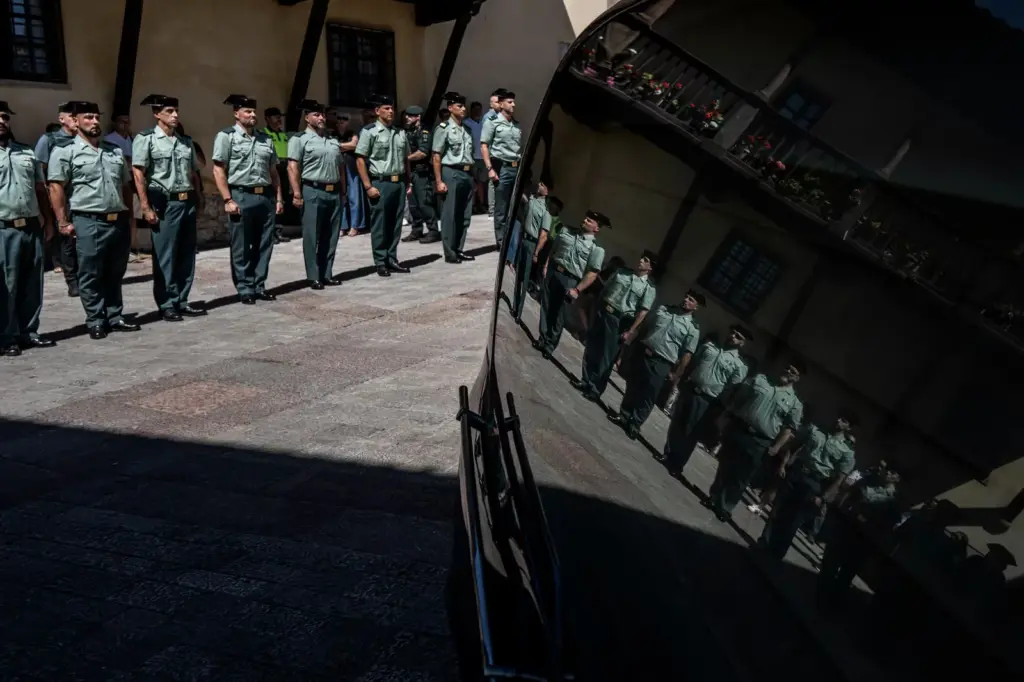
The officer has just ordered to break ranks. “Ar!” he shouts in the Llanes square as the hearse departs for the cemetery. Then, the civil guard who preferred to cry in silence changes her mind and turns to talk about her friend: “She was a great mother, and always with a smile. He killed her because she was happy,” she says haltingly, almost out of breath.
So far this year, 36 women have been murdered by their partners or ex-partners. Since the official statistics began in 2003, there have been 1,377 women. And the number of minors orphaned this year due to this violence has already reached 26, 536 since they have been counted, starting in 2013. Laura’s eldest son, already 18, is not included in that statistic for being of legal age.
The phone number 016 serves victims of gender violence, their families, and their environment 24 hours a day, every day of the year, in 53 different languages. The number does not appear on the phone bill, but the call must be deleted from the device. Contact can also be made via email 016-online@igualdad.gob.es and WhatsApp at 600 000 016. Minors can contact the ANAR Foundation phone 900 20 20 10. In an emergency, call 112 or the National Police (091) and Civil Guard (062) numbers. And if calling is not possible, the ALERTCOPS app can be used to send an alert signal to the police with geolocation.
Read more The Generation Z rebellion shakes the southern world