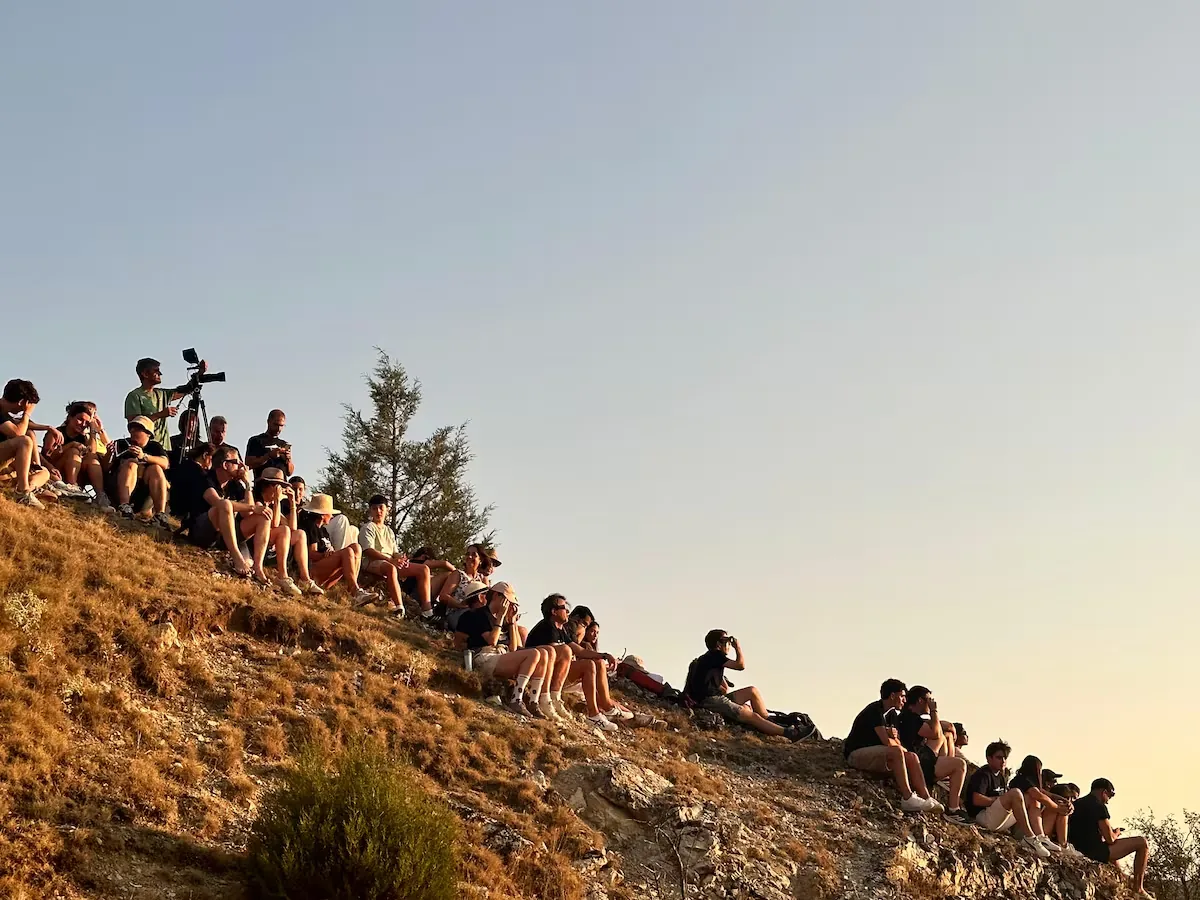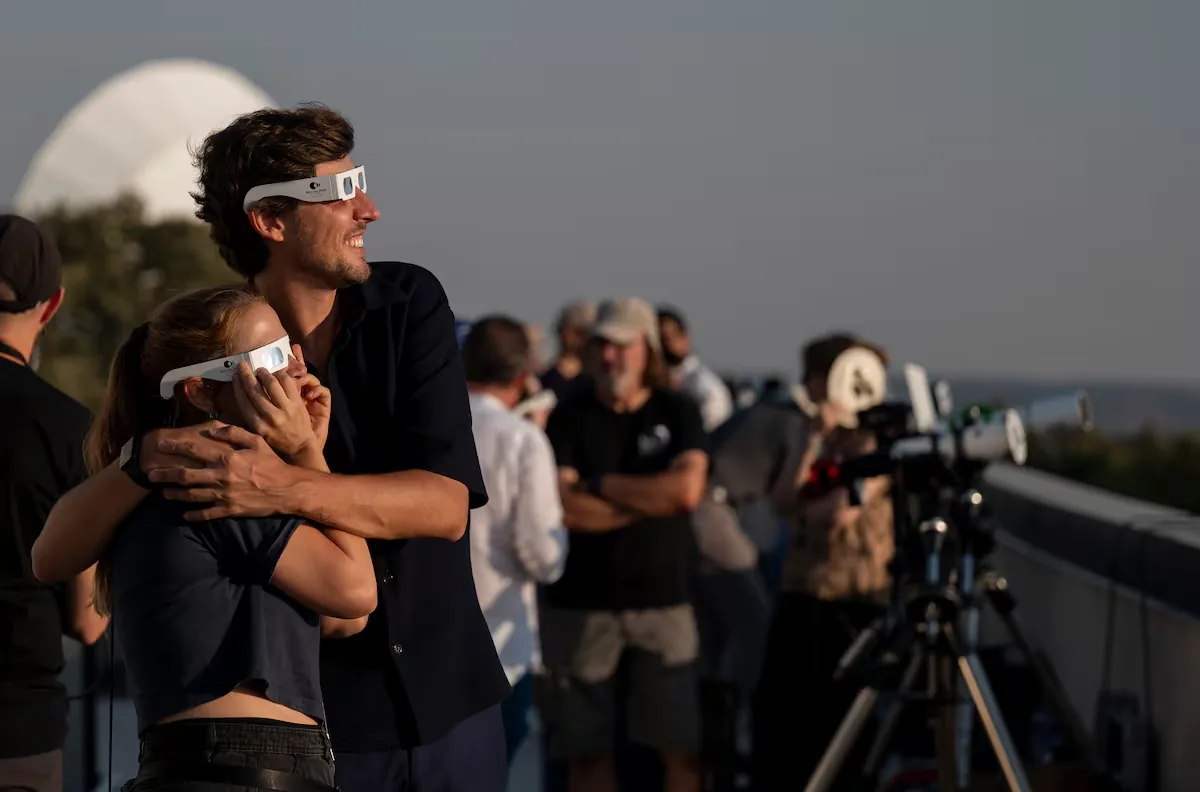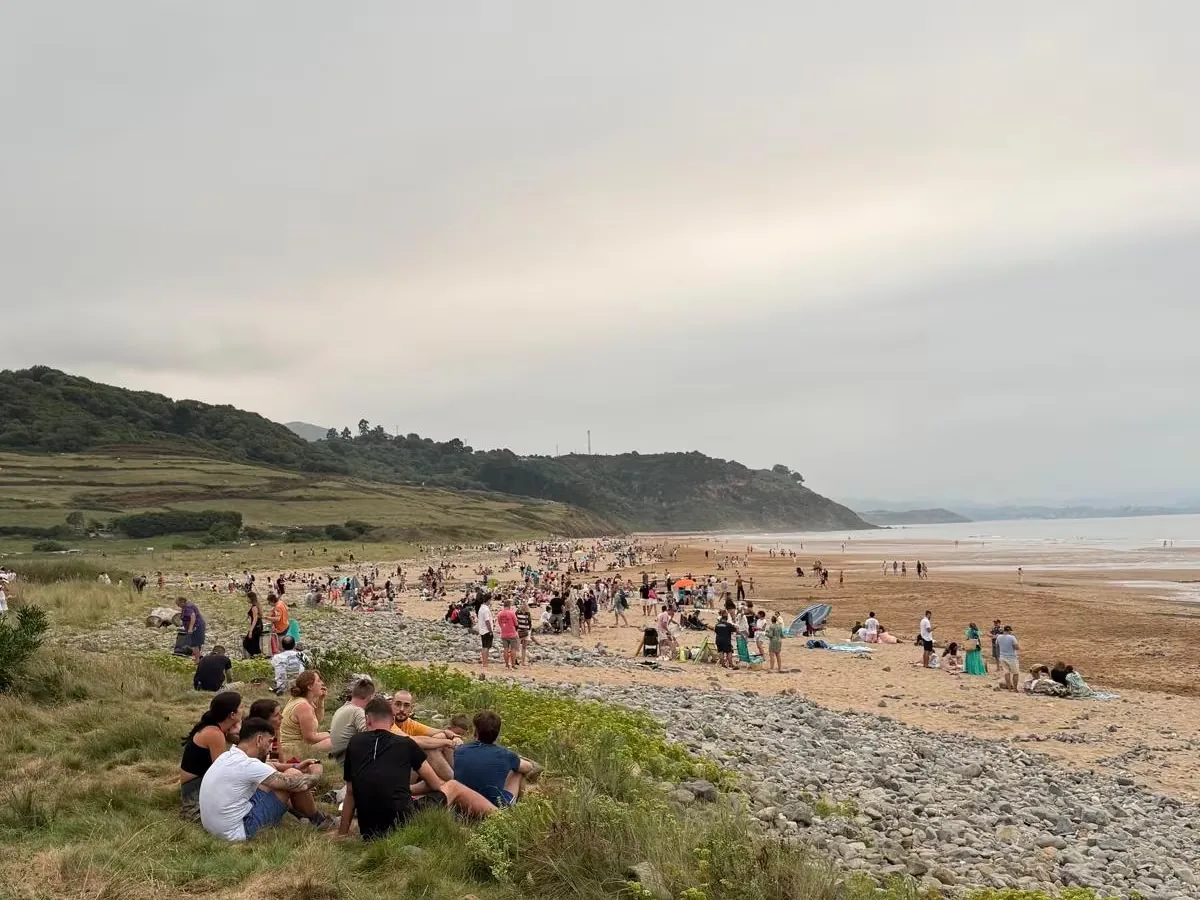
This Wednesday, August 12, for a few seconds and in almost 4,000 municipalities in Spain, it will get dark in the middle of the afternoon. It will be one of the greatest astronomical spectacles there is, but also one of the briefest. We will have a window of barely two seconds (from Derio, Vizcaya) up to a maximum of 110 (for example, from Navia, Asturias) to focus on what happens in the sky. And also on Earth.
Read more The farewell to Laura Cruz: “He killed her because she was happy”
These are some of the phenomena that will occur before, during, and after totality. Noticing them will allow us to appreciate and remember something that, on the Peninsula, has not happened since 1905.
Before totality
Solar eclipses occur when the Moon comes between the Sun and the Earth, and they happen, on average, twice a year worldwide. They are an astronomical coincidence: the Sun is 400 times larger than the Moon and, in turn, is 400 times farther away than the satellite. This makes it so that, from Earth, the Moon can exactly cover the entire solar disk and produce this “shadow” over our planet.
The shadow will travel across the Iberian Peninsula from northwest to southeast. It will also be observed as partial in the northern part of the American continent, much of Europe, and western Africa. The shadow of totality will start from the Arctic Ocean, graze the northeast of Greenland and an edge of Iceland, cross the Atlantic, and enter the Iberian Peninsula, which it will traverse from west to east. For Spain, it will be an evening phenomenon, and the eclipse will arrive already in its final phases.
A Coruña will be the first provincial capital where it will be visible: it will begin at 19:31 and totality will occur at 20:27, lasting one minute and 16 seconds. The last place where it will be visible will be in the Balearic Islands, on the island of Formentera, where totality will be at 20:33 and last 40 seconds; the Sun will set before the last phase of the eclipse ends. The urban centers of Madrid and Barcelona are outside the band. There will be no totality there, only a partial eclipse.
Source: Skyfield and IGN.EL PAÍS
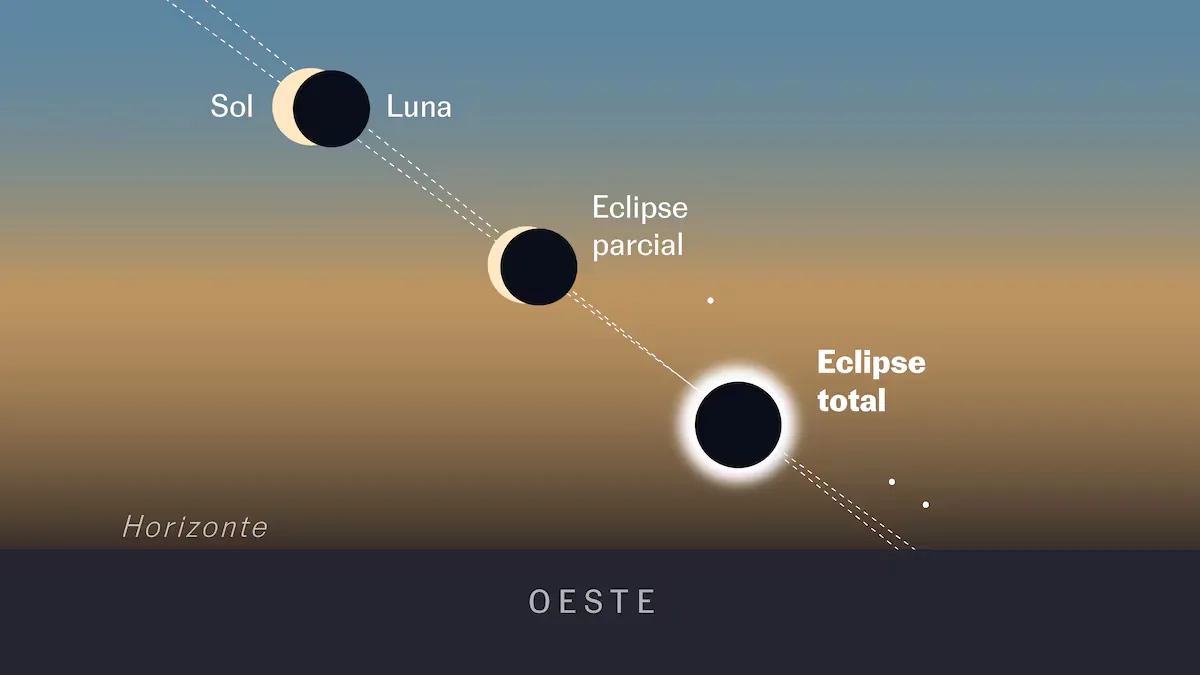
Before and after totality, unique phenomena can be appreciated. One of them is the diamond ring, which occurs when the Moon has almost completely come in front of the solar disk and only that final fragment of direct light remains in a small area, resembling a ring with a large diamond.
A few seconds later, we will see how the ring breaks into small balls of light: these are called Baily’s beads, and they occur because the Moon is not a smooth sphere but has relief, like mountains and craters, and the last rays of the Sun sneak through them. Besides producing a beautiful visual effect, these beads have had important scientific value for studying the Moon’s topography, as explained by the IGN in its guide to viewing the eclipse.
The appearance of the solar corona is one of the most awaited moments of an eclipse of this caliber. The corona is the Sun’s atmosphere, a layer that surrounds the star and is very difficult to see under normal conditions. Interestingly, the solar corona reaches temperatures of millions of degrees Celsius, much higher than the Sun’s surface (about 5,500 degrees). When the corona appears, it will be the only moment during the entire eclipse when we can remove the certified glasses and observe it without protection.
“The Moon is, in a way, the best instrument to observe the solar corona that exists. During totality, it blocks the solar disk with extraordinary precision,” explains astronomer Rafael Bachiller, director of the National Astronomical Observatory and the Royal Observatory of Madrid, to EL PAÍS. “That is why total eclipses remain scientifically very valuable.”
However, the eclipse on August 12 will take place with the Sun very low on the horizon, so the corona might not be as sharp as in other recorded eclipses. “Scattering, turbulence, and atmospheric extinction itself can reduce contrast and definition. From the Scientific Commission for the Eclipse Trio, we have been warning precisely that to observe the August 12 eclipse, a very clear western horizon is needed,” warns Bachiller, so it will be essential to consult recommended sites where visibility is guaranteed.
Totality
During totality of an eclipse, the Moon blocks the Sun’s light and solar radiation, which heats the Earth’s surface, suddenly disappears. In other words, it will darken abruptly. “During totality, not only does the sky above us darken, but the horizon takes on a strange twilight appearance in all directions. It’s as if we were at the center of a gigantic sunset,” details Bachiller.
This sudden darkness generated by the total solar eclipse could change animal behavior, although not all in the same way or intensity. According to Joan Montaner, biologist at the Oceanogràfic of Valencia, “birds are where the most behavioral change can be observed,” as he explains to EL PAÍS. “During an eclipse, they try to find shelter and hide to sleep, and everything becomes silent. After those two minutes, sunlight starts to come back, and suddenly they begin to sing as if it were dawn,” says the biologist, a behavior that “can be observed, for example, with pigeons: they may stop flying or perch, seeking shelter. In the forest, birds may go into the treetops.”
A study during the 2017 eclipse in the United States details that 75% of the species observed during the event changed their behavior toward night-like conduct. “But we should not imagine that all animals will react spectacularly,” warns Rafael Bachiller, as the response “will depend greatly on the species and environment.”
Source: Joan Montaner, Oceanogràfic of Valencia, Scientific Information and News Service.EL PAÍS
Read more Genoa takes a step back in the controversy over Ayuso’s penthouse
An eclipse like the one happening on Wednesday is a great opportunity to continue researching these changes. In fact, several zoos and aquariums across Spain have joined forces to check the effects on animals during this and the other two eclipses that will occur in Spain in 2027 and 2028. “At the Oceanogràfic, we will observe eight different species that we will monitor,” details Montaner.
The August 12 eclipse is a unique occasion to learn more about animal behavior, as such a phenomenon happens very rarely, and in Spain, we will witness three eclipses in three years. “We have never observed anything like it; you can read articles, talk to people who have experienced it, but in the end, we have not lived it,” admits the biologist. “The most expected is disorientation because animals have never experienced an eclipse either. It is a very short period in which everything changes completely,” he adds.
Colder and “eclipse wind”
In the 2024 United States eclipse, temperature drops between 2 and 5 degrees were noticed in the totality band. “The temperature does not drop suddenly as if we flipped a switch,” explains Bachiller, adding that “the change in lighting is almost instantaneous, but the atmospheric response takes some time.” In the United States, the maximum temperature drop or wind gusts were recorded half an hour after totality.
The temperature drop can cause pressure changes that modify air circulations near the ground: this is called the “eclipse wind.” In Spain, “the effect produced by the eclipse will overlap with what normally happens at the end of the day,” assures Bachiller, “so I would not necessarily expect a drop of several degrees as can be observed under certain circumstances during an eclipse that occurs with the Sun very high on the horizon.”
During totality, if for a moment we focus on other bright points around the disk, we will be able to see Jupiter at the lower right of the eclipse and, following the diagonal downward, Mercury. Until then, they were barely visible due to daylight, but the Moon passing in front of the Sun will allow seeing these two planets, if the terrain elevation permits.
When totality ends
If we have removed the glasses to observe the solar corona –remember that only during totality can we remove the glasses without damaging our eyes– it is time to put them back on to see how the Moon undoes the eclipse on the other side. The sequence will play in reverse: the solar corona will disappear, Baily’s beads will be seen, and later, the diamond ring.
Another phenomenon to pay attention to just after totality are shadow bands. These are very faint stripes of light and darkness that move and can be seen on light surfaces. “Under certain conditions, they can be observed on light surfaces just before and after totality,” explains Bachiller.
What shadow bands look like
Sorry, your browser does not support the video tag.
Shadow bands during the total eclipse in Dallas, United States, in 2024. Source: Youtube (@gabrielbn).
Their origin is related to small fluctuations produced by the atmosphere in the light coming from the Sun, as detailed by NASA. Shadow bands are caused by the same effect that makes stars twinkle when we see them from Earth.
Rarely do so many astronomical coincidences align. Precisely on the night of August 12 to 13, when the eclipse ends, will be the peak time of the Perseids, a “meteor shower” also known as the Tears of Saint Lawrence. This 2026, the best time will be between 4 and 6 in the morning, “although activity is considered intense between 11:00 p.m. on the 12th and 11:00 a.m. on the 13th,” according to the IGN.
The Perseids are particles that collide with our atmosphere. Specifically, they are like grains of sand released by comet 109P/Swift-Tuttle over the years and found in its orbit. Every year, in early August, our planet crosses the orbit of this comet, and these particles enter the Earth’s atmosphere at high speed. Friction heats and vaporizes them.
Besides the August 12 eclipse, Spain will have two more in the next two years, something very unusual. In the total eclipse of August 2, 2027, totality will cover Ceuta and Melilla, almost all of the provinces of Cádiz and Málaga, and the south of the provinces of Granada and Almería. On January 26, 2028, another eclipse, this time annular –the Moon does not completely cover the solar disk– will be seen from several autonomous communities in the southeastern peninsula. This will complete the Iberian eclipse trio of 2026-2028. It will not be possible to observe another total solar eclipse from Spain until 2053.
After that historic trio, Spain will have to wait until 2053 to experience another total solar eclipse. In certain years, there may be up to five, as last happened in 1935 and will not happen again until 2206. “I will watch it from the Yebes Observatory, in Guadalajara,” confesses Rafael Bachiller. “When the time comes, I will try to do something very simple: set aside the scientific part for a few moments, forget about the phone and all screens and instruments, and enjoy the show,” admits the astronomer. “It will be a true privilege to be able to look up and finally contemplate those minutes of totality.”