









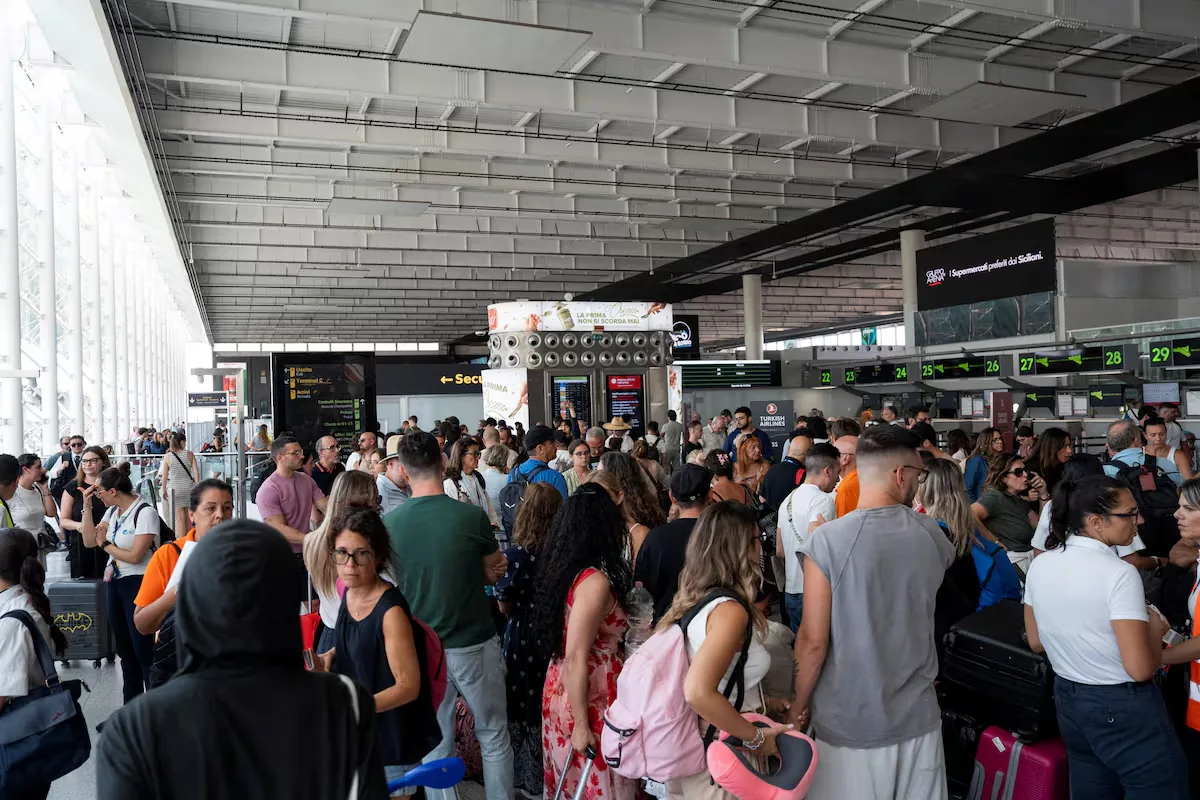
The recent eruption of Etna has disrupted air connections in Sicily at one of the busiest tourist times of the year. The persistent ash cloud emanating from the volcano has been causing closures, cancellations, and diversions at Catania airport, the main one in the east of the island, for more than five days, and this Wednesday it also forced the suspension of operations in Comiso, further complicating the situation.
Catania-Fontanarossa airport woke up this Wednesday practically paralyzed again. Authorities had initially planned to resume operations at 11:00 a.m., but the evolution of the eruptive activity and the wind direction forced the suspension to be extended.
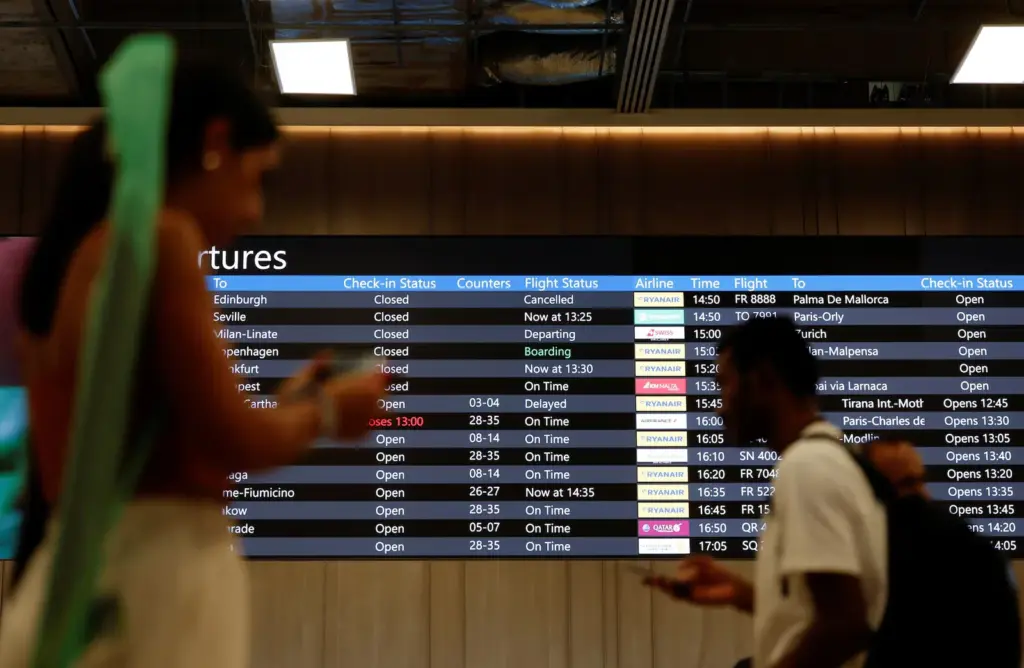
In the terminals, especially busy during the high season, these days images of departure and arrival boards dotted with canceled, delayed, or diverted flights, long queues at airline counters, and groups of passengers waiting for hours with their suitcases or even sleeping on the floor are repeated.
Uncertainty about when they will be able to take off is added to that of those who have been diverted to other parts of the island and must find an alternative to reach their destination. The chaos continues outside the airports: buses connecting the main cities of the island travel full, taxis and rental cars are scarce, and finding an alternative to cover the hundreds of kilometers separating the airports has become an odyssey. Some travelers have even reported taxi fares of up to 800 euros to travel from one end to the other of Sicily after their flights were diverted.
Moreover, land communications are not particularly smooth at this time either. One of the main highways on the island, connecting Catania and Palermo, is under construction in several sections, with detours, narrowings, and restrictions that lengthen travel times, further complicating passenger transfers.
According to initial estimates, 190 flights have been diverted to Palermo airport alone since the eruptive activity of the muntagna, as the people of Catania call the volcano with a mix of fear and respect, resumed. Authorities estimate that about 30,000 passengers have been affected so far.
The situation worsened even more when the ash also reached Comiso airport, in the province of Ragusa, which had been used precisely in recent days as one of the support points to absorb some of the flights affected in Catania. Operations had to be suspended there for a few hours this Wednesday due to volcanic ash contamination.
Palermo and Trapani, in western Sicily, have meanwhile become the main alternatives for airlines, which have diverted numerous flights initially destined for Catania to both airports.
Read more Inmates of Figueres prison access confidential information of the center
The impact on tourism
Interruptions due to volcanic activity are not new to the Sicilian city, which is used to living with the periodic eruptions of Etna, one of the most active and tallest volcanoes in Europe. This time, the eruption coincided with one of the busiest times of the year at Sicilian airports, both arrivals and departures, as this week is traditionally a holiday period for most Italians.
Uncertainty mixes with concern about already organized and paid vacations. “We have to go to London, we have booked the hotel and excursions and we don’t know when we will leave or when we will arrive,” lamented a Sicilian passenger to the microphones of the Italian public television, Rai. For some, the alternatives offered are far from immediate: “They canceled our flight and gave us alternatives for the 20th, in eight days,” explained another affected person.
Hotels, tour operators, and unions have begun to warn about the consequences for the sector. The first estimates collected by the newspaper La Repubblica, citing data from Assoesercenti, an association representing Italian companies and businesses, already place losses for tourism between 12 and 24 million euros. Several sector associations demand joint and permanent coordination between airports, airlines, tour operators, and authorities to manage these recurring situations.
The consequences of the eruption have even crossed Italian borders. The ash cloud traveled about 220 kilometers south and reached Malta, where about twenty flights have also suffered cancellations and delays.
For years there has been debate about the possibility of building a new airport in central Sicily or moving part of the air traffic to other airports, such as Comiso. Although many transport experts consulted by local media insist that the most effective solution would be to improve connections between the different airports on the island, with greater investments in the railway and road network.
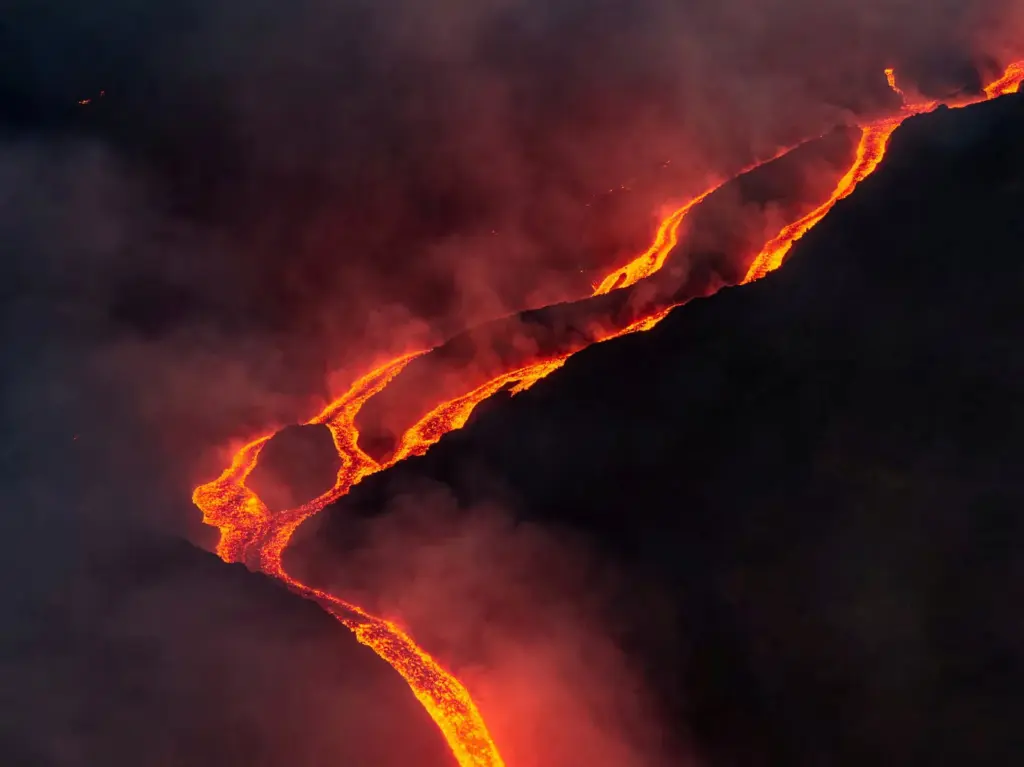
The Italian National Institute of Geophysics and Volcanology (INGV) has detected eruptive activity in several mouths of Etna and different lava flows. The aviation alert reached red level, the highest on the scale, due to the risk that ash represents for aircraft, as it can reduce visibility and, above all, damage engines if inhaled during flight. For now, the eruption does not pose a direct threat to the population of Catania.
Meanwhile, hundreds of curious people are approaching Catania and the slopes of Etna these days to closely observe the spectacle of the eruption, the columns of smoke and ash rising above its summit, and the tongues of glowing lava descending its slopes.
Read more Robles issues a warning to Morocco: “Ceuta and Melilla are untouchable. They are very Spanish”