








Spain needs to speak openly about immigration, and the regularization process that the Government has just launched is a very good opportunity to do so. The best way to disarm populist discourses is not to avoid difficult questions, but to face them with rigor and without complexes. Because there is a question that Spain has gone too long without asking itself with the seriousness it deserves: do we have an immigration policy that is truly aligned with the needs and capacities of the country, while respecting the rights of immigrants? The answer from the Cercle d’Economia, as we have argued in a recent note that addresses the issue from a broad perspective —productive model, social cohesion, welfare state—, is no.
Read more The day Paul Weller switched sides
It is advisable to start from the facts. Spain is, by far, the country in the European Union that has attracted the most immigration in recent years. Between 2000 and 2025, the proportion of the population born abroad has gone from 4% to 20%, a pace unparalleled in our environment. In Catalonia, one in four inhabitants was born outside Spain. The phenomenon is of a magnitude that demands rigorous reflection. And rigor means, above all, opening a fundamental debate that we have never had: about the relationship between immigration and the productive model, about our real capacities for reception and integration, and about what kind of country we want to be by 2050.
This is the central point of our note, and it deserves an explanation. Over the last 25 years, Spanish economic growth has been based on an extensive model: more population, more employment, but low productivity and stagnant wages. Immigration has been both a consequence and a driver of this model. It has supported GDP growth and job creation —between 2022 and 2024, almost half of the new jobs were filled by immigrants—, but the benefits in terms of per capita income have been very limited. Spain has lost relative positions in the European context and, more worryingly, this model can hardly guarantee the future sustainability of the welfare state.
This pattern poses a dilemma that we cannot continue to avoid. If, as is undoubtedly desirable, we want to bet on a model of higher productivity and therefore higher wages —more intensive in technology, innovation, and qualified human capital—, immigration policy must be aligned with that objective. This does not mean less immigration in absolute terms, but more orderly, more qualified immigration at a speed compatible with our capacity for reception and integration.
Added to this are tensions that are already evident. The housing market, with supply growing far below demand, has become a factor of exclusion that initially affected mainly low-income families, but has escalated to hit a broad layer of the middle class. Public services —healthcare, education, social services— operate under increasing pressure. It is not that the immigrant population makes disproportionate use of these services —evidence actually shows the opposite—, but that the increase in population and demand is not being matched by an equivalent increase in supply. Infrastructure and services in Catalonia, for example, are not sized for the more than eight million we have reached in this first quarter of the century. And those who suffer this pressure the most are people and families with fewer resources, who compete directly with newcomers for the same scarce goods. It is precisely there that populist discourses take root more easily.
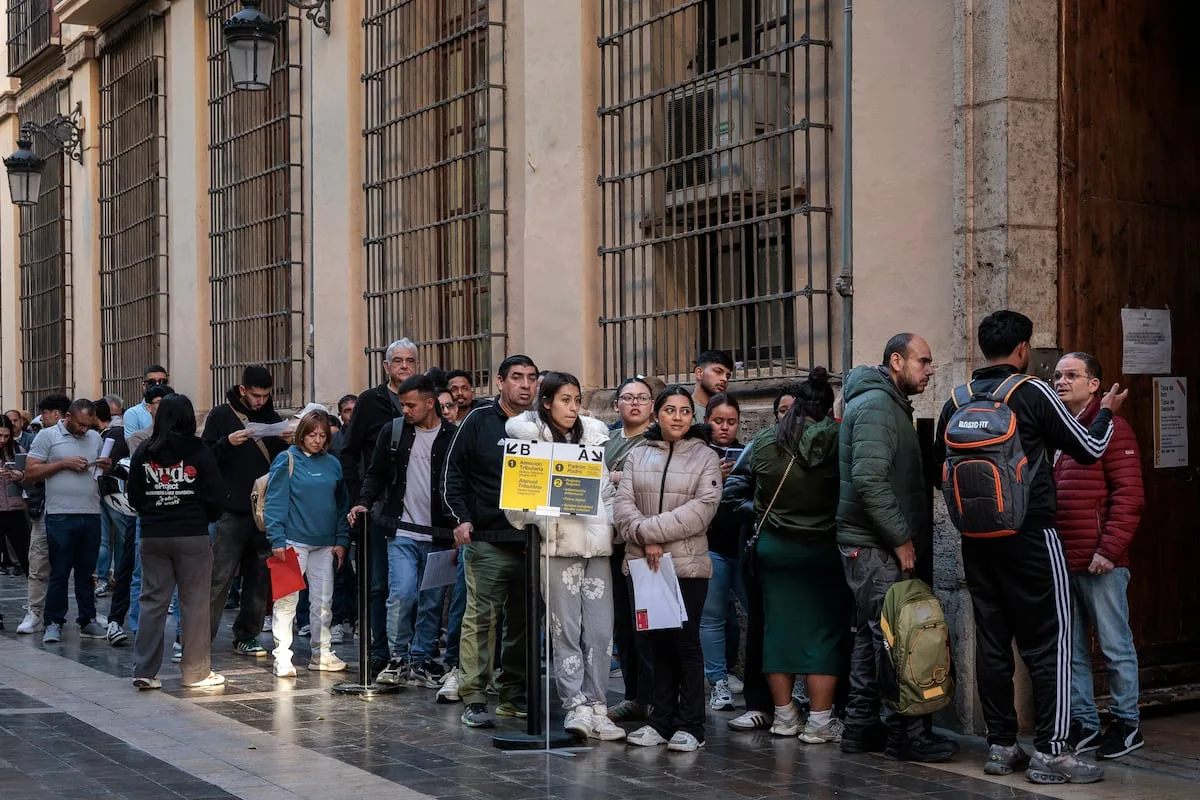
In this context, the large-scale regularization launched by the Government is necessary, and in many respects inevitable. It makes no sense to keep hundreds of thousands of people who already live and work here in irregularity. Regularization offers them a future perspective and the possibility of building a stable life project, and it can also generate tangible fiscal and social benefits by bringing employment, contributions, and tax payments to light. But it would be a serious mistake to present it as a solution. It is, rather, the confirmation of a failure: the failure of a system that facilitates entry, generates irregularity due to lack of monitoring mechanisms, and ends up offering an expectation of regularization a posteriori —through the figure of arraigo—, but only after condemning immigrants to a minimum of two years of precariousness and administrative invisibility. It is a system that does not work for anyone.
Read more The sustainable cowboy is made in Spain
Resetting the counter without changing anything else would be repeating the same mistake. What Spain needs is to articulate, once and for all, a true immigration policy. A policy that modulates entry flows to make them compatible with the real capacities of the country. That critically reviews the arraigo mechanism so that it stops functioning as a massive ex post regularization channel. That adjusts family reunification criteria so that they fulfill their humanitarian function without becoming indirect entry channels. That strengthens control over irregular hiring. And that, simultaneously, decisively bets on attracting qualified talent, reducing the administrative barriers that currently hinder it.
But an immigration policy is not exhausted in managing flows. The integration of those already here is equally decisive. Guaranteeing access to legal work, speeding up the recognition of qualifications, investing in public schools as a driver of integration for second generations, providing municipalities with the resources they need to manage reception: all of this is an inseparable part of a responsible immigration policy.
None of this is right-wing or left-wing. It is a matter of country. And that is why it should be treated as a true state policy, seeking the greatest possible consensus. This directly challenges the two major parties, which have the responsibility to engage in this debate with courage and a vision for the future, instead of using it as a weapon or, worse, looking the other way.
As Max Frisch recalled referring to the immigrants who arrived in Switzerland in the sixties and seventies, “we wanted workers and people came.” People with rights, dignity, and legitimate expectations. Governing immigration responsibly is not incompatible with defending those rights; it is their necessary condition. We cannot afford to continue without a policy worthy of that name.
Read more Flea takes off the mask