









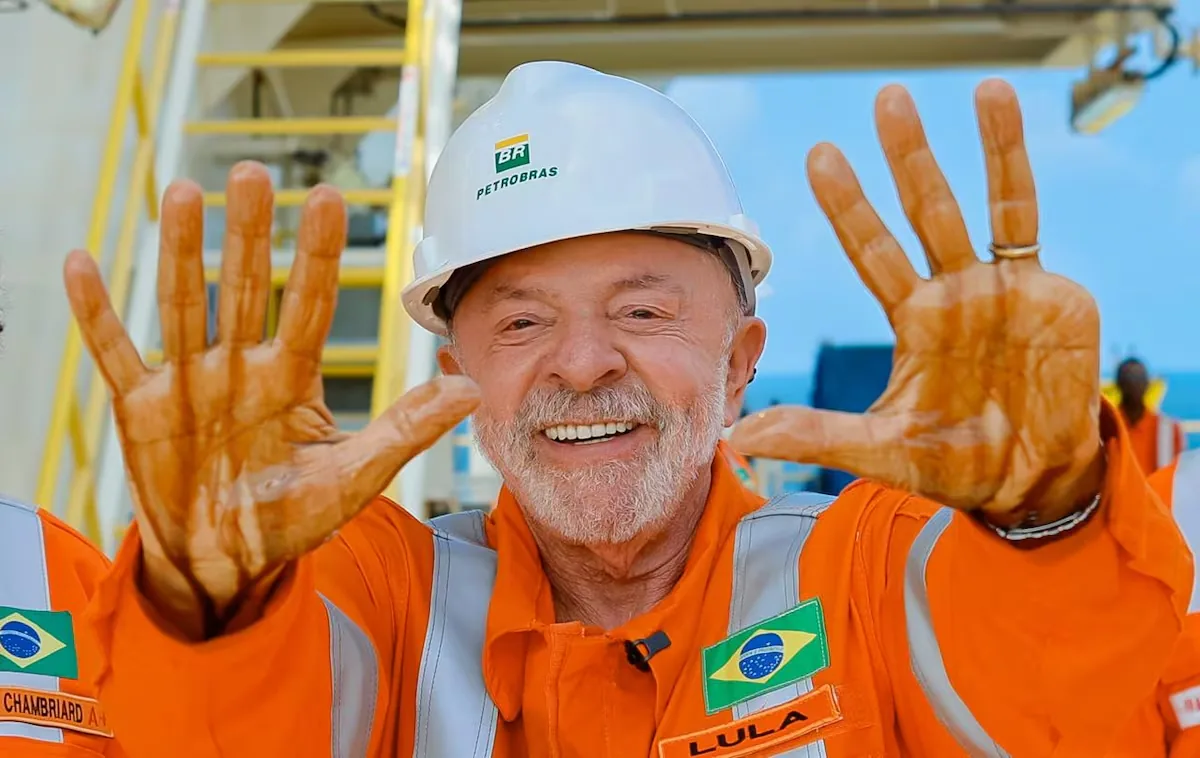
Brazil has just discovered oil off the coast of the Amazon, on the equator line, and the president wanted to celebrate it with a trip to the site of the promising find. Luiz Inácio Lula da Silva flew this Monday to a point 175 kilometers offshore, in the north of the country, at the mouth of the Amazon River, where the Petrobras state oil company’s drilling ship operates, tasked with the delicate and controversial mission. “This means national sovereignty,” Lula proclaimed, reports the digital outlet G1. Officially embarked on the campaign for the general elections in October, Lula sent a message: “A country that has oil of this quality will not allow anyone to touch it.”
Brazil is already a major crude producer. Petrobras technicians continue their work offshore to verify the amount of oil or gas hidden on the seabed, its quality, and to what extent commercial exploitation would be viable.
The project is highly controversial, given that Brazil is an oil power but also an environmental power. Aware of the concerns that the potential extraction of oil off the largest tropical rainforest in the world raises for environmentalists, the president of Brazil added: “I am not denying my fight for us to stop needing fossil fuels.” His thesis is that oil money should help pay the bill for the environmental transition.
The presidential trip comes just three days after Petrobras announced on Friday the discovery in a very little-studied mangrove area 350 kilometers from the Amazon basin, the world’s largest river by volume. “There is oil, but we don’t know how much. We are really optimistic,” explained the company’s president, Magda Chambriard, alongside the president.
Read more La Moncloa and Ceuta agree on spaces to steer the humanitarian crisis amid great political tension
Lula dreams of repeating the 2006 oil discovery, when in his first term Petrobras discovered the pre-salt, a gigantic reservoir beneath thick layers of salt off the coast of São Paulo. That accounts for 80% of the current supply. Brazil is currently the seventh largest producer in the world and aspires to become the fifth. Encouraged by the offshore wells that have put Guyana on the oil map and revolutionized its economy, Brazil wants to take advantage of this new race for black gold. With crude extraction and with the transfer of technology to neighboring countries to extract it from the seabed.
The official environmental agency only authorized exploratory operations in the so-called block last year, after a decade of reports and technical doubts. Paradoxically, the final green light was granted on the eve of COP30, the UN climate summit that Brazil hosted in the Amazonian city of Belém.
Environmentalists’ criticisms go in two directions. Some argue that if the goal is to give up fossil fuels, now is not the time to look for new wells but to exploit existing ones more efficiently. Others point out that if the crude extraction project goes ahead and an accident occurs, the Amazon coast and, specifically, its mangroves would be in grave danger. That risk is the main reason that Brazilian Institute of Environment technicians have cited for years.
Read more Mallorca 1820: X-ray of the last great plague epidemic in Europe