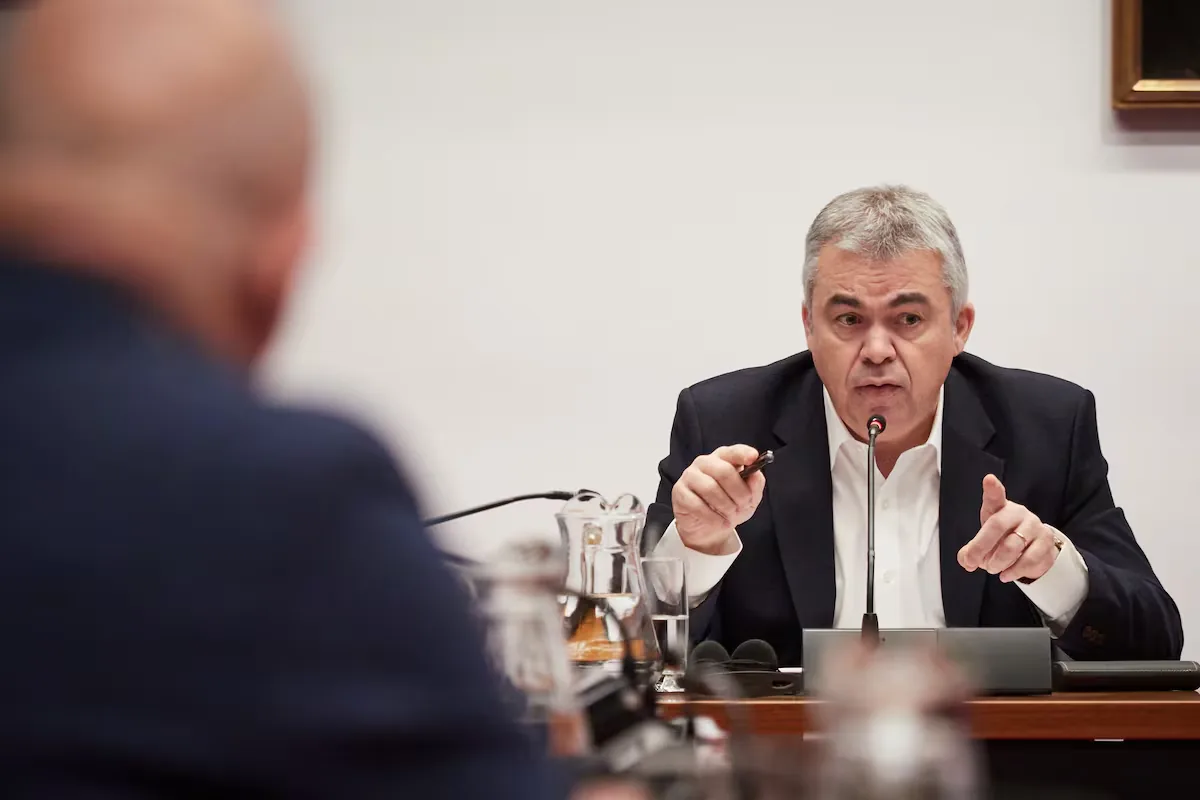
Agents of the Central Operative Unit (UCO) of the Civil Guard proceeded this Tuesday at the National Court in the presence of Judge Santiago Pedraz, instructor of the so-called Leire case, to carry out a second cloning ―commonly known as dumping― of the content of Juan Manuel Serrano’s iPhone, former president of Correos and former Chief of Staff of Pedro Sánchez when he was in opposition, charged in the case. Serrano, whom the investigation implicates in the alleged “schemes” devised for rigging public contracts and to “destabilize” judicial proceedings “that affected” his party and the Government, had questioned the first dump, as neither he nor his lawyer were present during it, and filed an appeal requesting that the seizure of the device itself be invalidated, considering it was done without the judge’s authorization since on May 27, when it was seized, he was not yet under investigation.
Read more A new 4.8 magnitude earthquake shakes Granada and leaves three people with minor injuries
With Tuesday’s dump, Pedraz tries to clear any doubt about the legal validity of both the mobile phone intervention and the material found inside it, which is why in the document summoning the former executive of the public company he emphasized that it will be done in his presence “for the purpose of its incorporation” into the Leire Díez case file in order to “ensure the authenticity and integrity of the data and the guarantees of its preservation.”
Specifically, the agents are proceeding this Tuesday, already in the presence of both the magistrate and Serrano himself and his lawyer, to make a new exact and faithful copy of the device’s content so that investigators can work with it in search of evidence of the crime under investigation. Although the judge can limit what is searched to very specific files or folders ―known as “selective copying”―, it is usual to perform what in police jargon is called “bit-by-bit cloning,” that is, of the entire device memory, including the part that may be empty. This apparently information-free part is dumped in search of traces of documents that may have been deleted.
For this, the agents have used cloning devices, which have a sophisticated forensic computer tool ―the most used is one developed by the Israeli company Cellebrite– that allows exact copies of computer equipment to be transferred to external hard drives accompanied by a unique alphanumeric code known as hash that guarantees that its content cannot be tampered with. This software also allows what is known as “rooting” ―Pedraz expressly mentions this figure in the order authorizing the May searches― to access all the information on the device, including that stored in applications such as, for example, Google Maps for geolocation or instant messaging apps like WhatsApp. According to police sources, it involves entering “through the back door” of the mobile phone’s system folder to make much more information visible than a conventional user has.
Read more At least 10 dead in a Russian missile attack in the Ukrainian Kharkiv region
That day, the UCO went to the federal headquarters of the socialists on Ferraz Street and searched the homes, among others, of the former PSOE Organization Secretary, Santos Cerdán, and the former Presidency Counselor of the Andalusian Government, Gaspar Zarrías. At that time, Pedraz was cautious and did not charge Serrano despite a judicial resolution already pointing to the existence of “indications” that he “collaborated with the investigated in the execution of specific and isolated acts in aid of their illicit plan”; but he did authorize the intervention of his phone. This could not be cloned on the spot and was sealed for transfer to judicial premises, where later this technical procedure was carried out to obtain a faithful copy of all its content that cannot be manipulated and from which the agents perform the analysis.
Finally, last July, Pedraz charged Serrano after receiving a UCO report indicating that he had “a prominent participation” in the alleged scheme and, specifically, in Díez’s arrival at the end of 2021 at Correos, the public company he presided over, which “would have allowed the members” of the network “to position themselves in relevant posts in the public administration,” “being exploited for their own benefit or that of third parties.” The investigations also implicate him in maneuvers to sabotage judicial cases involving the PSOE and the Government. The agents place him at several suspicious meetings and state that, for example, Díez kept him informed of her meetings with retired commissioner José Manuel Villarejo, whom they referred to as “the one with the beret.” “The one with the beret has given some very good papers for the boss,” the then still member told him.