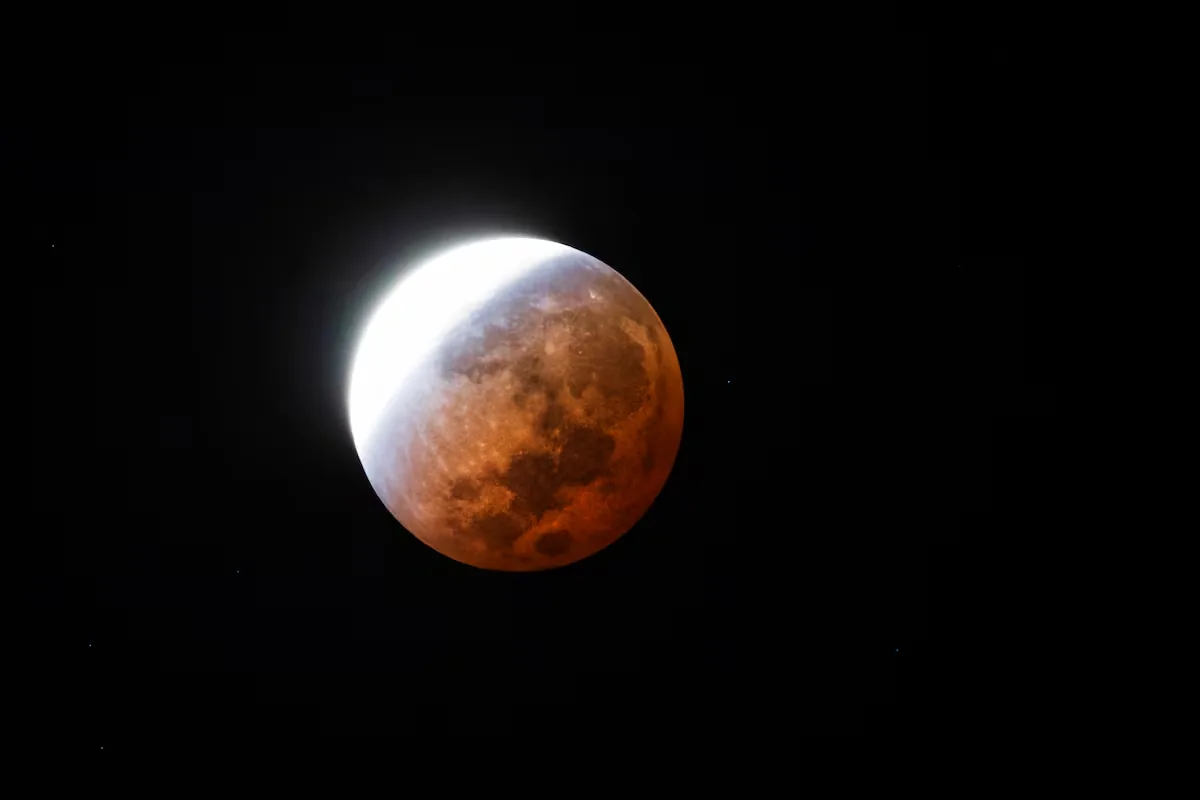
The vastness of the sky wants to keep surprising us. Just a few days ago, Spain witnessed one of the most breathtaking spectacles in the firmament: a total solar eclipse, which dazzled both locals and strangers. Two weeks later, another satellite will take over. On August 28, the country will witness a partial lunar eclipse. The astronomical event is scheduled for the early hours of that Friday.
It will be visible from Europe, Africa, western Asia, and America, although in different phases. The partial eclipse, for example, can be seen from all over Spain, but not in the same way. In the center and east of the Peninsula, the Balearic Islands, and Melilla, the Moon will set before the partial phase ends. While in the western peninsula, the Canary Islands, and Ceuta, the lunar sunset will occur after it has finished. This has been reported by the National Geographic Institute (IGN).
It will begin at 3:23 (Spanish peninsular time), when the Moon starts to pass through the Earth’s penumbra. The partial phase will start around 4:34 and reach its maximum at 6:12.
The proximity between the two eclipses has a lot to do with mathematics. Astrophysicist Javier Armentia explains that it is due to the geometry of the orbits. “On August 12, the Moon passed right in front of the Sun,” points out the science communicator. At that moment, it was a new moon, and 15 days later, on the 28th, it will be a full moon. “The Moon’s orbit around the Earth, which completes a turn every 29 and a half days, and the Sun’s orbit, which takes 365 and a quarter days, are tilted five degrees. This means that not every full moon does the Moon enter the Earth’s shadow because sometimes it is above or below,” comments Armentia, who has been director of the Pamplona Planetarium from its inauguration in 1993 until 2024.
Not all full moons cause the natural satellite to enter the Earth’s shadow. In August, however, the alignment occurs. “On the 12th, the Moon was at the node, the point where the two orbits meet,” notes the astrophysicist. Now, being again near the plane of the ecliptic during the full moon, the Earth’s shadow will reach the satellite.
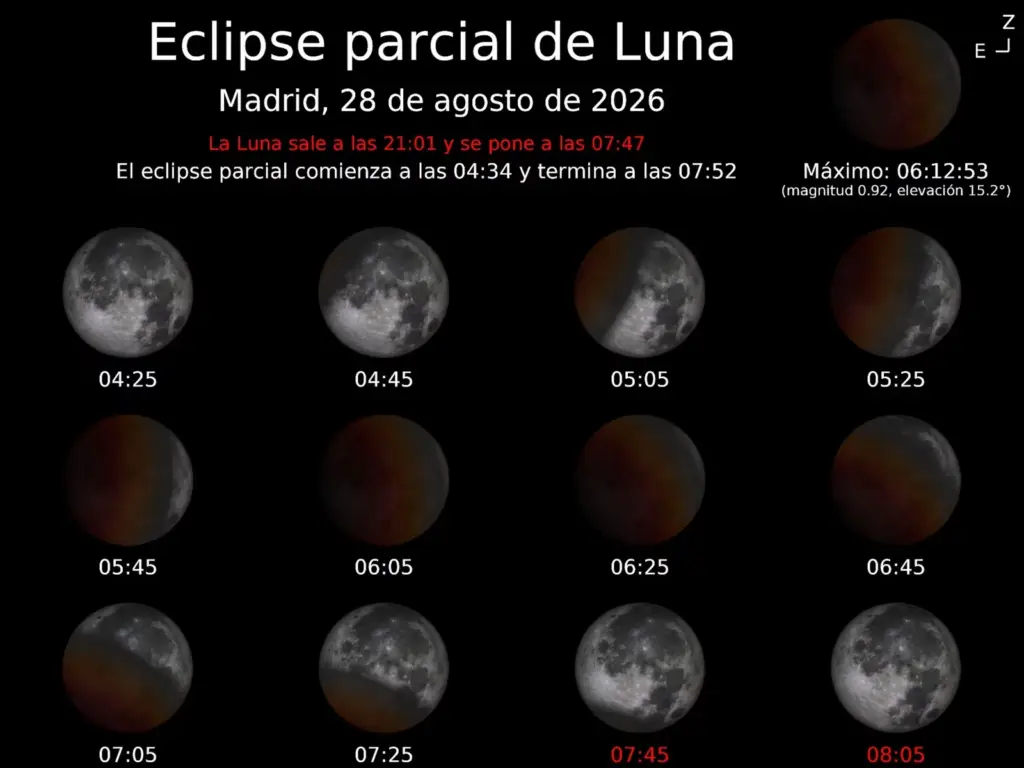
The magnitude of the eclipse will be 0.93. This is a measure that indicates how much of the lunar radius remains inside the Earth’s shadow. In this case, such a magnitude means that approximately 96% of the lunar disk will be in shadow. A percentage that will be reached during the maximum of the eclipse, scheduled for 6:12. “When 96% of the lunar surface is darkened,” explains Armentia. From that moment, the shadow will begin to withdraw until dawn.
The appearance of the celestial body will be different from its usual phases. “It looks like it is being cut by a larger circle because it is the Earth’s shadow,” describes Armentia. During that early morning, the Earth’s only natural satellite will be illuminated by our planet, with sunlight passing through the atmosphere. “It is light that we send from here, the one we see in the evening sky will reach the moon,” describes the astrophysicist.
“It will have that reddish tone, just like sunsets are reddish. In fact, we usually say that the color of the lunar eclipse is the color of all the Earth’s sunsets projected onto it,” says the science communicator.
Read more A new 4.8 magnitude earthquake shakes Granada and leaves three people with minor injuries
No totality band nor special glasses
Logically, it will be very different from what was experienced on August 12. There will be no need to look for a solar corona in the totality band nor use special glasses. A lunar eclipse can be observed directly and without risk to the eyes, like looking at the Moon on any night. The Earth will come between the Sun and the Moon, and part of the surface of our satellite will enter the Earth’s shadow.
“Since the Moon’s shadow is very small on the Earth’s surface, only in that band that ran from Galicia to the Balearic Islands did we see the total solar eclipse,” explains Armentia in comparison with the phenomenon of last August 12. This time, he adds, the lunar eclipse will be easier to observe and “it is possible to photograph it without special equipment.”
However, the moment of dawn and the position of the celestial body will make some areas of Spain enjoy more phases than others. “More or less from Asturias to Málaga, the Moon will set below the horizon before the eclipse ends,” details the science communicator. The luckiest will be in the western peninsula: “In the westernmost part, in the provinces of Huelva, Seville, or Cádiz, in Extremadura, Salamanca, Zamora, Galicia, and part of León.”
While in places like Pamplona or Madrid, the end will not be seen. By that time, the Moon will have already set below the horizon and, on the other side, the Sun will have risen. “In these places, the Moon will be eclipsed, it will become brighter, but it will be missing a piece,” explains Armentia.
“Solar eclipses are certainly more striking. The lunar one happens at night, and there are no such striking changes for us here on Earth. But it is a beautiful spectacle to see,” says Armentia.
It will be a new opportunity to keep being amazed. If the solar event was enjoyed, says the expert, the lunar one “is like completing the collection of eclipses we have this summer.” “It can be a somewhat more intellectual than physical delight. It is worth seeing,” he points out.
Read more At least 10 dead in a Russian missile attack in the Ukrainian Kharkiv region