







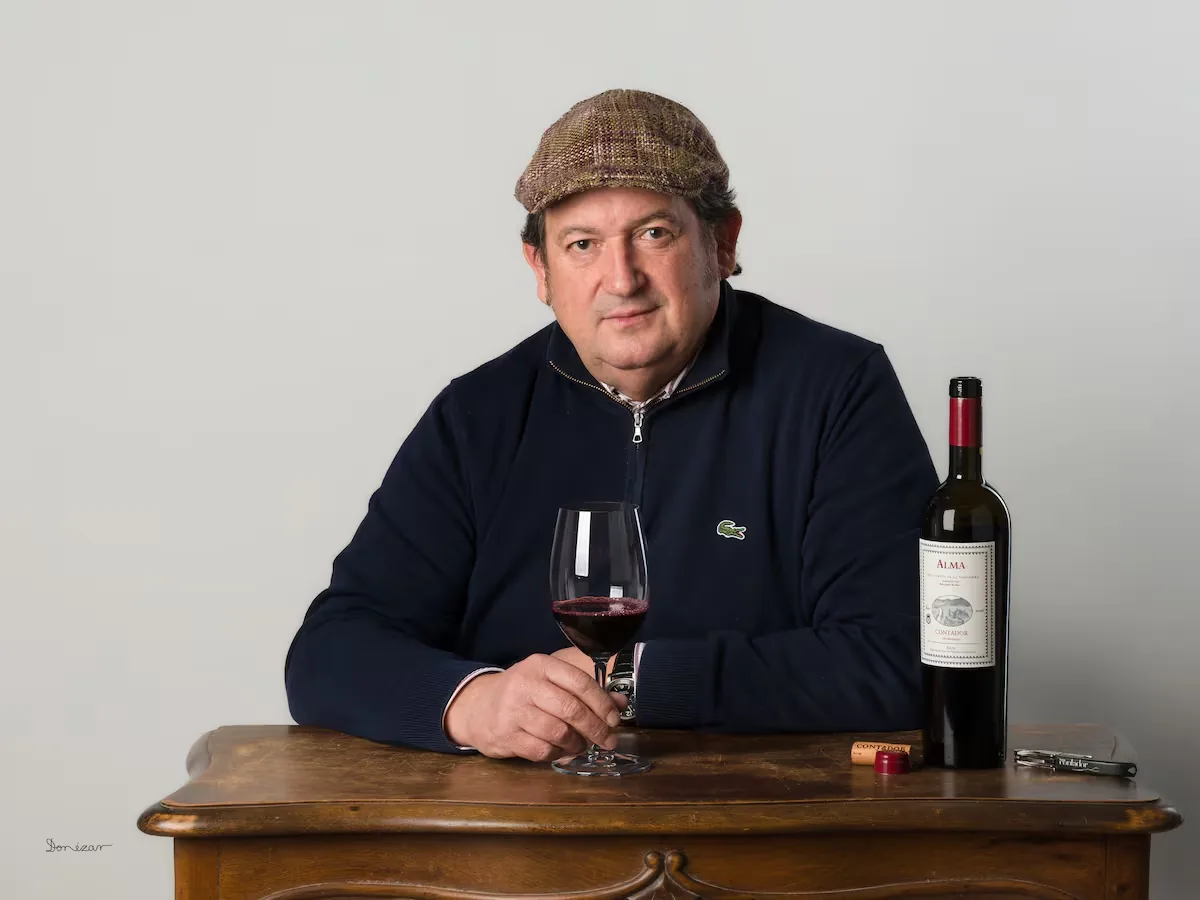
His distinctive figure, always topped with a cap, will no longer be seen in San Vicente de la Sonsierra (La Rioja), the town he helped make internationally known in the 2000s through its wines. Benjamín Romeo has died in Bilbao at the age of 61 due to cancer.
Read more The narwhal tusk, a «mythological horn» that was thousands of years ahead of materials engineering
The winemaker was one of the pioneers of the revolution that changed Rioja from the 1990s onwards. In the heat of a particularly feverish moment, several wineries began to bring new life to the denomination. Artadi, where Romeo himself served as technical director until 2000, Roda, Muga, and the Eguren family turned their attention to the territory, something still novel at that time.
The towns, the landscapes, the soils, and the plots acquired a value that had not been sufficiently recognized until then. Romeo took that idea to San Vicente de la Sonsierra and applied it to a mosaic of small vineyards that he got to know, bought, and worked on over the years. The municipality, with around 2,000 hectares of vineyard, offered a huge range of plots, orientations, altitudes, and soils. Along with other producers in the area, he helped make San Vicente one of the reference names of the new Rioja and attracted the attention of international critics such as Robert Parker, Jancis Robinson, and Tim Atkin.
Born there, in Rioja Alta, in 1964, Romeo belonged to the fourth generation of a family linked to the vineyard. He studied Enology in Madrid and in the mid-1980s joined Artadi under the guidance of Juan Carlos López de Lacalle. The winery would become one of the great standard-bearers of contemporary Rioja. Romeo served as technical director and remained at the house until 2000, participating in one of its most restless periods.
His own project had begun while he was still working at Artadi. In 1995 he bought a century-old cave under the castle of San Vicente de la Sonsierra and a year later launched the first vintage of La Cueva del Contador. The place belonged to the old winery district of the town, in an area where wine was previously stored, counted, and sold. From there he took the name that would accompany his entire career. In 1999 came the first vintage of Contador and, after leaving Artadi in 2000, Romeo dedicated himself fully to his project. Seeing the good reception of those first wines, in 2001 he adapted his parents’ house garage for winemaking. A very American-style garage wine. Those who knew him then remember a character hard to forget. With a sturdy appearance, direct in manner, and not fond of formalities, he had even done military service in the paratroopers. At the same time, he was a curious, creative, and especially sensitive man. He was interested in music, cinema, and art. Predicador, one of his best-known wines, was born as a tribute to The Pale Rider, the film directed and starred by Clint Eastwood in 1985. The hat that appears on its label is a nod to the film. He was also a great fan of magic, had magician friends, and even organized meetings with them at the winery itself.
That mix of tradition and modernity was wonderfully reflected in his wines. His first Contador wines were aromatic, floral, and elegant, with a personality difficult to fit into either classic Rioja or much of the modern wines of those years. “He was one of the pioneers of the revolution of looking back at the vineyard, looking back at the towns, making a wine with roots,” explains Luis Gutiérrez, head of Spain, Portugal, and Jura for The Wine Advocate.
Read more Mathilde Favier, the woman with the best agenda in Paris, dies in a traffic accident
The international breakthrough came with Contador 2004 and 2005, which consecutively received 100 points from The Wine Advocate, the publication founded by Robert Parker. That recognition made Romeo one of the best-known names in the new Spanish wine. By then, the small project that had started in a cave and continued in the family garage had already taken on another dimension.
However, the focus of his work remained in the vineyard. Romeo gathered about 75 hectares spread over around 55 plots, most of them bush-trained. He worked with organic fertilizers, incorporated prunings into the soil, and gave fundamental importance to grape selection both in the field and in the winery. Part of those vineyards came from his own family. La Liende, formerly known as La Viña de Andrés Romeo, was born from a tempranillo plot planted by his father in 1985.
Romeo also did not reject Rioja tradition. He made wines from family vineyards and even recovered the gran reserva category with a wine dedicated to his mother. Over the years, he expanded a range in which Contador, La Cueva del Contador, Predicador, Qué Bonito Cacareaba, the single-vineyard wines, and Alma de Contador coexisted, the latter marketed internationally through La Place de Bordeaux.
In 2008 he finally inaugurated his winery at the foot of San Vicente. Designed by Catalan architect Héctor Herrera, the building reproduces the slope of the terrain through three terraces covered with vegetation. Surrounded by vineyards, it had the capacity to produce about 150,000 bottles and represented an investment of four million euros. Romeo conceived it from the beginning with a close relationship to art. A concern that continued in Viña detrás de Santiago, a garden created next to the winery where he planted the seven varieties he worked with: malvasía, garnacha blanca, and viura among the whites; tempranillo, garnacha, graciano, and mazuelo among the reds. Romeo defined it as a “didactic whim” and as an extension of the winery itself. The space also hosted interventions by Maite Centol and Pablo Maojo, along with 22 wrought iron pieces by Rafael Herreruelas.
The Riojan remained faithful until the end to that way of understanding wine. To his vineyards, to San Vicente, and to the idea of making bottles capable of aging for years, regardless of fashions and changes in popular taste. Some of the most recognized Spanish wines of recent decades remain as a memory, as well as a way of looking at Rioja that has spread over time. If today we talk about landscapes and plots, soils and vineyards, it is partly thanks to him. He leaves behind two children, Alma and Andrés, and a wife, Iraide.