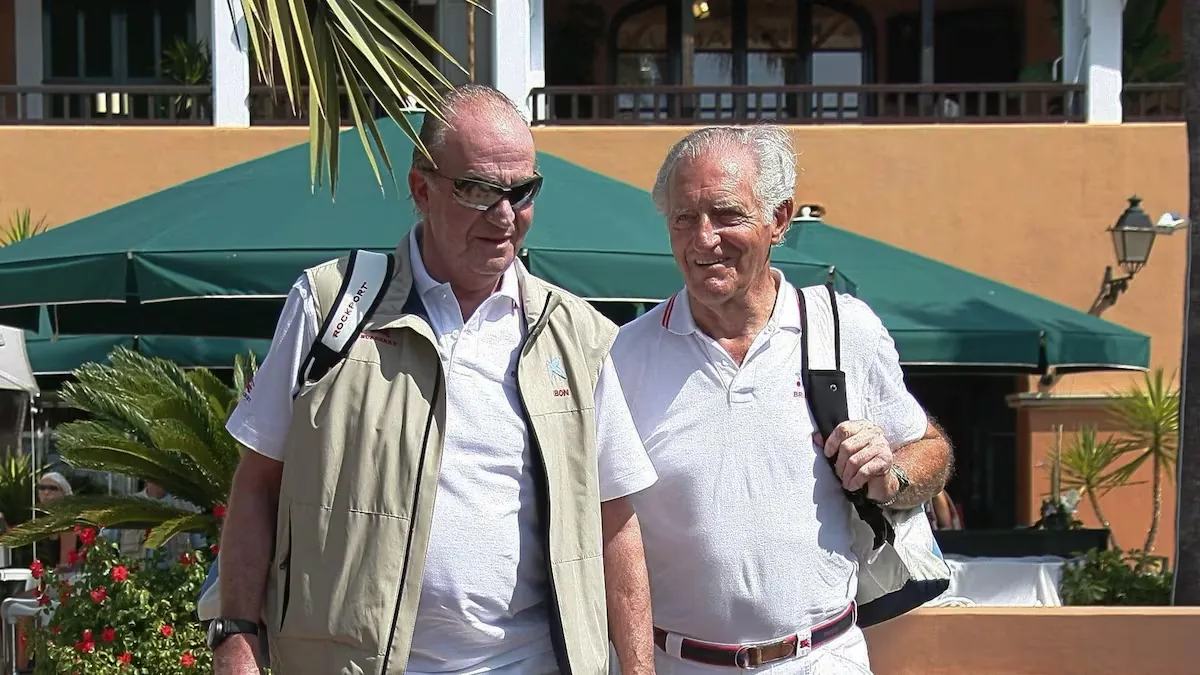
Josep Cusí, the loyal friend of Juan Carlos I, passed away this Wednesday in Barcelona at the age of 92. A discreet businessman, Cusí was the owner of the bribones, the racing boats of the emeritus king, but above all one of his most discreet confidants after meeting him in the early seventies during a hunt organized by the dictator Francisco Franco, of whom he was his shooting instructor and hunting companion.
The businessman had a varied resume. An electronic engineer by training, businessman, and competitive water polo player and swimmer, although he attended the 1968 Mexico Olympic Games to participate in the shooting competition. And he was one of those discreet old-school members who usually make up the Catalan bourgeoisie, a member of the Real Club Náutico de Barcelona or the Círculo del Liceo. He was married to Inés Muiños and had six children.
Although his relationship with Juan Carlos I is well known, Josep Cusí, who has been photographed on multiple occasions alongside the monarch, the newspaper The Telegraph revealed six years ago that Cusí had been in charge of sharing the honeymoon trip of the current kings of Spain, Felipe VI and Letizia, with the emeritus king, which exceeded half a million dollars. As a result of that good relationship, Cusí broke his usual discretion in 2018 to, at an event of the Elena Barraquer Foundation, defend the good relationship that the current queen maintained with her predecessor in office and mother-in-law, Sofía.
Read more The Government tenders the works in the Valencian ravine of La Saleta to prevent floods
Journalist Pilar Urbano, in her book Genio y figura, recounted that the good relationship between the two friends had gone through “some low points when Don Juan Carlos intended to attend some of the meetings accompanied by Corina Sayn-Wittgenstein.” Cusí explained in an article published in La Vanguardia in 2012 that he shared Juan Carlos I’s confession that the decision to go on a hunting safari in Botswana, for which he had to be evacuated after breaking his hip, “was not a wise decision.” He then pointed out that “one must avoid stumbles, on the stairs of a bungalow and in public life,” a point he tried to take to the extreme whenever his temperament allowed him. In any case, in 1983 he said about his relationship with the king: “I do not consider myself his patron, but his servant, at sea and on land, inside and outside the Bribón”