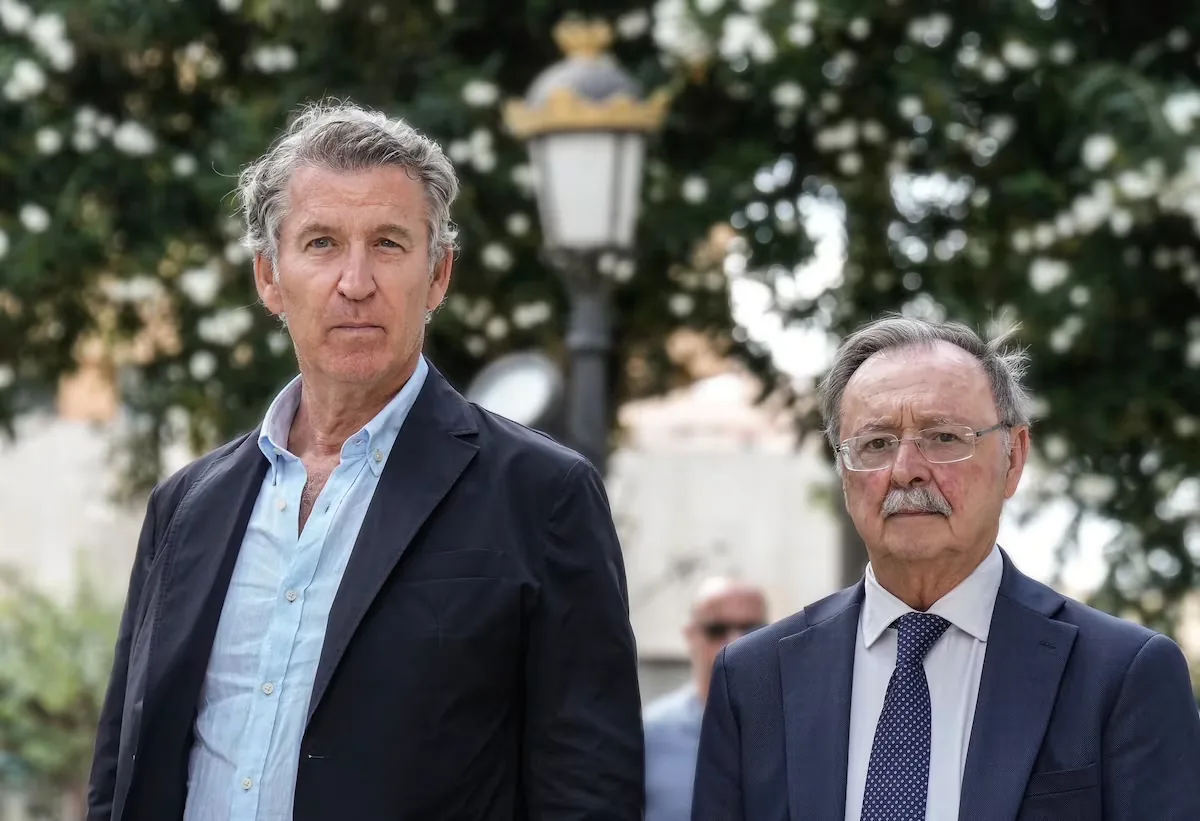
The president of the PP, Alberto Núñez Feijóo, insisted this Wednesday in Ceuta that all the people who crossed the border on July 30 and 31 “must return to their country.” And he did not allow exceptions. “Neither adults nor minors. They all must return,” he stated. The popular leader took advantage of his second visit to the autonomous city since the large arrival of immigrants to criticize the Government of Pedro Sánchez for the change of stance with the more than 7,000 immigrants who refuse to return to Morocco and live in poor conditions on the streets of the autonomous city, including about 2,000 minors. Feijóo’s criticism comes after it was revealed that the Ministry of Youth and Childhood is considering the transfer of 500 girls to the Peninsula to improve their situation and ease guardianship duties, which depend on Ceuta. “Mr. [Interior Minister, Fernando Grande] Marlaska said in the city that everyone had to return to their country of origin, he said everyone, why would I contradict something the Government has said correctly, even if later they do everything the other way around?” he questioned.
Read more A minister on the beach
The PP leader defended the same position held by the city’s president, Juan Jesús Vivas, and aligned it with that of the European Commissioner for Migration. “You cannot use the occupation of a country to then ask that the minors who have entered be allowed to stay in that country,” he stated. “How many minors could stay in Spain? How many millions of minors could stay in Spain? How many from anywhere in the world, even occupying and invading our territory?” he asked.
“The child protection law is not designed for that,” Feijóo insisted, referring to the reception of children in cases of a large irregular entry of citizens from another country. On the contrary, for these situations, the return regulation and European legislation would serve, in his opinion. “There is already experience, both with minors and asylum. Poland, Greece, and other countries are applying the law,” he noted. And then he added: “We have to take care of our minors. Morocco has to take care of its children.”
Regarding the Government’s plans to transfer the girls, Vivas assured that the Secretary of State of the Ministry of Youth and Childhood is currently in Ceuta and has not made any request in that regard. “He has not asked to activate any transfer mechanism to the Peninsula for these people, these girls, and therefore, we have not been able to say no because it has not been proposed to us,” he responded to journalists. The Ceuta president stated that European legislation has eliminated the requirement of the minor’s willingness to return, but it does require Morocco to issue a report on the family or entity that will take charge. “If Morocco is a valid country to jointly organize a World Cup, it must also be a valid country to care for its minors (…) If Morocco truly wants to collaborate, as it says, we hope it collaborates in issuing those reports,” he requested.
Feijóo appeared in the Throne Room of the Ceuta Assembly, accompanied by President Vivas and with three flags behind him: that of Ceuta, Spain, and Europe. “The purpose of my visit is to describe the reality and make proposals,” he announced. In a solemn tone, he insisted on the critical situation of the autonomous city, due to a tragedy that has recorded more than 100 deaths between Morocco and Spain and in which he estimated that more than 10,000 people remain illegally.
A “single command” and an appeal to the Supreme Court
The president of the PP criticized the central Government for saying that normality had been restored and for its lack of action. He also proposed a plan, with seven urgent solutions, which he committed to implementing if he comes to power. The initiatives, which he then detailed one by one, are the need for a single command; voluntary return or expulsion of illegal immigrants; respect and reciprocity with Morocco; the use of all available means; the guarantee of the inviolability of the border; European recognition of Ceuta and Melilla; and an economic reactivation plan with an investment of 650 million.
Additionally, Feijóo announced that his party “has been forced” to go to the Supreme Court to ask this body whether Government ministers can refuse to appear in the Senate ―where the PP has a majority― and not report on what happened in Ceuta, to do so first in the Congress, as is already planned. “The Government cannot decide in which Chamber it appears nor when it does nor under what conditions it accepts to be controlled,” he considered. For the PP leader, a later appearance before Congress “does not exempt it from also doing so in the Senate, which requested it first.” “And that is why we will use all the instruments at our disposal to ensure this constitutional obligation is fulfilled, which is to inform the people of Ceuta and all Spaniards from the territorial chamber,” he pointed out.
The city president supported the leader of his party at an event attended by his nine councilors, the representatives of the Senate and Congress elected by the city, and Juan Bravo, deputy secretary general of Economy of the PP. Vivas also had complaints for the Executive, such as that it did nothing to contain the large influx of immigrants; that it said normality had been reached ―”there is none,” he emphasized, 20 days later―; or that at this point no legal initiative has been processed to carry out the returns of migrants who have “disrupted the good coexistence of the city and are taking it to a limit situation.” “Ceuta must be taken out of the ICU,” he requested.
Read more Rafa Jódar cannot beat Cobolli and says goodbye to the Cincinnati Masters in the round of 16