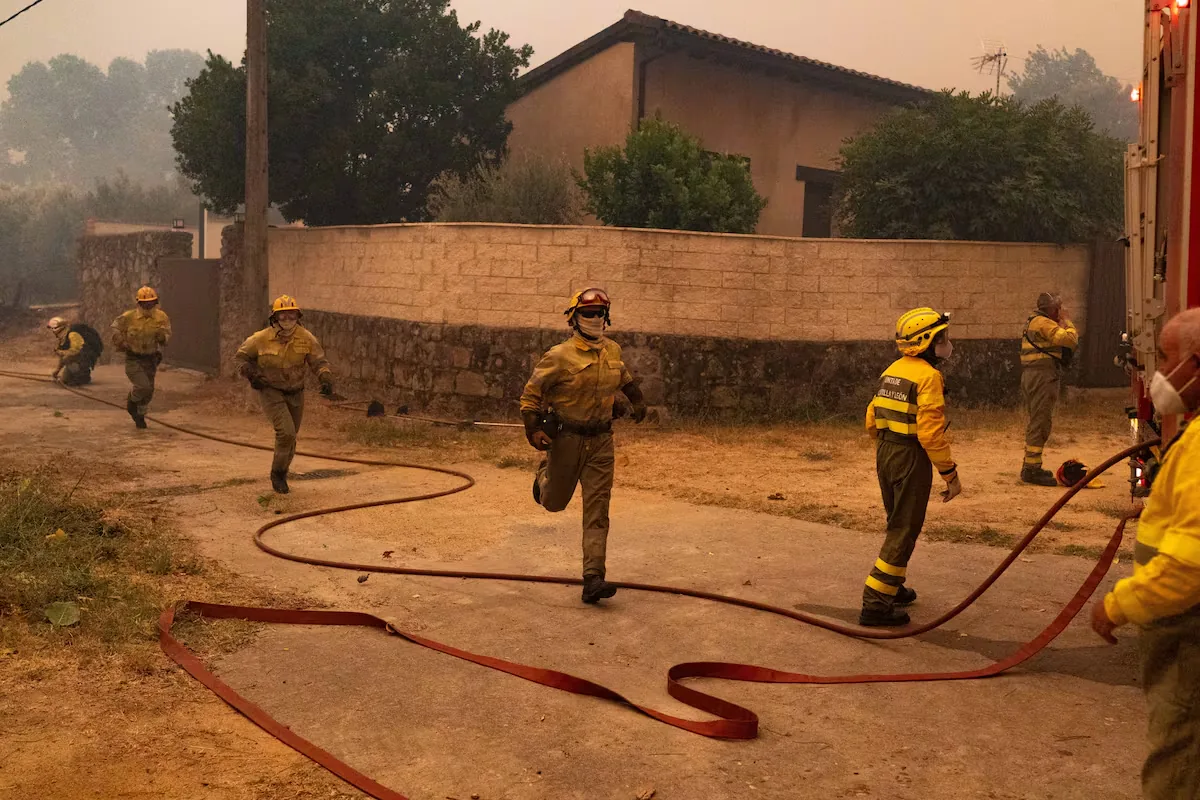
The firefighters of Castilla y León often express on their social networks, both individual and group, the union pride in a critical environment from which they almost always come out unharmed. Privately, they admit that, despite their utmost support for their colleagues, some do not have sufficient training or experience. It is not their fault, they explain, but rather a precarious system from which those who can escape, and with the Junta (PP and Vox) looking for hands, the Environment Department hires whoever offers themselves without more requirements than compulsory secondary education. Often without training before sending them against the fire or without knowing the language well, because many Spaniards do not want that job. Not to mention the precariousness of their resources: useless transmitters force them to use their mobiles in areas without coverage, broken-down vehicles without maintenance, incomplete crews or insufficient guards. There is still summer and sighs like this: “Little happens to us, we are always skirting tragedy, trusting luck.” Firefighters and social groups and unions have called demonstrations in several provinces, as in 2025, this Friday.
Little happened. Little happened in the hell of Burgohondo, the Ávila fire in July that has been described as the largest in history, when a crew was scorched by a tongue of fire for acting where they should not have by order of an ineffective technician. Part of the truck melted. Little happened in Casavieja, where EL PAÍS saw uncoordinated firefighters not knowing where to intervene. Many members stationed in El Barco de Ávila were outraged, furious because when that slight smoke began to grow they were not recruited: they were left at the base playing badminton. Another source reproaches that the Junta “has turned a blind eye” because Madrid and the Government monopolized headlines while Ávila was burning. Castilla y León continues accumulating flames: El Bierzo (León), Segovia, or Zamora know it.
Castilla y León has suffered severe fires in recent years that have been breaking records. In 2021, 22,000 hectares burned in Ávila, the most severe fire in the territory’s history until the following year when almost 30,000 hectares burned in separate fires in the Sierra de la Culebra (Zamora), a year in which almost 100,000 hectares were lost. The years 2023 and 2024 were favorable, but in 2025 almost 140,000 hectares were charred, an unprecedented figure, with León and Zamora as the most affected along with Palencia and Salamanca.
A worker from León lists calamities: “The radios work terribly, the central cannot be understood, they have not invested in improving repeaters, radios… When there are fires it is terrible; colleagues have been in danger for not having communication with either the management or the colleagues.” The alternative, their mobiles hampered by the lack of common coverage in these rural environments. Regarding the vehicles, the soldier who died when overturning in Huesca reminded them of what happened in Espinoso de Compludo in 2025, with another firefighter dead in a similar accident. “The fire trucks are lamentable despite boasting of having bought new ones: they are fine for the Tierra de Campos region, when cereal burns, but not for León; many do not fit due to their width and are not operational in the mountains,” he exemplifies. “Maintenance practically does not exist; there are many fire trucks with breakdowns, brakes, pumps, wheels in poor condition,” the worker points out. Material shortages accompanied by human ones: there are incomplete crews, drivers missing for the trucks, and some laborers have been hired just a few days ago.
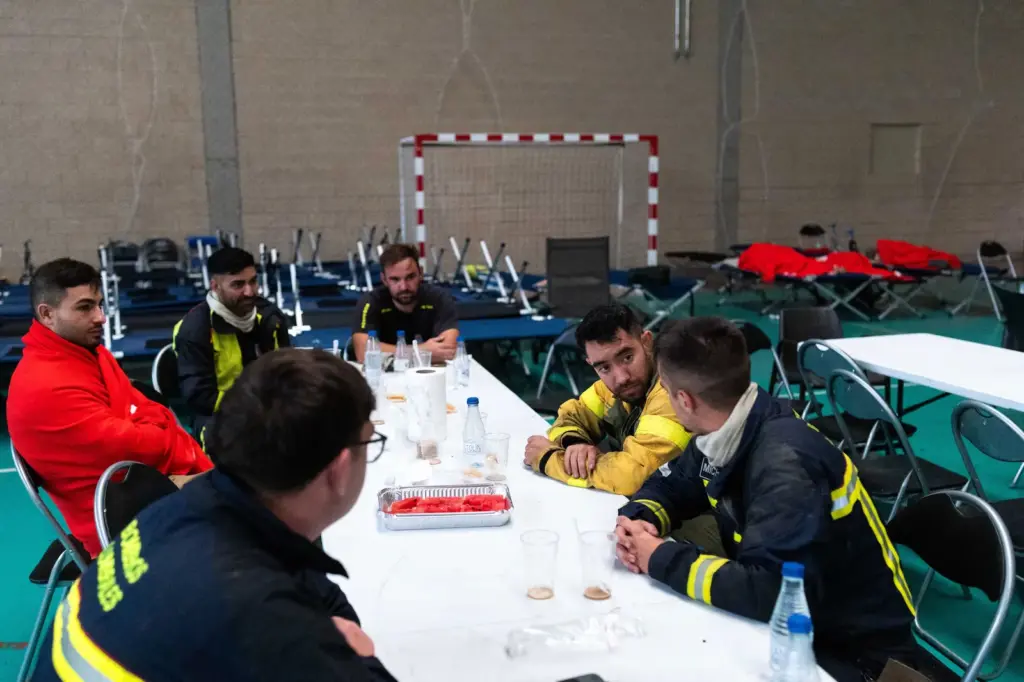
Another worker from Palencia denounces that in his base the locker room is for 10 people and 16 are crowded in, that there is no air conditioning even with 39 degrees “and luckily a guy brought a fan,” that “when it rains it floods and there are leaks,” and that the isotonic salts or energy supplements they provide “are expired.” He continues: “When we lose a cotton neck gaiter or protective glasses, it takes weeks or months to supply them, they do not give good masks and we do not receive extra pay for inhaling toxic substances nor do we have equipment to protect ourselves.” They have bought water bottles, belts, or harnesses themselves because the Junta does not provide them and act as “carpenters, plumbers, or bricklayers” to fix the base… with their own tools. The first aid kit, expired: “I carry it in case of emergencies.”
Regarding the lookout posts, old complaints. Many remain vacant, missed in Segovia when it took time to detect hotspots; others are inaccessible or have not been built and mean watching from construction huts at ground level. The Junta has bet on cameras, which were criticized in 2025 by the lookouts, because it is about 11 million euros that barely detect smoke. There are half-finished bases, like the one in Oterico, León despite its high investment, and helicopters yet to arrive. The Association of Forest Fire Workers of Castilla y León has criticized that, after a fire in Segovia, “unemployed people without experience” were hired to complete the lookout posts at the end of July, after 3,000 hectares burned in Brieva: “They were released without explaining how the radio works. We colleagues are helping them by phone, and even so, every day they give some false alarm.” Also, there are fire truck laborers taken from unemployment who have gone to fires without the basic course, a risk for themselves and their team. Companies, apart, pressure for firefighters on leave, like one who was left “like a board, unable to sit in a chair,” to return as soon as possible, since the Junta sanctions them if personnel are missing: “It is inhuman.”
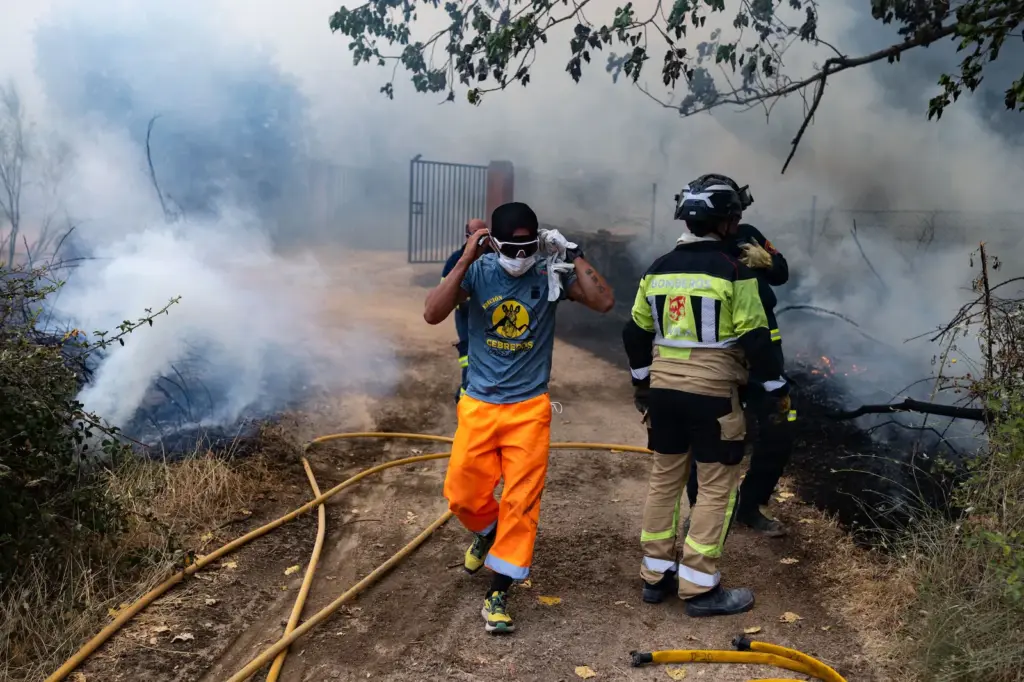
One of the president Alfonso Fernández Mañueco’s (PP) flagship measures was to transfer employees from private companies to the Tragsa model, not much better, but applauded by firefighters upon learning about it. Now, they lament that the poor general conditions prevent completing the crews because of lack of personnel, accepting almost any profile. More complaints about the extinction technicians, many of them “lacking training and professionalism, unaware of the operation, do not know how to use the fire trucks, do not bother to learn the staff schedules, the composition of the crews, the models of vehicles and machinery, do not learn the codes to name the resources…”.
Another firefighter gets angry: “There are many middle and high-ranking officers chosen by hand.” One adds, laughing, that those technicians take vacations in summer and leave “poor interim kids, with no fucking idea.” Mañueco also created the Directorate General for Forest Fire Prevention and Extinction, which was occupied by Ángel Sánchez, formerly technical chief of the Forest Fire Service. The position Sánchez left was put out to tender in August.
A firefighter from the Forest Fire Reinforcement Brigades, from the Ministry of Ecological Transition, criticizes that Castilla y León and other autonomous communities slim down their operations relying on that reinforcement and the Military Emergency Unit. “The device is incomplete and very green,” observes this veteran brigadista, also self-critical, especially with the rookies attracted by boasting about risk, although he understands that talent or experience flees: “There are people who go to take photos and videos of fires to get likes and followers, it is not the Junta’s fault. Every day we are more pessimistic. In the short and medium term, I see no solution, but it is the system that the Junta and some other community have created and fostered.”