

Nobody forgot it. One after another, from Lula, the great historical figure, the political father of many, to Zohran Mamdani, the latest great star of global progressivism, passing through important promises for the future like the Italian Elly Schlein or presidents with enormous electoral appeal like the Mexican Claudia Sheinbaum… all had words of recognition for Pedro Sánchez. The Spaniard was the great protagonist of a weekend of moral injection into an international progressivism that is experiencing a moment of weakness, but trusts in being able to regain ground now that Donald Trump and his allies seem to be starting to lose strength.
Read more Macron announces the death of a French UN soldier in Lebanon and points to Hezbollah
Barcelona, a fetish city for the left, the only major Spanish city where at this moment all political power – mayoralty, provincial council, Generalitat – is in the hands of the socialists, became this Saturday the ideal place for a Madrilenian like Sánchez, who suffers strong harassment from a very emboldened right in his hometown, to consecrate that leadership not only of the European left, but also as a reference for the American one.
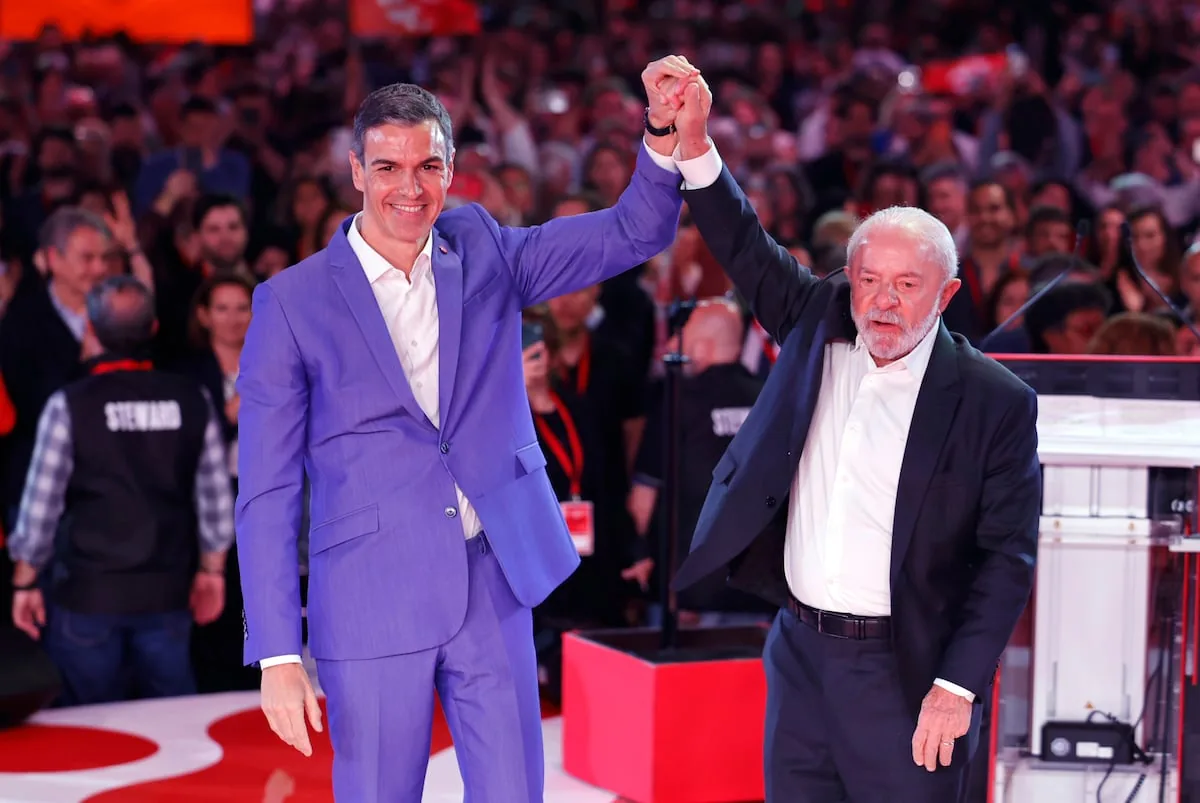
In fact, the Brazilian Lula, the mythical Brazilian fighter, the uneducated metalworker who became president of a power with 200 million inhabitants, almost anointed him as a kind of political protégé – although he jokingly insists at 80 years old that he has a pact to live to 120. “Sánchez has done something extraordinary. Progressives are very few now. But he is managing to grow the flock,” declared Lula after asserting that the Mexican Sheinbaum or the South African Ramaphosa had come to Barcelona, called by the Spanish president. The image of Sánchez and Lula, alone on stage before 5,000 enthusiasts, with the Brazilian raising the Spaniard’s arm, marked the end of the summit and a kind of transfer of legacy.
In the president’s inner circle, they believe that this summit in Barcelona manages to give image, sound, and memory to something they have been seeing for months and have been pointing out as something not quite perceived in Spain – where the head of the Executive continues to face enormous political difficulties and very unfavorable polls -: Sánchez’s international leadership. “Thank you for saving the soul of Europe,” Giacomo Filibeck, secretary general of the Party of European Socialists, told him. That is why it is no coincidence that the most important meeting in recent years of global progressivism took place in Barcelona and was convened by Sánchez.
Barcelona, the same sources point out, marks a very clear narrative. While the right has simple messages of rejection of immigration, of the culture of the law of the strongest, of tax elimination… the left lacks a powerful and simple narrative. This event provides it, the president’s inner circle states, and it does so, moreover, around the leader of a country that, contrary to what Donald Trump said this Saturday, has the best economic data in the euro zone. In countries like Italy, for example, Spain’s case is the great reference for the opposition against the right-wing Meloni. “Thank you, Pedro, for your leadership,” declared the Italian Schlein. “Thank you for demonstrating that the progressive agenda works. Thank you for defending our dignity with four words: no to war.” Lula insisted in his last speech on this commitment to the Spanish president as a reference: “I wanted to congratulate Pedro Sánchez for this progressive event that tries to show the world that democracy did not die. That no one has to be ashamed of being progressive or being left-wing. I praise Pedro because he had the courage not to allow US warplanes to leave here to bomb Iran.”
In recent months, and even more so after his “no to war” and his direct clash with Donald Trump, La Moncloa had already detected a great increase in international political and media interest around Sánchez’s figure. More and more groups from all over the world show interest, contact the Spanish Government to understand its project, or to ask, for example, about the latest extraordinary regularization of immigrants, which goes against the trend of the rest of Europe and even other progressive governments. More and more requests for interviews, for special reports on Sánchez, are also arriving. Outside Spain, the appeal is undeniable, although domestically things remain politically very complex for the president. But the summit, or the sum of summits of the weekend, because there have been up to three different ones, have made that movement detected by La Moncloa very evident.
Meanwhile, Sánchez played that role of host and great star of the European left with an optimistic message against the pessimism installed in a part of the left. “I know that the far-right international and a subservient right make a lot of noise; that, sometimes, it seems as if no other voices existed. But let them not deceive us. They don’t shout because they are winning, they shout because they know their time is running out. The right does not lead, it languishes. People are realizing that they have no project, no solutions. Their policies have only brought war, inflation, inequality, social fracture. The time of the far-right international has come to an end. We are going to bring a new era of progress to the world,” he encouraged.
“They call us ‘charos’, lefties, reds, greens, progressives, woke. But we must regain our pride,” Sánchez continued. “They have tried to make us ashamed of our ideas, but that’s over. In Barcelona, this April 18, shame changes sides and will do so forever. From now on, shame for them. For those who remain silent in the face of injustice, those who exploit workers, those who support war and violence. For us, the pride of being pacifists, environmentalists, trade unionists, feminists, the pride of being left-wing, because progressivism today is more necessary than ever. And to those who criticize the extraordinary regularization: Spain is a child of immigration and will not be a mother of xenophobia,” he added.
The Spanish president did not focus solely on talking about left and right, but also about democracy versus authoritarianism, about messages of unity against the hatred that triumphs on social media, which Lula insists on calling “digital” because – he says – they have shown that they have nothing social about them. “Democracy cannot be taken for granted,” Sánchez reiterated before the progressive leaders. “The risk is that democracy empties from within. But it is not enough to resist, we have to propose, lead, demonstrate that democracy can be strengthened,” insisted the Spaniard.
Sánchez seems convinced that this weekend in Barcelona is starting to change things in the political imbalance currently favoring the right. And, above all, the Spaniard and the Brazilian place great trust in the fight against techno-oligarchs, whom they see as the key to explaining the success of the far-right in the world. “Technology,” highlighted the Spanish president, “does not govern itself. Without rules, technology divides us. We cannot accept that disinformation conditions our societies or that algorithms reward hatred.”
From Barcelona emerges an unexpected atmosphere of progressive optimism. After Trump’s fiasco in Iran, Orban’s defeat in Hungary, Meloni’s failure in the Italian referendum, and the slowdown of the far-right in the French municipal elections, a change of cycle no longer seems entirely impossible. “Let’s not forget that all waves, no matter how high, die on the shore,” declared the other host, the Catalan president, Salvador Illa. Sánchez closed his speech as the new global progressive leader with that call to optimism: “We must do something more, regain faith in progress. Lula believes in democracy because a humble person like him became president of the Republic of Brazil. They seek to see us scared, dejected, defeated. That we focus on protecting, not transforming. But we are not going to buy into their pessimism and despair,” concluded the dreamed-of summit by a president who has growing support abroad, although domestically he faces increasingly difficult challenges, the next one in Andalusia.
Read more Atlético — Real Sociedad live, the Copa del Rey final live