






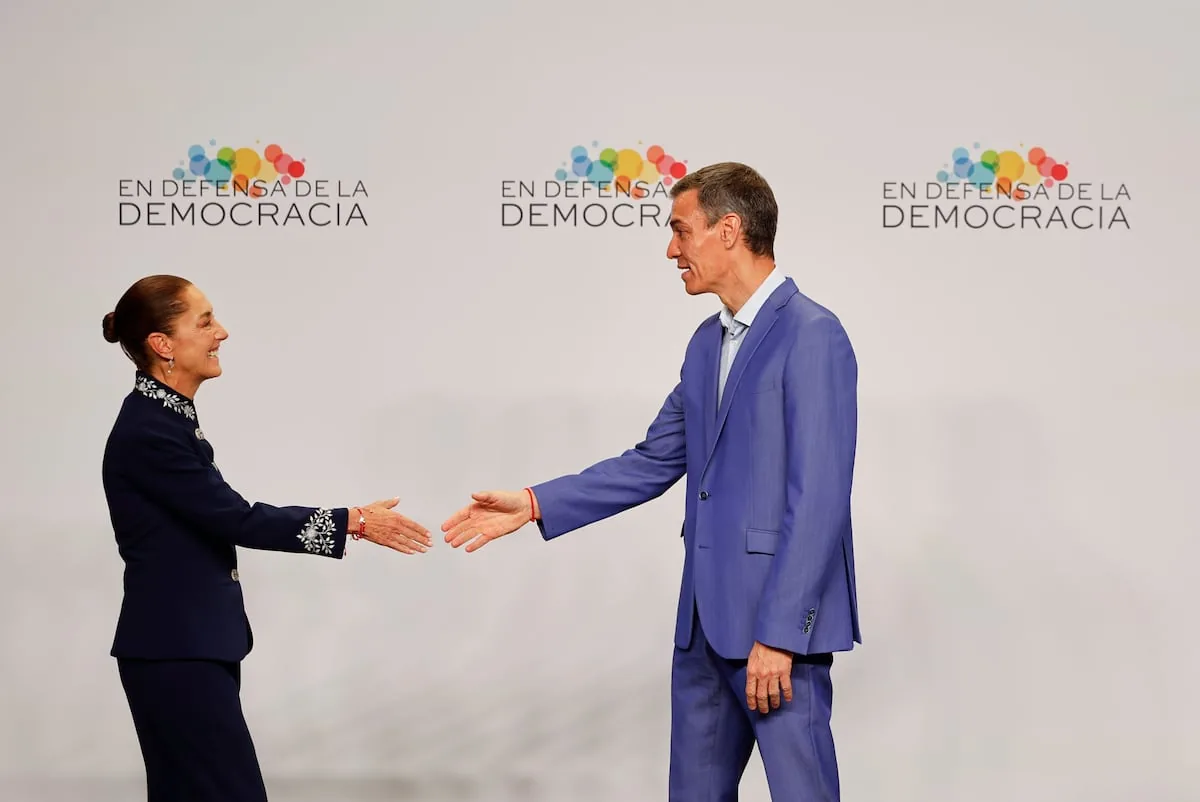
Mexico and Spain took a decisive step towards reconciliation. After seven years of tensions and stagnation in the bilateral relationship, Pedro Sánchez and Claudia Sheinbaum met this Saturday for the first time at the IV Meeting in Defense of Democracy in Barcelona and practically declared the political paralysis over due to differences regarding the abuses committed during the Conquest. “There is no diplomatic crisis. There never has been,” Sheinbaum affirmed as soon as she arrived at the meeting, the first high-level encounter between the authorities of both countries since 2018.
Read more 70-year-old cyclist killed by a car in Pinto
The Mexican president’s statements set the tone for the rest of the day, during which both leaders exchanged gestures to draw closer and make it clear that the priority is to look forward and leave disagreements behind. “We share a great harmony on how to continue strengthening our very special cultural, economic, and social ties,” Sánchez noted on social media. During the meeting, Sheinbaum proposed that Mexico host the next progressive summit scheduled for 2027, an offer that her Spanish counterpart appreciated, announced shortly after as a done deal, and described as “great news.”
The moment that confirmed the thaw occurred during the summit reception. Until then, several unknowns prevailed about the first meeting between the leaders, especially due to the moderation and caution that predominated in the days leading up to the meeting. Sheinbaum made few statements after landing at El Prat airport on Friday night and announced only a couple of days before the trip that she would hold a bilateral meeting with Sánchez, albeit without a joint statement. The doubts dissipated as soon as the first handshake took place. The presidents smiled for the cameras and thanked each other for the meeting.
“We talked about how important it is for Mexico to recognize what the Conquest was, the arrival of the Spanish,” Sheinbaum detailed at the end of the bilateral meeting they held behind closed doors on the sidelines of the diplomatic summit. The president stressed that the two countries will continue working on the recognition of indigenous peoples, but credited efforts from the other side of the Atlantic to reach a compromise that both parties could accept after the apology request sent by former president Andrés Manuel López Obrador (2018-2024) to Felipe VI in March 2019. “There has been an approach from both the president and the King himself, and the important thing is to continue dialoguing,” the Mexican leader responded to journalists’ questions, while also stating that she expected to host Sánchez at the next summit of progressive governments.
The diplomatic work to reach this point was arduous and took years. López Obrador froze political contacts and decreed a “diplomatic pause” until apologies from the Spanish State were materialized, in a conflict that stirred emotions and was capitalized on by the conservative opposition in Spain. The relationship experienced low points again after Sheinbaum decided not to invite Felipe VI to her inauguration in October 2024, a sign that seemed to indicate she would not distance herself from the positions adopted by her predecessor and political mentor.
Culture served to begin rebuilding some bridges. Spain was the guest of honor at the Guadalajara International Book Fair in 2024. A year later, the Princess of Asturias Award was granted to the National Museum of Anthropology of Mexico. And also landed in Spain Half the World. Women in Indigenous Mexico, the largest exhibition of pre-Columbian art ever presented outside Mexican borders, organized by the authorities of both countries.
During the inauguration of the exhibition last November, the Spanish Foreign Minister, José Manuel Albares, acknowledged that the common past between Mexico and Spain “has its chiaroscuros” and that indigenous peoples were wronged. “There was injustice, it is right to acknowledge and regret it. That is part of our shared history; we cannot deny or forget it.” Last March, it was Felipe VI who admitted that “there were many abuses” and “ethical controversies” surrounding the Conquest and colonization in the territory that currently makes up Mexico.
“There are things that, when we study them, we learn about them, you say: ‘well, by our current criteria, with our values, obviously they cannot make us feel proud,’ but we must know it and in its proper context, not with excessive moral presentism, but with an objective and rigorous analysis,” the King said in an informal conversation with the Mexican ambassador, Quirino Ordaz, after visiting the exhibition of 400 pre-Columbian artworks. Although apologies have not been explicitly made, Sheinbaum acknowledged that there have been “advances” in the last year and urged a deeper understanding of the shared history between both countries.
Nevertheless, the announcement of her trip to Spain on April 10 was quite surprising. “Sheinbaum’s decision represents a radical change in Mexico’s foreign policy regarding the López Obrador Administration,” states Jorge Schiavon, an academic at the Universidad Iberoamericana. The specialist points out that, although the diplomatic and symbolic gesture is significant, the Sheinbaum Government has also been extremely careful in the turn it has given to the management of the relationship with Spain. “It marks a difference with López Obrador without abruptly breaking with him,” he notes.
Read more La Mancha
The Mexican Government has carefully managed several balances during Sheinbaum’s visit to Spain, from the messages sent to her core supporters to those sent to the Donald Trump Administration, by attending a meeting convened by Sánchez, one of his biggest critics. The positions taken by the Mexican president during the summit of progressive leaders are also understood in this vein.
“It is very important that the strength of indigenous peoples for our homeland is recognized,” she said upon arrival. “I come from a people that recognizes its origin in the great indigenous cultures, those that were silenced, enslaved, and plundered, but that were never defeated, because there are memories that cannot be conquered and roots that can never be torn out,” she insisted during her initial speech at the IV Meeting in Defense of Democracy.
The forum convened in Spain also offers an unprecedented opportunity in the last seven years to work on common agendas for both countries on the political front. The Sheinbaum Administration has stated in Barcelona that it seeks to regain a certain prominence on the international stage by defending the principles that have characterized its foreign policy, such as non-intervention and the self-determination of peoples. It is the first trip by a Mexican head of state to Europe in eight years.
In parallel, the Sánchez Government has made clear its intention to lead a coalition of progressive allies and the need to secure all possible support for that effort. Although cultural and economic contacts have functioned normally, the so-called diplomatic pause in the bilateral political sphere did not seem sustainable for either party.
“I have discussed with President Claudia Sheinbaum the global situation and the key to advancing EU-Mexico relations,” Sánchez wrote at the end of the meeting, while the Mexican president highlighted the reception some of her proposals received during the forum, such as a declaration to condemn a possible military intervention in Cuba and to dedicate 10% of global military spending to reforestation programs.
Sources from La Moncloa have given maximum relevance to the Mexican president’s visit and have echoed that there is no diplomatic crisis with the Latin American country, while other attendees at the multilateral summit, such as Brazilian President Luiz Inácio Lula da Silva, have publicly celebrated the rapprochement between both Governments and Sheinbaum’s participation in Barcelona. Spain is only the seventh country the Mexican president has visited in just under two years in office.
Both countries have agreed, according to Sheinbaum’s statements, to continue working in areas where they coincide, such as cultural exchanges and the promotion of clean energy. “It is a very significant normalization process, but discreet and one that will take time,” Schiavon points out.
For now, the president, who is scheduled to return to Mexico this Sunday, has ruled out a meeting with Felipe VI in the immediate future, although a month ago she extended an invitation to him to attend the World Cup to be held next June and July, according to the Royal Household. “It constitutes a propitious juncture to evoke the depth and singular character of the ties between Mexico and Spain, forged by a historical brotherhood and sustained by the shared legacy of language, culture, and collective memory that is full of great examples of solidarity, empathy, and a humanist vision among our peoples,” states the letter that the Mexican Government sent to La Zarzuela, which, in turn, emphasized “the fraternal relationship of friendship between the two countries.” This Saturday’s meeting is another sign of the mutual interest in overcoming past differences and opening a new stage towards the future.
Read more The international left hails Sánchez: “He has done something extraordinary”