









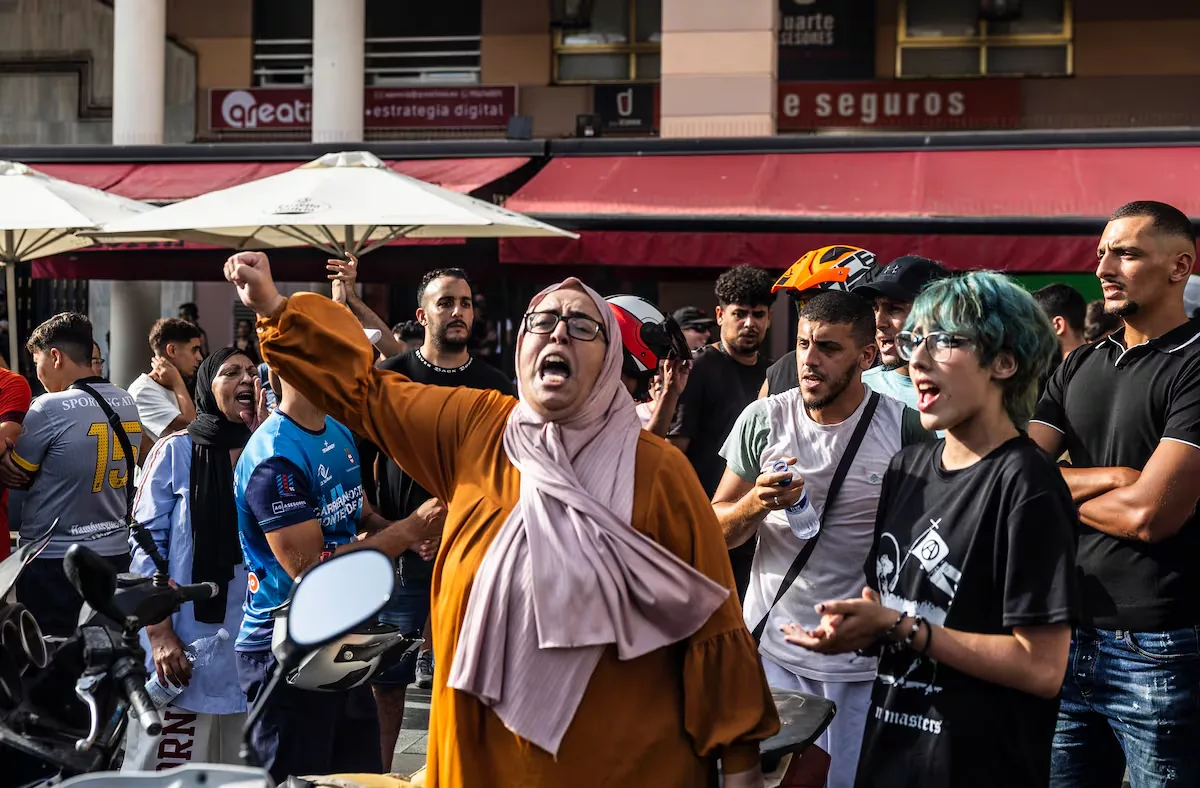
Some politicians who promote “national priority” say that Spain is losing its identity. They criticize the construction of mosques, call for banning the use of the niqab and burka or, as is happening now with the crisis in Ceuta, take advantage of the border debate to talk about a supposed “Islamization of Spain.” The latest has been to try to ban halal menus (those that strictly comply with the dietary rules of the Islamic religion) in school cafeterias. “Goodbye to the halal menu in our house. We decide the menu, not the guests,” said Vox spokesperson in Les Corts of Valencia, José María Llanos. This is not new rhetoric. Increasingly, parties are incorporating anti-Muslim discourse into their agenda. For years, various far-right parties in Europe have turned Islam into a symbol of threat to national identity. “We want to stop the growing Islamization process that we are suffering uncontrollably due to the massive invasion,” said Javier Cortés, Vox spokesperson in Andalusia, a few weeks ago when expressing his opposition to the project of a mosque in Seville.
Read more The storm of rumors about regularization
Why Islam? Doctor in Sociology and specialist in this religion Zakariae Cheddadi defines this phenomenon as part of political globalization, in which “there is a rethinking of religion within the public sphere at the international level” due to a clear dispute over values. Religion, he points out, is part of the offer that the radical right intends to incorporate and of “a global agenda whose fundamental promise is the cultural supremacy of the West.”
Cheddadi, a researcher at the University of the Basque Country, refers in this sense to the influence in the discourses of US President Donald Trump, who constantly alludes “to Christianity, to the traditional,” and to those who have joined the court of tech oligarchs orbiting around him. An example of this is the support for Alternative for Germany, “an Islamophobic party,” by Elon Musk, owner of Tesla, SpaceX, and the social network X, who held a position in the Trump administration.
For the sociologist, this is the type of politicization that Vox uses in Spain. “It is a party that instrumentalizes coexistence in order to rise electorally. It turns Islam into a scapegoat, as if it were the evil happening in Spain.” The academic states that Abascal’s group is not interested in building a dialogue Islam, but they use Muslims “for their own electoral gains” because they know it works to replicate incidents like those in Torre Pacheco, the Murcian town where there was a persecution by ultra groups of young Maghreb immigrant youths after the assault on an elderly man. According to 2024 data from the Moroccan Association for the Integration of Immigrants, almost half of the Arab population in Spain (47.5%) has felt discriminated against in housing, healthcare, education, employment, or technology.
But their idea is not new. Far-right parties in Europe describe similar behavior. In France, the National Rally party, led by Marine Le Pen, has campaigned against Islam and proposed restricting its religious symbols; Alternative for Germany has also adopted rhetoric against Muslim immigration, as has the Italian League, the far-right party that claims to defend a homogeneous cultural vision of the country and has linked this religion with insecurity.
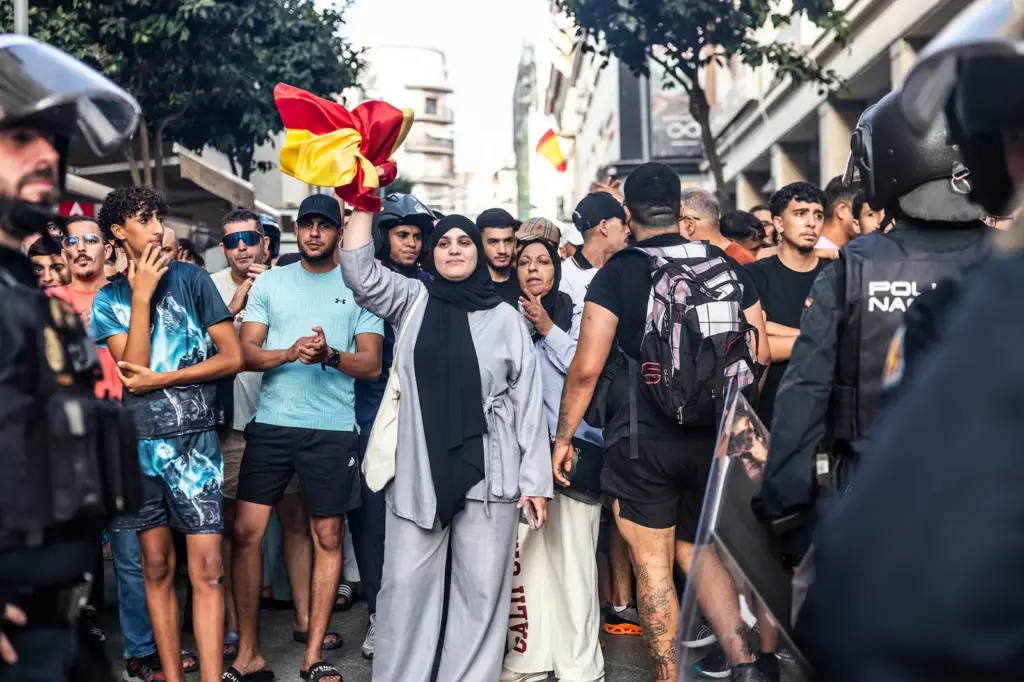
For Cheddadi, Vox is not the only one responsible and the lack of integration of the Muslim community remains a pending task in our country. “In any issue related to radicalization, the left prefers to look the other way,” he comments. And although he recognizes that it is a long-term problem, which is not solved with a single administration, he questions that the central government often “uses migrants as a way to establish distinctions with the radical right,” something that, in his opinion, contributes to immigration becoming an element of polarization. “Islamophobia is not only by action but also by omission,” he states.
The professor of the Area of Arab and Islamic Studies at the Complutense University, Laura Mijares, warns, on her part, that “there is an intentional strategy” that seeks “to generate a nonexistent social problem” to gain votes through an “Islamophobic” and “racist” discourse. In this sense, she mentions that Congress has approved this year to create a subcommittee to study the use of the burka in Spain, despite there being no evidence that this garment is widely used in the country. The director of the group for Analysis on Arab-Islamic Cultures in Transnational Contexts also warns that Vox, a party that denies gender violence and questions reproductive rights, uses the “rhetoric of salvation to position itself because it is a very electorally profitable bet.”
At this point, the Arabist Mijares states that Vox has positioned the debate and other political forces are joining, including the left and certain “liberal or mainstream” feminist organizations, where women, she warns, are constructed as victims or threats. The expert insists on the need to include the Muslim population in the debate and that it is not “always men deciding what a woman should or should not wear,” something that from her perspective only serves to exclude and criminalize them.
Geopolitical context
The researcher at the Barcelona Centre for International Affairs (CIDOB), Moussa Bourekba, insists on the need to know the context: the Islamic Revolution of Iran in 1979. He explains that, although this is a first manifestation of the relationship between geopolitical events in Muslim countries and the first brushstrokes of Islamophobia, currently there are three key elements: the growing visibility of Islam in Europe through immigrant populations; their demands for equal rights and, above all, jihadist terrorism.
For this expert, tragedies such as 9/11 in the US, 3/11 in Madrid, or the Bataclan theater attack in Paris reinforce stereotypes that are built through terrorism and the demonization of Muslims. “Islam has this peculiarity of representing an external enemy and, at the same time, an internal enemy,” he assures.
The professor questions that religion becomes an explanatory factor of behavior. “It is as if a person did bad things because they are Muslim and not for other factors as a human being, as happens in all cases,” he warns. Bourekba agrees that this discourse is very profitable because it connects identity with security and makes it easier to restrict freedoms in the name of more security. Criticism of Islam as a religion is legitimate and more than recommended in a democratic context, according to the researcher, but he questions that such criticism arises from “simplistic and reductionist discourses” that become a way to validate discrimination against Muslims: “Just as homophobia is not an opinion, Islamophobia should not be either. It is an attitude that can constitute a hate crime,” he defends.
Read more 25 years of Tadeo Jones: the archaeologist is now a father and uses AI