









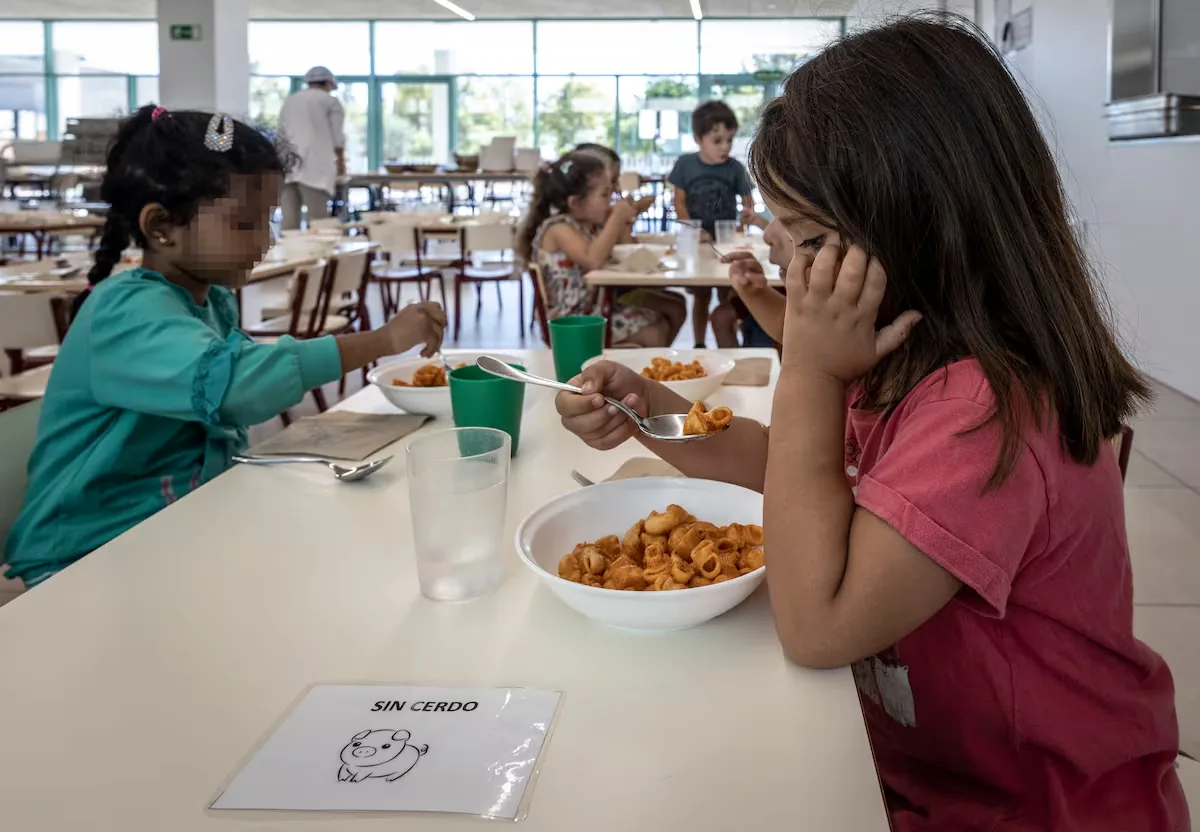
Vox has spread the idea that it has expelled the halal menu, the one adapted to Muslim religious beliefs, from the school cafeterias of the Valencian Community. And that message has been circulating for days on social media, with opinions both for and against the measure. But the reality is different. The changes introduced this summer in the school regulations by PP and Vox do not prevent schools from offering that and other special menus, such as vegetarian or vegan, in the new school year starting in September. Despite the posts on social media, neither halal nor vegetarian menus have been banned, according to the Generalitat’s own Department of Education, which confirms this to EL PAÍS.
Read more Immigration will be the key issue to win the next elections
The only modification to the rule affecting menus is that, when they contain “meat, the animal’s slaughter must have been carried out by a prior stunning procedure,” says a spokesperson for Education. And, contrary to a certain popular belief, the vast majority of meat certified as halal sold in Spain meets this requirement, according to sources from the sector that certifies this type of food. Meeting this condition, “schools will be able to offer food alternatives compatible with the students’ convictions,” both religious and ethical, adds the spokesperson.
The Popular Party, which governs the territory, managed to approve the Generalitat’s Budget at the end of July with the support of the far-right party. Vox demanded symbolic concessions in return, such as the inclusion for the first time in a law-level regulation of the expression “national priority,” within the framework of access to public services. At the same time, the Valencian Parliament modified various regulations through the so-called budget accompaniment law, including the school cafeteria regulation.
The Vox spokesperson in the regional Parliament, José María Llanos, declared during the debate in the Chamber: “We are determined to recover our identity. In school cafeterias, the consumption of local products is guaranteed, and thanks to Vox, submission to foreign customs in school cafeterias is over. Goodbye to the halal menu in our home. We decide the menu, not the guests. And whoever wants something else can bring food from home.”
Despite the tone, the national priority was the headline, and the issue of cafeterias went largely unnoticed until the Generalitat’s official newspaper. Some digital media close to Vox’s positions returned to the topic assuming the message Llanos had launched, and social media has been amplifying it since then. Considering how Order 53/2012, which regulates the school cafeteria service in Valencian public schools, stands after the changes, it turns out that the modifications have little scope.
Throughout Spain, it is not mandatory for public educational centers to offer menus adapted to the religious beliefs of students and their families. Although the 1992 law that includes the Cooperation Agreement between the State and the Islamic Commission of Spain says they should “try” to do so, and the autonomous communities can establish it, as indeed happens in the Canary Islands. In the Valencian Community, it is not mandatory now nor was it before this summer’s change. But they are not prohibited either.
The Valencian regulation still establishes (article 8, section 2.1) that: “Educational centers will have autonomy to develop, approve, and implement their school cafeteria educational project.” The management team must develop it “according to the recommendations of the faculty, the school council, and the association or associations of parents of students of the center.”
The modifications that, according to media close to Vox, imply the expulsion of halal menus are two. The first affects article 10.3 of the order, which until last school year was worded as follows: “All school cafeterias will be required to have a special or diet menu to serve students who, through the corresponding medical certificate, prove the impossibility of ingesting certain foods that may be harmful to their health.” The change in this case has consisted of including the word “exclusively” after “special or diet menu.” But this only emphasizes the fact that public educational centers have only that obligation (as, in fact, has already been the case until now).
Andrés Boix, professor of Administrative Law at the University of Valencia, states: “That exclusively refers to the fact that all centers have the obligation to have that menu and that is what it regulates. So both the exclusively and the rest of the wording apply only to that: that alternative menu that must obligatorily be offered. That does not prevent in any case that, as until now, centers can offer additional alternatives: halal, vegetarian, fair trade, or however they want to organize themselves.”
Read more From the veil to the halal menu, this is how Islam has burst into the political battle
The second change introduced by PP and Vox is a new section, 10.4, which says: “The educational center may not offer menus where the slaughter of animals has not followed a prior stunning procedure that guarantees the loss of consciousness and sensitivity of the animal until the moment of its death,” although, it adds, it must keep in the refrigerator dishes cooked with that type of meat if the student brings them from home.
What is halal meat
The key in this case is that, contrary to a widely held idea, meat from animals slaughtered with stunning “is within the standard followed by most companies that certify in Spain” what is halal food (and specifically, meat), says Mounir Benjelloun, president of the Spanish Federation of Islamic Religious Entities (FEERI).
A source from one of these large certifying companies, who asks not to be identified to avoid being involved in the controversy, goes a step further and assures that the vast majority of halal meat certified as such in Spain is slaughtered with prior stunning. That is, it already complies with the new section included by PP and Vox in the Valencian cafeteria regulations.
The requirements of halal food (which in Arabic means permitted), and specifically the exact technique used for the slaughter of animals, is not something commonly debated by Muslims in Spain, says Benjelloun: “In Spain, there are a number of private companies that certify what is halal, according to a standard approved in turn by a religious entity that accredits them for this. And for the average citizen, if those certifiers say a meat is halal, it is halal. The debate would be at another level, jurisprudence, schools, or Islamic interpretations, but it is not something on the street.” The president of the Islamic Federation regrets that there are parties that use what he considers a strategy of confusion “because it sells and gets votes” despite also “fostering hatred and division.”
Concern
The spread through social media of the supposed ban on the halal menu has generated concern among directors of Valencian public schools. “We are very worried. We have many students who take this type of menu, as well as vegetarian and vegan ones. And in schools, it is handled normally, just as in many schools fish is served every Friday during Lent. The Spanish Constitution prohibits discrimination based on religion or opinion. The publication of the regulation has also arrived in the middle of August, and the directors ask in the chats we have how things stand,” says Isabel Moreno, president of the association of public school directors of Alicante, the province with the most Maghreb students in the Valencian Community.
Schools have already organized, moreover, adds Moreno, the cafeteria service for the new school year. And they have done so according to the instructions sent by the Department of Education on July 28, three days before the approval of the accompaniment law in the regional Parliament. Point 9.3 of those instructions states: “All school cafeterias will be required to have a diet, special, or alternative menu to serve students who prove the impossibility of ingesting certain foods for health, religious, or cultural reasons, according to the educational project of the educational center.”
Campaign
Vox launched a campaign at the beginning of the year to ban the halal menu throughout Spain, presenting a non-legislative proposal before the Education Commission of the Congress and motions in regional parliaments and city councils, with sometimes surprising results. In Badajoz, the initiative passed with the votes of the PP and the far-right party, to the dismay of the Islamic Commission of Extremadura and the municipal opposition, who pointed out that no school in the city offers that type of menu.
The Canary Islands are proof that this persecution makes the PP uncomfortable, which depends on Vox in half a dozen autonomous communities and dozens of municipalities. The Popular Party there is a minority partner in the government with Coalición Canaria, but they lead the Department of Education, which on August 20 published its instructions for the organization and operation of cafeterias, which establish: “The School Council will guarantee the proper provision of dietary services and/or the adaptation of menus when these respond to duly accredited medical needs or ethical or religious reasons.” For Canarian students, it establishes rights that Vox pushes to curtail in others.
Read more The storm of rumors about regularization