









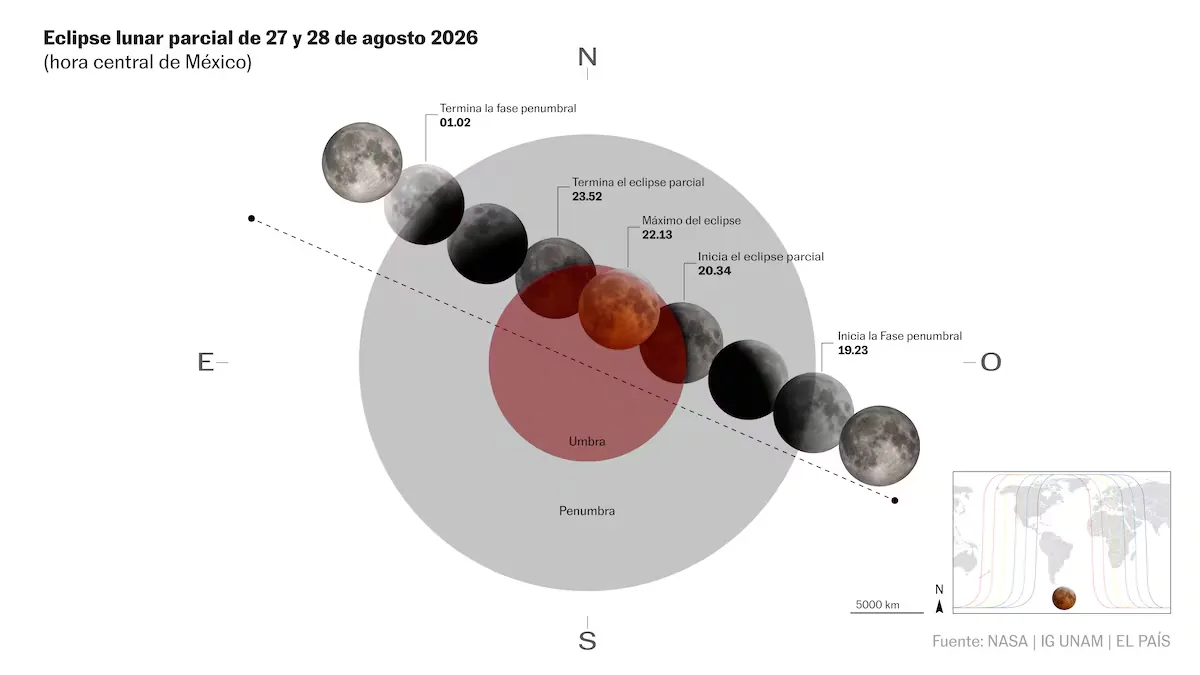
The full Moon that bids farewell to August, the last of the boreal summer, will arrive accompanied by a partial eclipse that will tint the natural satellite red. The phenomenon, which occurs when the Earth positions itself between the Sun and the Moon and blocks sunlight, will be visible during the night of August 27 and the early morning of August 28 across the entire American continent, Western Europe, and West Africa. In Mexico, the Moon will appear above the horizon in the east after 19:00, and after half an hour it will begin to be engulfed by the Earth’s shadow. The most evident effect for terrestrial observers is the gradual darkening of the lunar disk, followed by the appearance of a reddish tone on the satellite’s surface when the eclipse reaches its maximum.
Read more La Primitiva: check draw for Thursday, August 27
Although the last eclipse of the year will be partial and cover 96% of the lunar disk, it is an ideal occasion to look up at the night sky, take photographs and videos. Unlike solar eclipses, there is no need to use safety glasses to see it; however, using binoculars or a telescope can enrich the experience and help capture more detail of the craters and seas of the rugged lunar surface.
Start of the eclipse
The Moon’s first contact with the Earth’s shadow will take place at 19:23 with the beginning of the penumbral eclipse, where the satellite will start to be engulfed by the penumbra, the outer and faintest part of the Earth’s shadow. During this phase, the change on the lunar surface for terrestrial observers will be subtle, with a barely perceptible decrease in the Moon’s usual brightness similar to the effect of a partially cloudy night.
Read more Bonoloto: check draw for Thursday, August 27
The Moon begins to be covered
A few minutes after 20:30, the Moon will begin its transit through the umbra and with it, the first changes in its appearance: minute by minute, the lunar disk will gradually take on an ochre tone as it is engulfed by the Earth’s shadow. After about 45 minutes, at 21:15, 50% of the lunar surface will be immersed in the umbra.
Maximum point
The eclipse will reach its maximum point exactly at 22:13, when 96% of the lunar disk is within the umbra. If the clear sky accompanies, this will be the best moment to see the dramatic ochre tones that give the Red Moon its name, an optical effect caused by the partial blocking of the spectrum of sunlight reflected on the lunar surface. Given its magnitude, with only 4% of its diameter outside the Earth’s deepest shadow, the perspective will be similar to that of a total eclipse with a minimal fraction in its usual tone. Immediately after reaching its maximum, the natural satellite will begin the reverse transit outward from the Earth’s shadow, a phase that will last until a few minutes before midnight with the end of the partial eclipse.
Read more Daily ONCE coupon: check the draw for Thursday, August 27