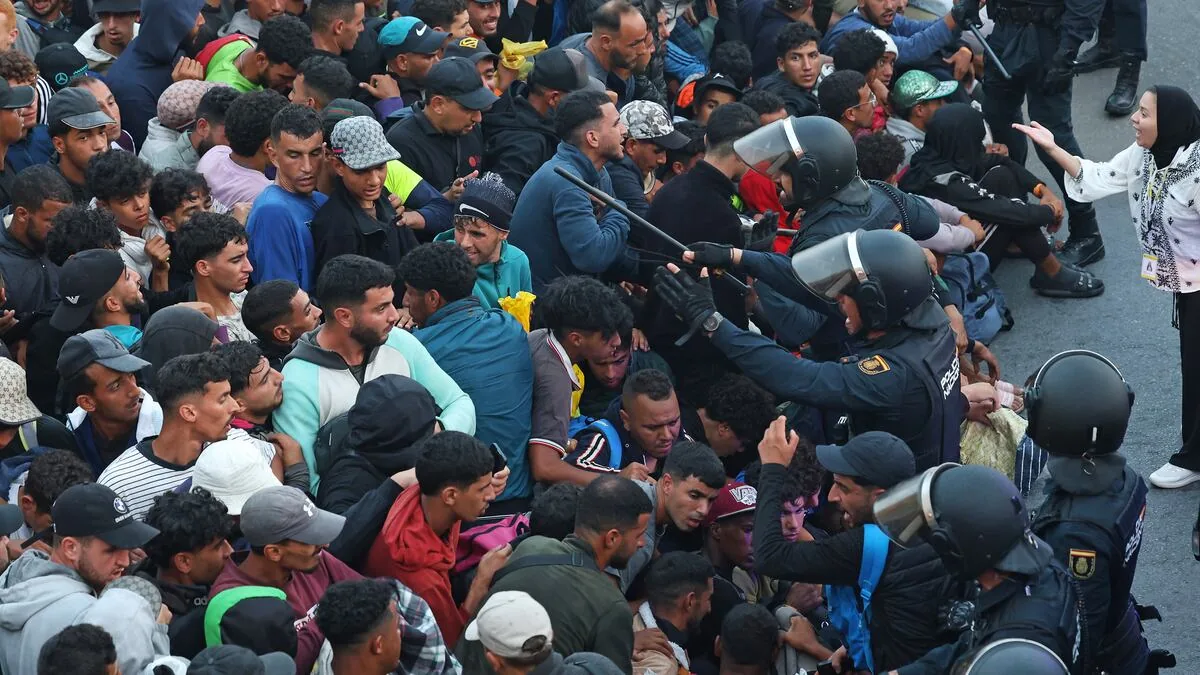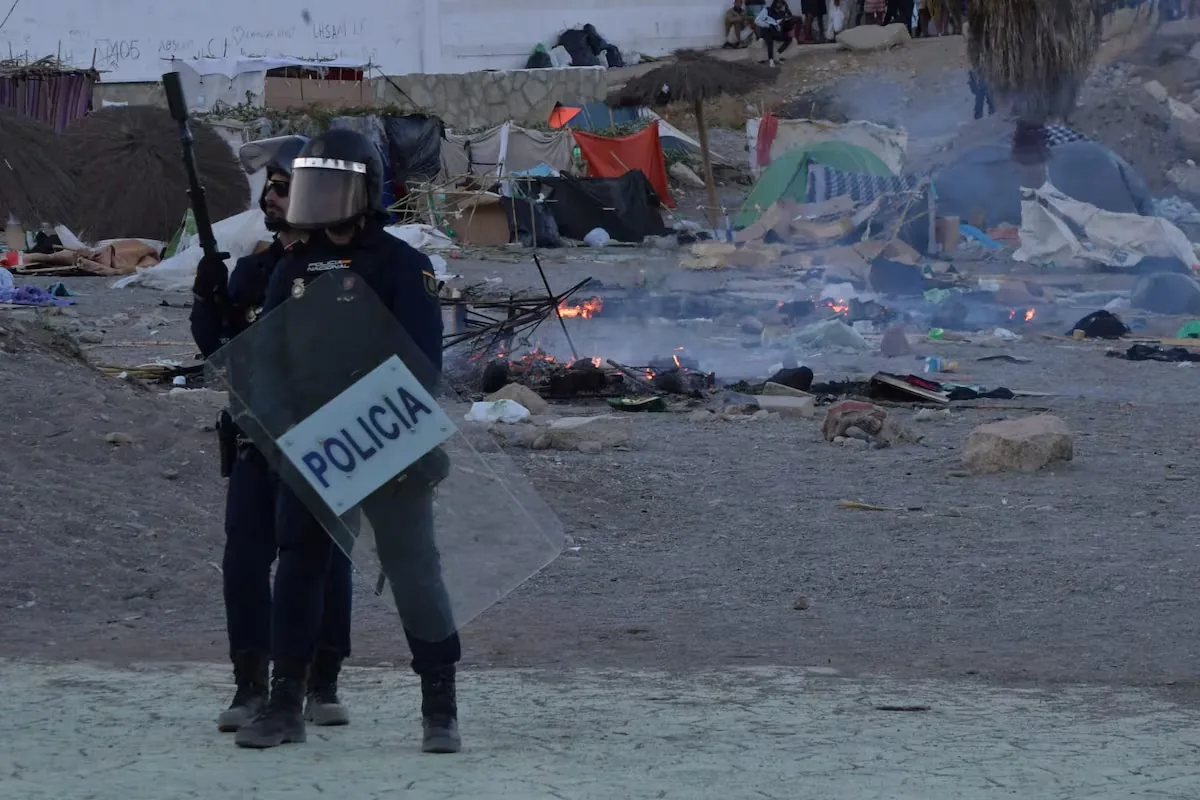
The social situation in Ceuta overflows at times. Until now, the central government and the city government had a huge problem that is far from being resolved to attend to and especially to start the return processes of the thousands of immigrants who remain in the city, despite more than 90% of the 70,000 who entered on July 30 and 31 having already returned to Morocco. But at least they had managed something without problems: feeding them every day, to avoid major conflicts, supermarket raids, or any similar turmoil that occurs when a large group of people are hungry and have food nearby. Now, even that has become a serious problem, because in the last two days, an increasing group of citizens is trying to prevent the daily food distribution on El Trampolín beach. The riot police had to intervene, in an unprecedented image broadcast live on television, to prevent fights between immigrants and protesters, while the Red Cross volunteers who until now distributed food without problems are increasingly scared.
Read more Marlaska goes to Congress after the clash with Robles ready to defend his version
In this context of maximum tension, which makes managing an already impossible crisis increasingly difficult, the Government made a call to all groups, but especially to the PP, which has governed and led Ceuta for 25 years, to help condemn and control this outbreak of violence. Ángel Víctor Torres, the highest authority of the unified command, admitted that he himself agreed with Juan Jesús Vivas, president of the autonomous city, on a joint message against violence that both launched similarly on Wednesday night. But so far it has not been enough, so Torres asked in Congress that all groups, but especially the PP, join in condemning the violence. “Yesterday Vivas and I agreed on an urgent message against violence. It would be good if everyone joined today,” he cried out. But it did not have much follow-up. The PP representative, Senator Cristina Díaz, told Torres that the violence to be condemned is that of the immigrants against a group of soldiers, something the minister immediately did but asked to also focus on the violence of some citizens against immigrants, against Muslim Ceutans, or against Red Cross volunteers who are simply feeding hungry people.
“Ceuta does not need lessons in patience and coexistence. We have been giving the rest of Spain this kind of lessons for decades. What we need is a Government that guarantees security, regains control, and returns normality to all Ceutans,” cried the PP senator.
Vivas was especially dramatic when talking about the violence, aware that the situation worsens every day. In fact, shortly after he spoke, things got complicated with a hundred people blocking the food delivery, something they managed for quite a while, and then episodes of violence and the burning of the immigrants’ makeshift camp on the beach. “You cannot attack Muslim Ceutans, just as you cannot attack anyone for being an immigrant,” cried Torres. “It cannot be that Red Cross volunteers who are from Ceuta feel threatened for delivering food on El Trampolín beach and want to give up doing that volunteer work. It also cannot be that journalists are assaulted. Public officials bear burdens, but violence against any public representative is not acceptable,” Torres insisted.
But the tone of the debate between the two major parties does not bode at all for an understanding to try to jointly calm the anger of some Ceutans. There were three ministerial appearances in Congress, and in all the clash was strong, because the opposition sees very clearly that this crisis could be a final blow to the Government already almost at the doorstep of the electoral period that will arrive in 2027, when almost all political power in Spain will be distributed with municipal, regional, and general elections in the same year in which France and Italy also vote.
The PP and Vox attacked the Government, while José María Aznar visited Ceuta also with a critical speech towards the Executive in which he called for restoring order. In Congress, the Minister of Justice, Félix Bolaños, who also appeared, recalled that Aznar never officially visited Ceuta when he was Prime Minister ―he only went once during the 2000 election campaign to give a rally, without any official act as a ruler― while Pedro Sánchez has done so four times officially attending the Government delegation, the last time on July 31.
Nor did the king, whose presence the PP now demands, go to Ceuta when Aznar or Rajoy were at La Moncloa, only Juan Carlos I visited once while Zapatero was head of the country. Aznar and the PP accuse the Government of weakness with Morocco, but Bolaños insists there is no evidence that this country is behind the massive immigrant jump and there are certainties that, thanks to the good relationship now with Spain, it has helped so that 90% returned quickly, although an important group remained that is now generating all the management difficulties.
Minister Torres tried at all times in Congress to ask for understanding from the Ceutans and especially to convince them that the only solution is to accept the transfer of immigrants from the beaches to some center that can be quickly adapted, and those are the ones closest to the population. The minister explained that this Thursday technicians went to visit the locations proposed by the city, on the outskirts, in Tarajal, near the border, to avoid neighbors protesting. But those places, Torres assured, “would require months of work to be adapted, they have no electricity or plumbing.” This has been the problem from day one: neighbors want the immigrants to leave, but to return them first they have to be placed somewhere and the procedures started, and many Ceutans reject any location near their homes, and that delays the solution even more in a vicious circle that seems endless.
Even so, this Friday there will be a new meeting of the unified command this time chaired from La Moncloa by Pedro Sánchez, and there, according to Torres, decisions will be made about some new sites to speed up the registration of all immigrants ―last week space was sought for 1,800, but much more is needed― to try to channel a crisis that now seems out of control. “I am not going to deceive by saying they can be returned tomorrow knowing that is false. Normality will be reached, but I cannot say when,” Torres concluded.
There is growing concern in the Government. Several ministers admit in private that they did not expect this attempt by some neighbors to sabotage the food distribution and point out that if they could not feed them, the situation would be infinitely worse, and that it has been precisely those 4,000 daily meals distributed since the crisis broke out that have managed to maintain some calm and avoid the disturbances that had not occurred until now.
Several ministers are very worried about the hate messages unleashed on social networks that are encouraging the pursuit of immigrants in Ceuta. Both volunteers and officials assisting immigrants are increasingly concerned and some of the former are under a lot of pressure and are thinking about quitting, according to these sources.
With neighbors against everything it is much more difficult, explain various Government members. Some who managed the 2021 crisis, which was also very complex with a jump of 10,000 people most of whom stayed, recall that then there was no neighborhood protest, the city quickly offered a sports center and that is why everything could be managed more discreetly and without conflicts. Then there were also transfers to the peninsula, especially of minors, something now openly rejected by the PP and especially Vox, whose councilors did not even attend the meeting with the Ministry of Youth and Childhood to prepare those possible transfers and approve the 25 million euros to finance them.
The Government remains trapped: it cannot massively return immigrants, because that would mean disqualification of any official who does so, as happened with the 2021 crisis with the Government delegate and the vice president of Ceuta, it also cannot take them to the peninsula, something the EU also rejects, and now it is even starting to have problems feeding them. The Executive trusts to find a way out in the coming days, but for that social pressure should decrease, and so far everything indicates it is rising.