









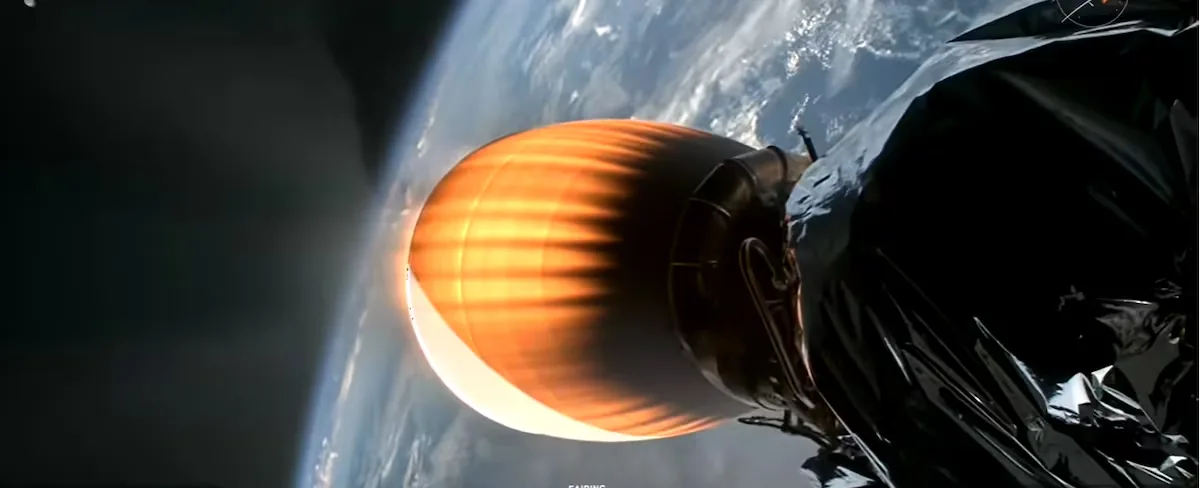
The Nancy Grace Roman Space Telescope, NASA’s new major bet to understand the universe, successfully took off this Sunday at 13:26, Spanish peninsular time, aboard a SpaceX Falcon Heavy rocket from the Kennedy Space Center in Florida. Minutes after the launch, the observatory separated from the rocket and began its journey to its destination: the Lagrange point L2, 1.5 million kilometers from Earth, where it will remain in orbit for at least five years, extendable to ten.
Read more Nicolás Maduro shares his first images from the New York jail: “I want you to know that we are firm”
With a primary mirror of 2.4 meters (the same size as Hubble), the main virtue of Roman is not to see farther than its predecessors, but to see much wider: its field of view is at least one hundred times greater than that of Hubble, which will allow it to photograph in a single shot what would take Hubble a hundred different images. Once operational, it will generate around 500 terabytes of data per year, more than Hubble has gathered in its 35 years of service.
Roman has two major tasks ahead. The first is to shed light on two of the greatest enigmas of physics: dark matter, which makes up 85% of the matter in the universe but has never been directly observed, and dark energy, the force responsible for the universe expanding faster and faster. To do this, the telescope will map more than a billion galaxies and thousands of supernovae, with a precision up to ten times greater than achieved so far.
“There might be a Nobel Prize thanks to Roman’s data, for demonstrating something that explains dark matter and dark energy in a way different from how we think now,” said Spanish scientist Begoña Vila to EL PAÍS. Vila is a systems engineer at NASA’s Goddard Center and co-responsible for the operations of Roman’s Fine Guidance Sensor.
Read more At least six dead after a shipwreck with about 270 people on board off the north of Cyprus
The second major task of the new telescope is the hunt for new worlds. Roman will use both the classic planetary transit method and the much less exploited gravitational microlensing technique, with which it is expected to identify up to 100,000 new exoplanets, a figure that would multiply by more than fifteen the number of confirmed worlds to date.
However, the most important discovery of Roman, its managers insist, is the one no one can foresee: the best findings of a new observatory are usually not the ones that were sought. “We have no idea what we are going to find,” admitted Vanessa Bailey, a scientist at the Jet Propulsion Laboratory (JPL), during a press conference before the launch on Saturday. “Since we have never seen the parts of the universe that we are going to observe with Roman, we all want to find things we do not expect, or do not understand,” adds Vila.
The telescope arrives in space after a construction and testing process of several years at NASA’s Goddard Center in Maryland, which finished nine months ahead of schedule. Now begins the most delicate phase: the journey to L2 and the tuning of its instruments, before the international scientific community can start exploiting its data. All Roman data will be available to researchers and students, without an exclusivity period by NASA, as has happened on other occasions.