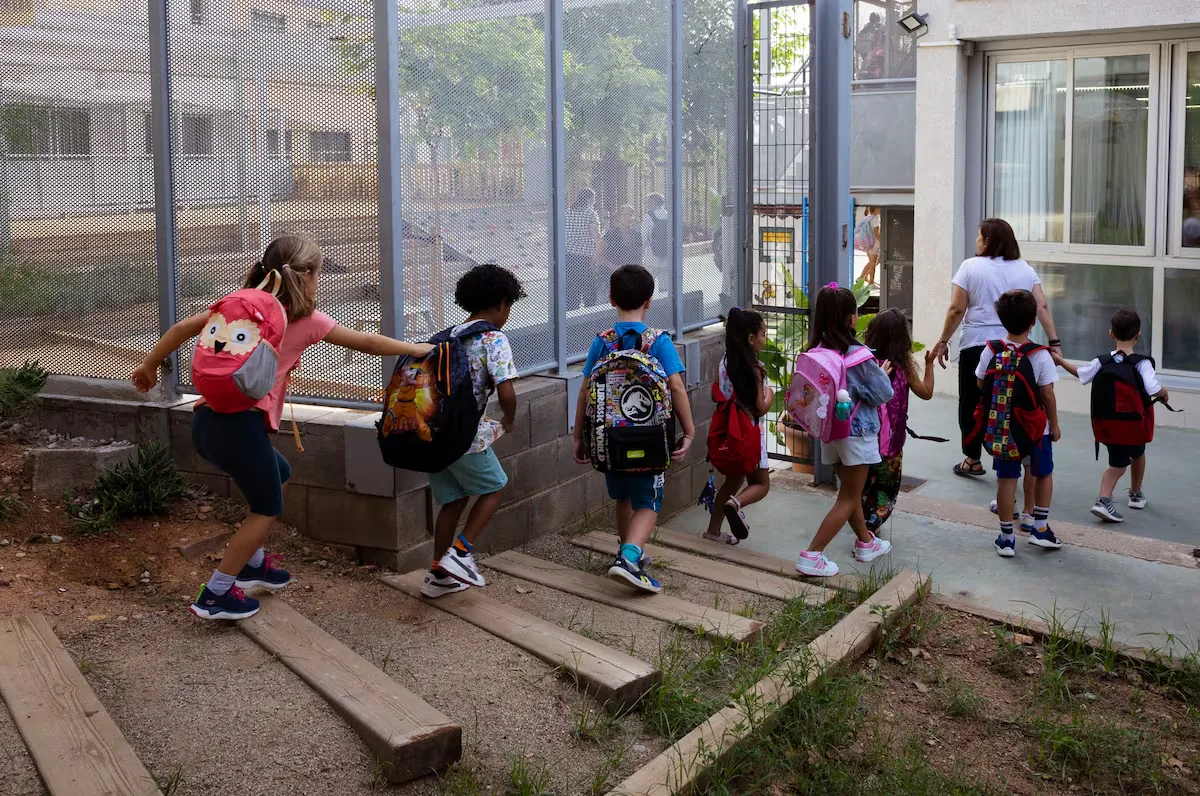
The start of the school year in Catalonia is set for next September 8, but everything indicates it will be very turbulent. If nothing changes —and the stalled negotiations do not suggest it will—, that day teachers will go on strike as agreed in July by the Catalan Educational Assembly, supported by the unions Ustec, CGT, Intersindical, CNT, and COS, which have been drawn in by the discontent of the educational community, which did not accept either the first agreement reached by the Generalitat with CC OO and UGT, nor the second reached with Ustec. The agreements, however, remain valid, and this year the 85,052 teachers and professors, which is 1,103 more than last year, will have an additional 700 euros annually added to their payroll, on top of the 800 euros they already received in May as a specific supplement. The total number of students drops slightly (by 0.04%) to 1,604,988 students.
Read more Barça kicks off its journey in the Liga F with a thrashing of Tenerife
The Government will present this Monday the main figures of the school year, the key lines of the exercise, and will delve into the issues that marked the previous year, especially the error in the PISA tests that does not allow comparison of Catalonia’s results with those of previous years, and the protests of teachers and educators. The school year, therefore, will start exactly as it ended in June: with strikes and protests that have majority participation, and that have overwhelmed not only the Government but also the unions themselves. Teachers demand salary improvements to recover lost purchasing power, but also more resources to address diversity in classrooms, lower ratios, and greater investment.
Pending the strikes and negotiations, the figures of the Catalan educational system indicate that the number of students is decreasing, only offset by the growth in demand for Vocational Training (FP). Students in the general face-to-face regime between early childhood education and FP total 1,312,192 people, 3,789 fewer students, although the figure will increase throughout the year with mid-year enrollments. Adding special regimes, adult education, and other distance learning, the total number of enrollees in the Catalan system amounts to 1,604,988 people, 735 fewer than the previous year, according to data provided by the Department of Education, led by Minister Esther Niubó.
But analyzing them by educational stages, these figures show that the system is experiencing a general reduction in students, especially in Primary education, which has 10,000 fewer than last year, and in ESO and Baccalaureate, which have approximately 1,500 fewer each. In contrast, Vocational Training adds about 16,000 more enrolled students compared to the previous year. This increase means that, overall, the total number of students in the system is only slightly lower than last year.
In contrast to this reduction in students, the number of teachers increases. The school year starts with 94,422 professional staff in the centers, 1,830 more than at the beginning of last year. Of these, the teaching staff will be 85,052 teachers and professors (1,103 more than last year), 4,564 are educational support staff (531 more), and 4,806 are administrative and service staff (196 more). In five years, since the 2021-2022 school year, the teaching staff has increased by 7,799 professionals.
Read more Aubameyang shines for Deportivo against a poor Valencia
Among the measures implemented this year, and which the department defends as improvements for the entire educational community, is the reinforcement of inclusive schooling, both in detection in regular centers —from this year, the program for detecting learning educational needs will also be applied to 5th grade of Primary— and in the number of places offered in special education schools —which will increase by 204—. There are also improvements on the organizational level: the department launches a pilot plan to implement the figure of the center manager or administrator, which is intended to support the management of the centers; and a new document is published to guide centers in the use of Artificial Intelligence. Additionally, the deployment of health professionals will cover half of the educational centers this year —and the forecast is that next year it will cover all—; reading comprehension skills are reinforced in 671 centers; and psychologists are incorporated into the educational system to support teachers, within the program Benestar per estar bé.
The department also wants to try to respond to one of the major demands of teachers, which is to have more support for inclusive schooling. This year, staff dedicated to diversity in classrooms increases by 531 people, including educators and social workers, integrators, and other professional profiles. Also, in response to complaints in the reception system, the Government wants to address this with several measures, including strengthening reception classrooms for migrant students, which increase to 2,141 and grow by 500 staff compared to the previous year. Intensive reception classrooms double, up to 45. And the maximum ratio in this educational resource is limited to 18 students per teacher.
The department also highlights the investment made in educational equipment and buildings, with seven centers starting the year in new buildings (with an investment of 35.4 million) and the construction of another four and two expansions during this year (with an investment of 36.8 million).
Finally, the Government emphasizes that the working conditions of teachers have improved despite complaints and demands. This year, all will have a new improvement supplement from the Catalan Education Service of 700 euros annually, which adds to the specific increase for teachers corresponding to 2026, which they received in May, and which was more than 800 euros. Thus, according to Education’s calculations, this year Primary teachers will have had a salary increase of 1,539 euros, and ESO teachers one of 1,558 euros. A payment is also established to compensate educators for overnight stays during camps and school trips, of 50 euros per night. And the Government will initiate the processing of the Public Authority law, to recognize teachers as public authorities, with specific protection and support measures for their role.
Read more The Civil Guard rules out the involvement of the partner of the woman found dead in Isla Cristina