









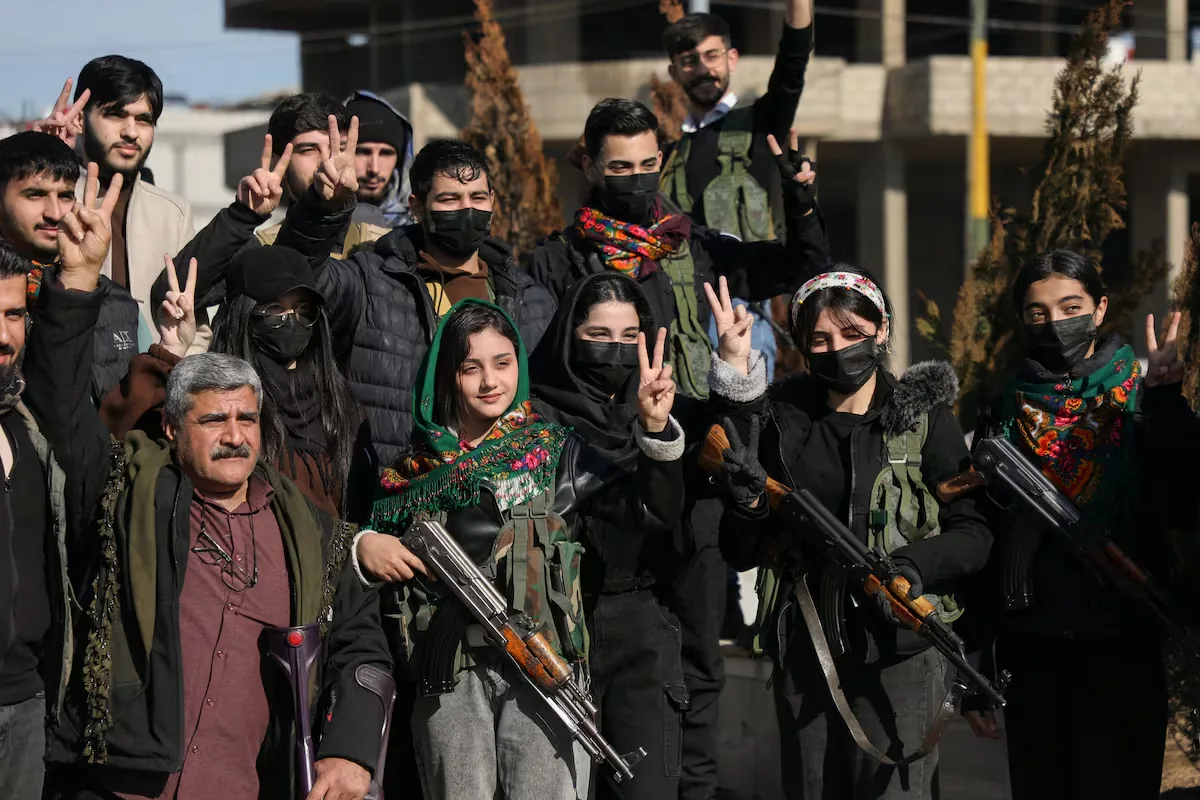
The Kurdish militias of Syria were advancing a decade ago against the forces of the self-proclaimed Caliphate of the Islamic State. And their heroic resistance and bravery in combat against the same jihadists who attacked in Europe won over international public opinion. In Iraq, the Kurdish peshmerga, also taking advantage of the fight against the Islamic State, incorporated new cities into the domain of the Kurdistan Regional Government before a Baghdad overwhelmed by the situation, and the following year they called a controversial independence referendum. In Turkey, the armed group PKK (Kurdistan Workers’ Party) tried to emulate their allies in Syria and brought the war to the cities seeking to create liberated zones, and in Iran, the forces of the exiled Kurdish groups took the opportunity to start a new phase of their border guerrilla war. Ten years later, the tables have turned: the dreams of autonomy have been buried in the face of the harsh reality of the Middle East and the changes in the regional balance of power.
“The dream of Kurdish territorial autonomy has been shelved throughout the region in the medium term. The opportunity that opened up after 2011, with the collapse of the State in Syria and the war against ISIS [English acronym for Islamic State], which led the West to provide weapons to the Kurds, has vanished. That combination no longer exists. And the regional order has been consolidated again around centralized nation-states, which is the structure Turkey desires and which Washington considers easier to manage,” says Ezgi Basaran, professor at the University of Oxford and author of several books on Turkish politics and the Kurdish issue.
The academic emphasizes that it has been a decision made “by the Kurdish movements themselves,” although she qualifies that autonomy as a political project still has support among the Kurdish population and “the demand will immediately resurface if the States fragment again.”
With about 30-35 million people spread across Turkey, Iran, Iraq, and Syria, the Kurds are usually defined as one of the largest stateless peoples in the world. However, and although there are family and commercial ties on both sides of each of these borders, there are strong historical, ideological, and linguistic differences among the Kurds. For example, in Syria and Turkey the Kurmanji dialect dominates, and Zazaki is also spoken; in Iraq and Iran, mostly Sorani.
“Within this new order, both in Syria and Turkey, the Kurds are being told to claim their rights as citizens of the existing States, rather than as an autonomous bloc. The Öcalan movement and Abdi’s have accepted this approach for now, which implies changing a military paradigm, in which they were losing, for a political and legal one, where their long-term prospects are better,” explains Basaran referring to the PKK leader, Abdullah Öcalan, who is negotiating with the Turkish Government a disarmament process, and his disciple, Mazlum Abdi, who this very week announced the dissolution of the Syrian Democratic Forces (SDF) as the culmination of the integration process of the Kurdish militias and their autonomous administration into the Syrian State.
“In Syria, due to the small size of the Kurdish population and its geographical dispersion, maintaining classic territorial autonomy was not viable,” says Roj Girasun, director of the Rawest research center in Diyarbakir, the de facto capital of the Kurds in Turkey. The mistake of the Syrian Kurds, in his opinion, was “not understanding the change in the balance of power” after the overthrow of Bashar al-Assad in 2024: “If they had reached an agreement [with Damascus] earlier, they could have maintained a certain degree of autonomy or special status. But by not doing so, they were forced to negotiate after a military defeat [last January].”
Negotiation processes in both countries are advancing in parallel due to the links between both movements and both central Governments, but, for now, the Syrian Kurds have seen their rights recognized (the official status of their language and education in their mother tongue), while in Turkey the only agreement has been a partial amnesty for PKK fighters. “The Kurdish society [in Turkey] does not see this process as a solution to the Kurdish issue, but as the liberation of the Kurdish issue from the armed conflict, a conflict that had left the Kurds exhausted. They want the issue to be decided by politics. So there is cautious optimism,” says Girasun. This is an important point because, due to the armed struggle of the PKK, any Kurdish demand was treated until now from the perspective of terrorism, so the end of the armed struggle opens a new period.
Read more The signs that warn of painful periods can appear up to three years before the first period
The trap of foreign support
The regional government of Iraqi Kurdistan – born from the US invasion of Iraq that, in 2003, overthrew Saddam Hussein and imposed a federal State – had been a mirror in which Kurdish nationalist movements from other countries looked, but since the failed independence referendum of 2017 – whose results were only recognized by Israel and which most saw as a maneuver by President Masud Barzani to prolong his time in power – political paralysis reigns. The parliamentary elections held in 2024 – two years late – produced a very divided regional parliament which, together with the strong divisions between the two major blocs (the Kurdistan Democratic Party, of the Barzani clan, and the Patriotic Union of Kurdistan, of the Talabani family), have prevented the formation of a government since then.
These divisions have “limited the negotiating capacity” of the regional Government, says Dlawar Aladdin, director of the Middle East Research Institute, based in Erbil, the capital of Iraqi Kurdistan. And the central Government has taken advantage of that. “Baghdad has long been trying to limit self-government, mainly by weakening its fiscal autonomy and through rulings by the Federal Supreme Court on oil exports [now handled by the Iraqi Government],” laments Aladdin.
Iraqi Kurdistan has also opposed Kurdish-Iranian armed groups based there using the territory to attack Iran, for fear of Tehran’s reprisals. When Israeli-American attacks on Iran began in February, these groups showed willingness to collaborate in a ground invasion, a plan promoted by the Israeli Government, but which US President Donald Trump ended up discarding due to pressure from Turkey and other regional allies. “Some Turkish nationalists became paranoid that Israel would transform the region using the Kurds. On the other hand, some Kurdish nationalists attributed an almost mythological power to Israel, believing it could be a decisive actor for the Kurds to gain status,” says Girasun, who considers that the situation in Iran “is not ripe” for Kurdish aspirations.
This point, that of Israel’s support, is interesting. Tel Aviv has gone from supplying intelligence and military equipment to Turkey in its fight against the PKK in the 1990s, to courting various Kurdish movements to weaken the States in the region. For example, in the last two years the government of Benjamin Netanyahu urged the Syrian Kurdish militias to resist Damascus, but they ended up rejecting his support.
And indeed, during the last 80 years, the support of an external power has been key in achieving Kurdish autonomy projects. But it has also been their downfall. The great example is the Republic of Mahabad (January-December 1946), which barely lasted a few months after its sponsors – the Soviets – withdrew from Iran.
“External sponsors have proven to be as reliable as their own interests. The US supported the SDF against ISIS, and abandoned them as soon as they decided to govern Syria from Damascus. Israel offered support to the Iranian Kurds, and then Trump withdrew backing,” Basaran reiterates: “The lesson, which the Kurds have already learned three or four times, is that an autonomy that depends on a foreign air force lasts exactly as long as the foreign power’s interest in it. Not a day more.”