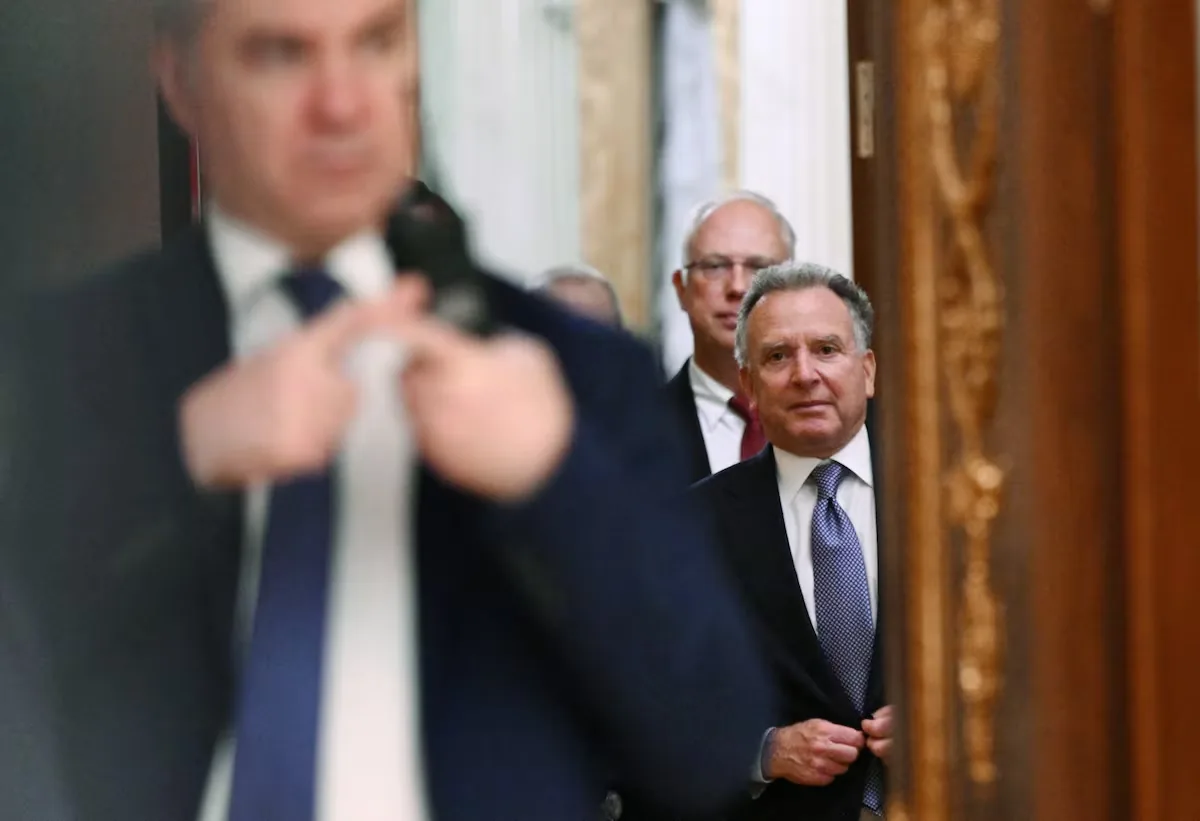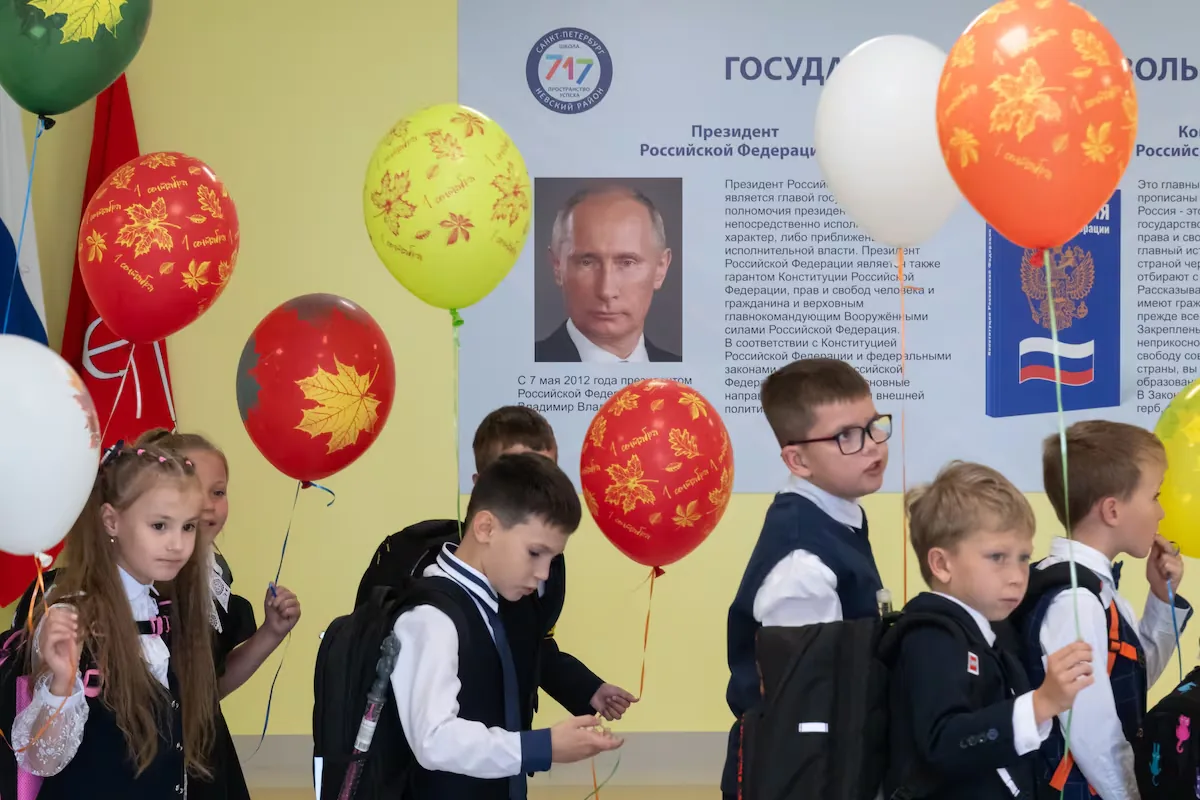
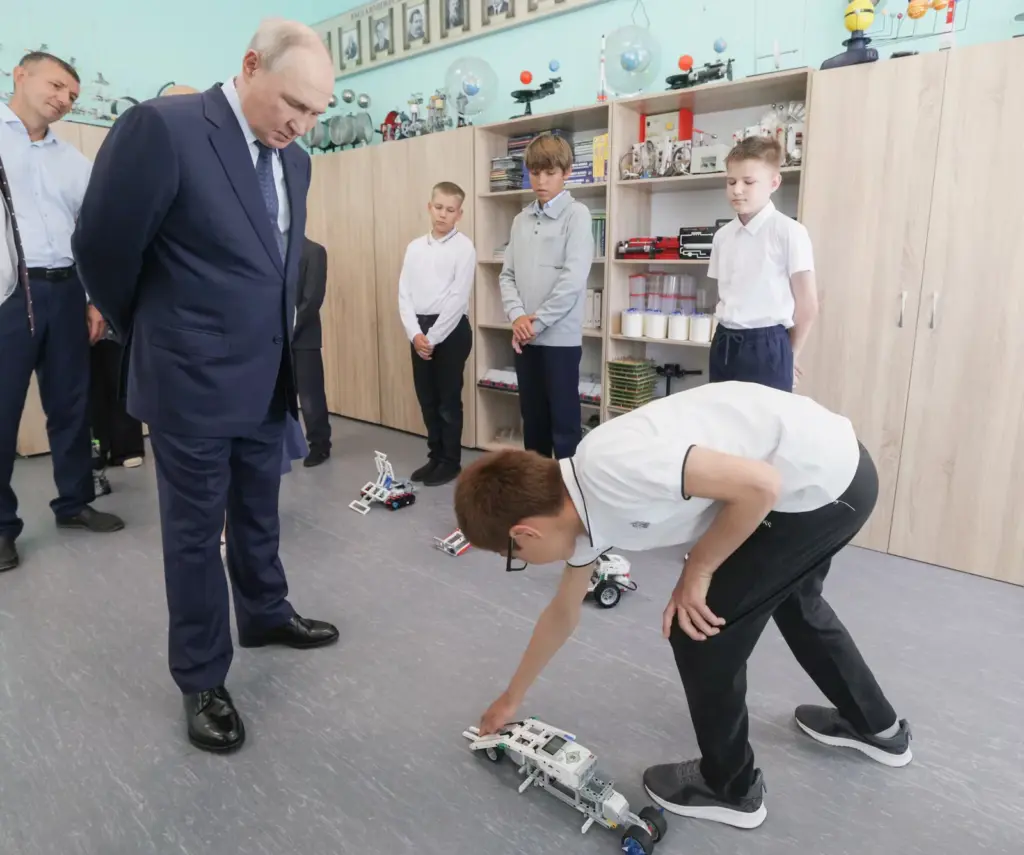
The scene took place last week, during an intervention before students and teachers at Moscow University, on the eve of the start of the school year, which began on Tuesday in the country. Talking about the North Pole, the Russian president, Vladimir Putin, used an unexpected metaphor to refer to the invasion of Ukraine. “Can you imagine? —he said enthusiastically to a professor—. “Orcas eat bears there as if they were little fish. They pounce in groups and boom!, they are torn to pieces. It’s fascinating, it’s like the food chain. We have to tell this to children so they understand the world we live in and why we carry out a special military operation [the invasion of Ukraine],” he stated.
Read more The Kurds bury their dreams of autonomy as they clash with the new realities of the Middle East
The biology knowledge of the Russian leader, as well as the history books he promotes, contained some inaccuracies. However, that scene and that analogy symbolize the foundations of the current Russian school. The professor did not dispute the leader’s words despite there being no evidence that polar bears are part of the orcas’ diet.
In Russian schools, government propaganda is omnipresent. In Moscow, a teacher at a school told children last school year that Europeans “want to kill them.” However, protesting to the administration when the Kremlin is on the teacher’s side is not always a safe option for parents. For example, the case of Alexei Moskaliov, sentenced in 2023 to two years in prison and separated from his 13-year-old daughter, who showed a drawing in class of a family under bombs with the Ukrainian flag. They now live in exile.
A view of history often loaded with propaganda is added in the school curriculum of Russian children with military learning, both theoretical and practical, and much less presence of English or sciences. For example, military teachings will cover 50%, instead of 20%, of the content of the subject Fundamentals of National Security and Defense. This involves learning to operate drones and will also include visits to military training grounds. This subject replaced, as the war progressed, the subject Fundamentals of Life Safety, in which children were taught how to act in case of first aid and emergency situations.
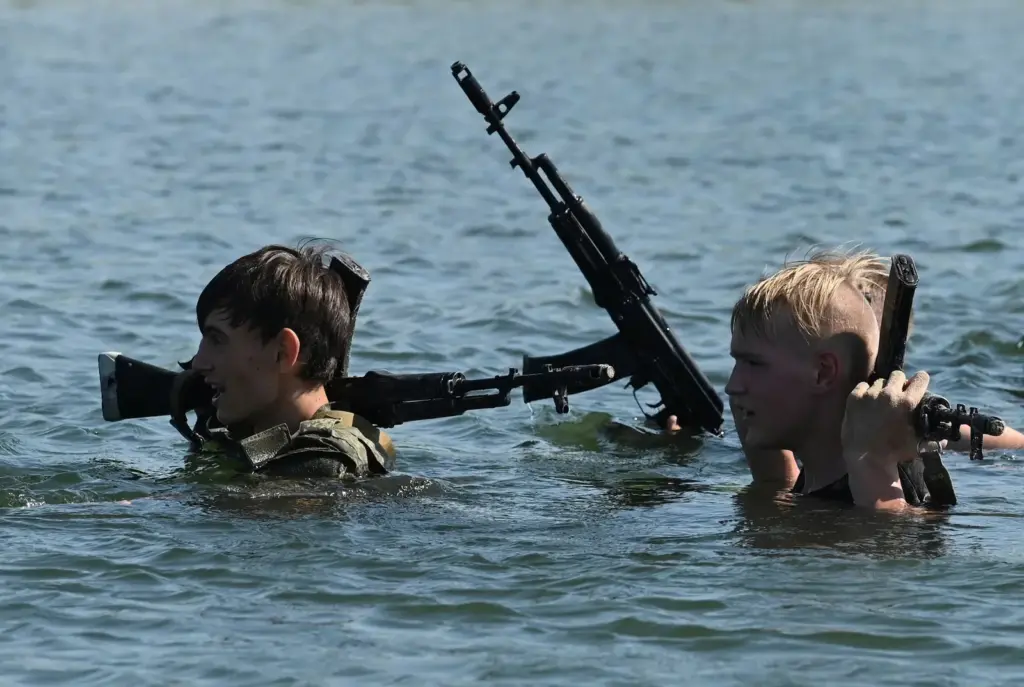
In another subject, called Conversations about What Matters, which was introduced into the curriculum at the start of the 2022 invasion of Ukraine, “civic responsibility, patriotism, and traditional Russian moral and spiritual values” will be taught. In addition to receiving veterans from the Ukrainian front and hearing tales of spies and military chaplains, children will study lessons with telling titles: “Everything for the front! Everything for victory!” or “Unity and mutual aid make a nation strong.”
Furthermore, the Kremlin will reduce social science and English classes this school year and will require one-third more hours of history and “spiritual and moral culture” of Russia, called, following Putin’s instructions, a unique “State-civilization.”
Putinism has precisely rewritten the books of this subject under the direction of the controversial Vladimir Medinsky, a friend of one of Putin’s daughters and former Minister of Culture. The government reinstated his doctorate days after the Russian academic council revoked the title in 2017 for massive plagiarism in his thesis Problems of Objectivity in the Interpretation of Russian History from the Second Half of the 15th Century to the 17th Century. He has also been head of the Russian negotiating delegation in the failed 2025 talks with Ukraine. To justify his failure and demand Kiev’s surrender, he later quoted two phrases falsely attributed to Napoleon and Bismarck.
Medinsky’s history books are a compendium of all government propaganda and hide and manipulate key facts of the 20th century such as the gulag or the Soviet invasions of Czechoslovakia in 1968 and Afghanistan in 1979, while praising all wars fought by Moscow to justify the current offensive against Ukraine. “99% of the comments boil down to the book creating an emotional impression of excessive victories,” Medinsky dismissed in an interview with the magazine Ekspert.
Another novelty of the course is the school textbook History of Donbas and Novorossiya to re-educate children from the occupied territories in Ukraine. Russian Education Minister Sergey Kravtsov stated that the textbook presents “a unified history linked to the Russian history course” and “objective information, unlike the lies found in Ukrainian textbooks.”
The Ministry of Education will also ban phones in class this year and has launched a pilot program in ten schools in each region to evaluate children’s behavior. According to deputy Alexander Rusakov, a member of the Federation Council’s education committee, this system will verify whether students conform “to the values accepted in Russian society.”
Inciting enlistment
The new school year has also started with good news for many Russian families. The Supreme Court banned a week ago the veto on children moving from ninth to tenth grade, equivalent to high school and necessary to enter university, after a wave of rejections of applications to attend that pre-university year in schools across Russia occurred this summer.
Those schools had reduced the available places to attend that year necessary to access Russian faculties, while the government promoted that young people take vocational training courses instead of higher university studies. Parents suspect that the authorities want to encourage a career path that facilitates their children’s passage through compulsory military service, the mili, to then force them to sign a contract with the armed forces and send them to the front in Ukraine. In Russia, in principle, attending full-time university studies entails a postponement of incorporation into the mili.
Still, the situation at universities is tense. The growing difficulties in recruiting new soldiers after almost five years of war have pushed authorities to order centers to urge a percentage of their students to sign a contract with the army. At a university in the Khanty-Mansi region, for example, the administration has asked teachers to convince their students with more learning difficulties “with promises of passing the course or being in safer drone units,” according to what this newspaper has learned.
Read more The signs that warn of painful periods can appear up to three years before the first period