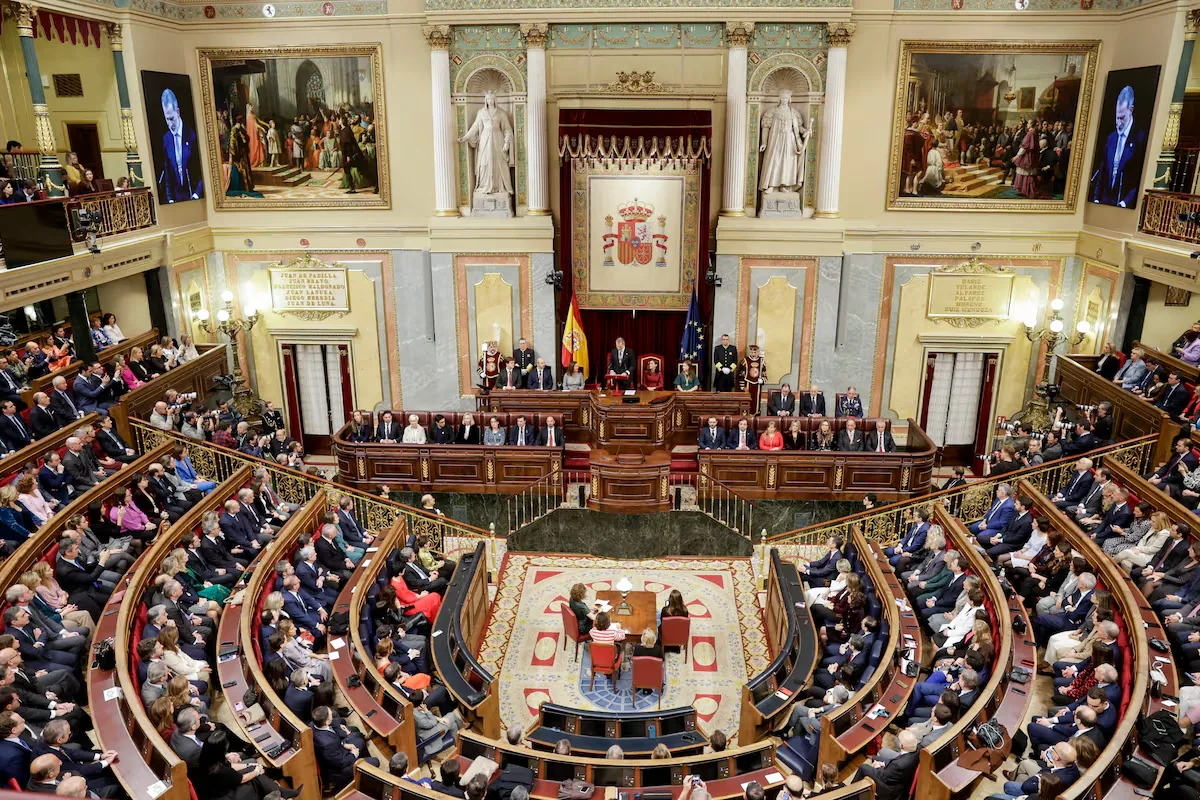
Pedro Sánchez once again insisted this Monday, at the start of the new political term, on his intention to complete the legislature and call elections for next summer, in which he wants to be the PSOE candidate again.
Read more Leaving Ceuta on my own feet: «I can’t take it anymore, I’m leaving. I still don’t know why I came»
Last December, the translator and essayist Pablo Batalla Cueto and the political scientist Estefanía Molina already debated in EL PAÍS whether this XV Legislature is exhausted. With a political situation perhaps more complex and polarized than then, they resume their arguments.
Finishing the job
Pablo Batalla Cueto
Cards on the table: I come to this debate not from a rigorist concern for liberal-democratic liturgy, which seems fantastic to me and better than authoritarianism, but which never gave me goosebumps. I think it’s fine that a German minister resigns because he copied some paragraphs from his doctoral thesis, but the matter does not keep me awake at night. I am concerned about the interest of the left and those social sectors that benefit from its government, and who would be punished by a right-wing one. Are we interested in advancing the elections or completing the legislature? When should they be called to obtain the most flattering result?
Another prior card: we have (they have) settled into the conviction that, whenever it is, the victory of the right will be apotheotic. I am almost sure it will not be so: that victory is likely, but it will not be Felipe González’s 202 seats. The result will be close, like those Latin American elections in which a grandson and admirer of an SS commander wins or loses by a few hundred votes against the candidate who says “please” and “thank you” and supports the eight-hour workday, abortion, Aemet, and CSIC.
Well; is the XV Legislature exhausted? It is a somewhat Byzantine debate. Many times we hold it thinking incorrectly about the entity legislature; judging it as a narrative, a work of art, a novel with introduction, climax, and denouement, or a series with seasons, to which the plot may become incoherent or repetitive, the characters detestable, the dialogues trite, the props bad, and 100 pages or 25 episodes too many. It is none of that. It is a legislative period. It does not have to be beautiful, but effective. Asking about the exhaustion, or not, of the liturgical beauty of a legislature is like questioning the smell of clouds. The objective today is that the legislators are not exhausted. There are a series of laws and measures, halfway processed or in preparation, that would benefit many people and that an early election would leave unapproved: the reform of dependency and disability laws, for example, which must be ratified in the Senate; that of safe digital environments, or a housing decree that includes the extension of leases, in addition to the General State Budgets. Laws that are words in the air of a Parliament whose chatter tires us, or written on dry paper, but which are also human beings and hopes; citizens named Benito or Nuria who wait impatiently for very concrete things of first necessity: a disability recognition, a work that removes architectural barriers from their building.
The General Budgets have no prospects of passing (and the Habermasian idea that they be extended does not keep me awake), but it is still advisable that their debate take place, and the left show a future program: parenting benefit, more public housing, 20-week parental leave… The program for those upcoming elections. It might seem sensible to call them after the budget debate, but before the regional and municipal elections, so as not to annoy the barons by making them bear the anti-Sánchez punishment. It might seem so, but it is not due to how close — it is my conviction — the forces really are. In such a context, any microgesture tips the balance. It is said of the 2014 Scottish referendum that one day when Braveheart was shown on television, the yes to independence began to rise in the polls; and that another day when a documentary about World War II was broadcast, the no rose again. Such trivial details determined whether a millennium-century event happened or not. And if we talk about gestures, an early election is a gesture of defeatism, it conveys surrender, and can become a self-fulfilling prophecy. That is why anti-Sánchez forces demand the advance, and do so with visible fury and impatience instead of a serene pretense of concern for liturgy. Their life depends on it; their result will be better in any other month than August. And the elections, then, have to be in August.
Read more Breaking ties with family: why many people choose zero contact
Resisting for the sake of resisting burns the left
Estefanía Molina
Pedro Sánchez should not complete the legislature. The crisis in Ceuta threatens to be a phenomenon similar to what October 1st meant for Mariano Rajoy: a political mistake that the narrative will not be able to cover and whose consequences can be mitigated in the short term, but will increasingly be felt in the long term, until the end of his presidency. Some left-wing speeches have already shipwrecked at the Ceuta border, and those who will suffer the most will be the PSOE’s partners. Rajoy fell because his then allies found the no-confidence motion convenient. Today the boomerang could turn against Sánchez in another way, making the crisis in Ceuta a hard blow both for Junts and for the PNV, necessary partners to support another possible legislature. The greater the alarm feeling about immigration, the more room Aliança Catalana will have to grow and the more nervous Carles Puigdemont will become, distancing himself from the Government and contributing to maintaining paralysis, including the lack of Budgets. The same applies to the PNV. There is nothing like a Basque Alliance, but there are voices in the party aware that being part of the left block sends votes to abstention.
With whom will the PSOE pact, even in the unlikely scenario of winning an election? That there are municipal elections before the general ones suggests a blow for part of the officialist independence movement and the consolidation of Bildu. If until now enduring served to eat away at the electorate of Sumar or Podemos, today Sánchez is not the only option for his voters: part of the left increasingly bets on territorial parties like the BNG or Adelante Andalucía. At this point, it is worth asking what the goal of the legislature already is, or what will be the last service of this governing left to its voters. Waiting could mean that a more established right comes to power and that the PSOE continues to dry up territorially. Panic spreads in many socialist federations.
Ceuta is also paradigmatic because it shows to what extent public discourse is already dominated by the right. The left today finds it harder to polarize with Vox on this issue. From the traditional framework of welcoming the immigrant, today the public discussion pivots around the idea of returning: how to reform the immigration law or speed up expulsion procedures. There are signs that some lefts do not live outside the demographic turn. In December, Oriol Junqueras hinted that Catalonia does not have the capacity to reach 10 million inhabitants, when until then the slogan had been Volem acollir. The Ceuta crisis, which will last a few months, is also damaging for Podemos, accused of lack of realism. Likewise, Ceuta breaks the narrative of the supposed plot that the PSOE had been promoting, since the responsibility for controlling the border lies with the Government, which delayed a month in creating the unified command. If the only yes is yes law knocked out the left of 15-M in the field of feminism, failing to ensure order in a region of Spain is very damaging for a pillar of the State like the PSOE. For the first time, blaming the far-right international, hoaxes, or the algorithm does not have the same evasive effect of responsibility as in other crises.
That Sánchez wants to hold on speaks of the political animal he is and his combative character. Perhaps the question is no longer whether the right will govern, but with what majority. Or even how long the left will take to return to power, if everything around the PSOE, including its partners or the party itself, has become scorched-earth politics due to our president’s decision to resist. What scant counterpowers will remain in Congress? From October 1st we learned that the Executive can fall overnight, because discontent is not buried under the apparent normality of the legislature continuing. From the Ceuta crisis, although in another way, perhaps we learn the same. There are moments that crystallize cycle endings or accelerate previous underlying currents. A victory, sometimes, is also a timely retreat.