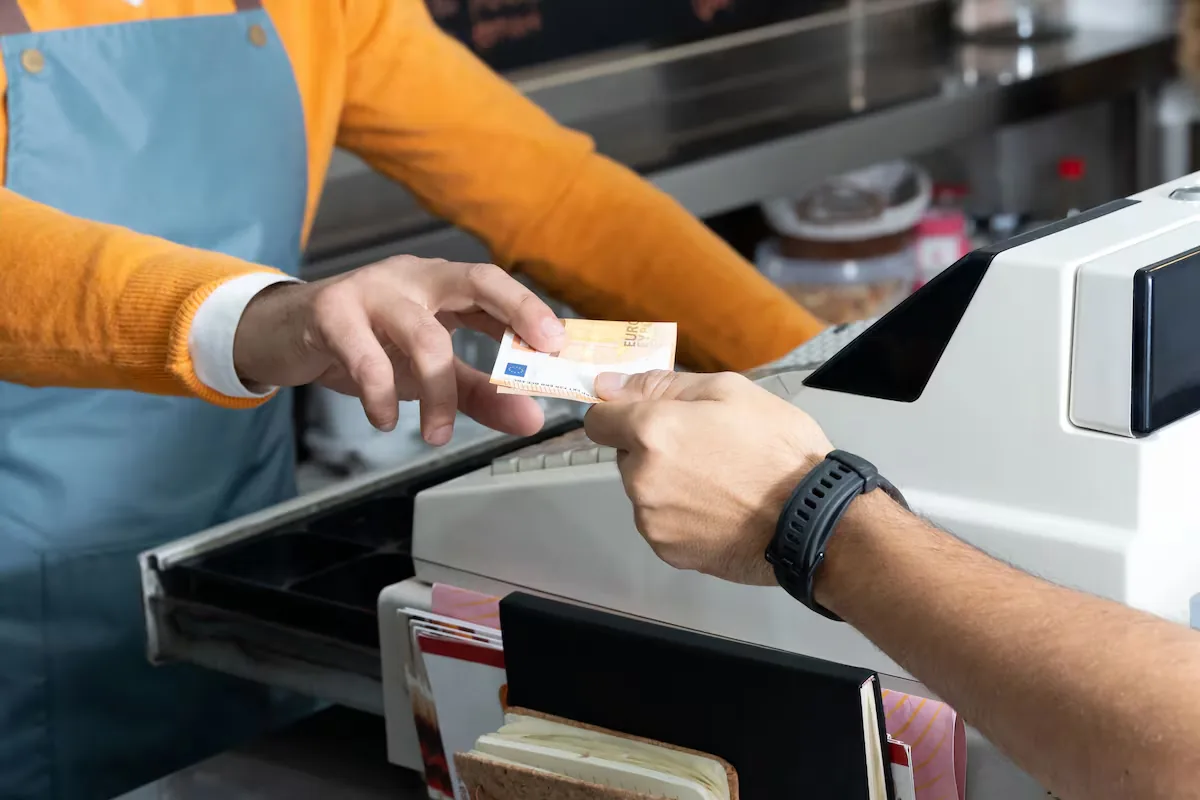
The voracious increase in card payments has meant that payments with coins or bills now only account for 57% of purchases. According to data from the Bank of Spain corresponding to the second half of 2025 and released last July, card transactions increased by 11.4% compared to the previous year, with 13.009 billion in one year. The amount of these transactions reached 219 billion euros, 10.9% more than in the second half of 2024. Adding the first half of 2025 (195 billion), we reach 414 billion euros paid with plastic in one year. The average amounts of each payment are decreasing (from 31.9 euros to 31.6), and that means millions of people now pay daily with a card for a loaf of bread, a liter of milk, or sweets for the kids.
Read more Is the reactionary wave a new counterculture?
Nowadays, one wants to carry cash and generally does not succeed, because ATMs are disappearing. From 61,714 of these machines in 2008 we have gone down to . That is, 18,404 ATMs removed in 17 years, at an average rate of 1,080 fewer every 12 months. Banks act friendly, but they have no mercy; especially not with rural areas.
This causes the card to increasingly come between the consumer and the provider, with its banking commission (around 0.4%); and that we give the bank the data of our purchases and our life. The more we pay by card, the richer and wiser the banks become and the poorer the shops. With the aggregated data from the two semesters of 2025, financial institutions took around 0.4% of 414 billion euros, that is, the not insignificant sum of 1.656 billion.
For all these reasons, it has become normal that every now and then they ask us at the kiosk: “Cash or card?”, something unusual in small purchases just a few years ago. And sometimes I have heard: “Card or cash?”. This formulation is understandable, but improper: paying by card also means paying with money: “plastic money,” as the academies state (“Payment system by credit card”), but money nonetheless.
In the 18th century, when someone paid in cash it was celebrated with the Latinism numerata pecunia, a phrase that the Dictionary of Authorities (1734) defined as “cash money,” with the mark “festive style” (jocular, joking). However, it was not until 1837 that the entry “cash” (previously only “true, certain”) acquired the economic meaning it has today, when it incorporated the equivalence of “metal money.” (Currently it says “in coins or bills”). That synonymy was changed in 1936 to “numerary,” a term that since 1817 had the meaning that still survives there: “Coined money or cash.”
Read more Matching toasters and kettles that make breakfast a pleasure
Therefore, when we do not pay “by card” we have the alternatives “in cash,” “in metal,” and “in numerary” (in addition to “with coins” and “with bills”). Among these possibilities, “in cash” usually prevails. The option “in numerary” became outdated, and “in metal” conveys to many people the connotation of “coin” (although it actually also includes bills).
Cards transfer, then, “ready money” (“money ready, cash and current”), to which we sometimes add “and ringing” because we hear its pleasant clink against the surface of the bar counter. In fairs and taverns of the 16th century, cash was also called “money on the board,” since it was dropped against pure wooden tables.
With all these options, it would not be necessary to say “I pay in cash” (in cash), an anglicism that shows signs. But every time we use a card we know what that means, not just in the Dictionary but in reality: giving a little alms to the bank.