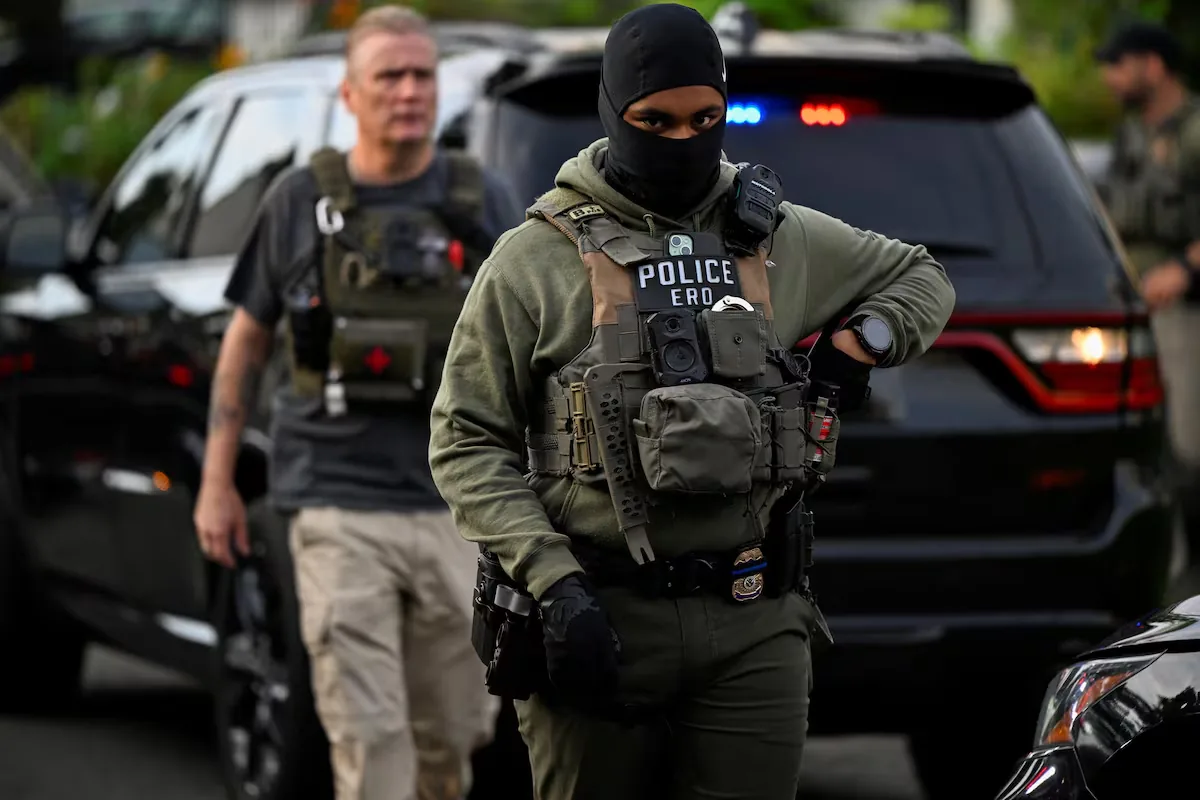
California has become the first state to put a stop to the new arsenal of the Immigration and Customs Enforcement (ICE) service to detain migrants. The legislative chamber approved on Monday night a proposal that prohibits the use of electric gloves, the penultimate acquisition of the agency to use in its operations. Robot dogs and a device that forcibly stops vehicles pursued by agents are new weapons with which the agency intends to boost arrests.
LaShae Sharp-Collins, a Democratic representative from San Diego who introduced the bill in California, described the gloves as an “untested” item and a “new and dangerous tool.” She pointed out as a concern that the gloves “were in the hands of the least trained law enforcement agents and most likely to act outside the law,” referring to ICE.
The governor, Gavin Newsom, a Democrat, has until September 30 to sign the bill. It is almost certain that if he signs it, as expected, the law will face legal challenges.
The agency closed a contract last month to acquire 6,650 gloves that administer an electric shock upon contact with the skin. With a play on words, the device is called GLOVE, an acronym for Generated Low Output Voltage Emitter. The Department of Homeland Security (DHS) will pay $16.7 million to Compliant Technologies, based in Kentucky, which secured the contract to manufacture them. It is the first deal this company has made with the government and there was no bidding process to award it.
The user manual for the gloves indicates that they may increase the risk of sudden death and should not be used against elderly people, young children, pregnant women, or people with “severe disabilities.” The excessive use of force and the impunity with which immigration agents act, who have shot and killed four people so far this year, have fueled criticism of the purchase of the gloves and the use officials may make of them.
ICE justified that the tool would serve “to reduce the intensity of incidents that could lead to a greater reliance on physical force, affecting safety and community relations.” On the contrary, 16 Democratic senators signed a letter addressed to the acting director of ICE urging him to cancel the acquisition due to concerns raised by the lack of training of its personnel and the lack of accountability for their actions.
Read more Apple approves $55 million stock compensation for John Ternus
Another of the new tools agents will have are robot dogs. ICE plans to spend up to two million dollars acquiring the machines from Boston Dynamics. The robot known as “Spot” is one of the most recognized products of that company. It is a quadruped machine with the appearance of a dog, equipped with cameras and sensors capable of detecting elements such as hazardous gases. It can also climb stairs and move over uneven terrain. The metallic canines will serve “for inspection, situational awareness, and risk assessment in environments that may pose dangers to personnel,” according to DHS.
The Secret Service also uses this technology. In 2024, Boston Dynamics’ robot dogs were seen patrolling Mar-a-Lago in viral social media videos. The robot dogs, which are equipped with 360-degree cameras and can open doors, are also used by police departments across the country.
Another of ICE’s bets to facilitate agents’ work is the grappler, a device capable of stopping a car’s movement. According to Scripps News, the government signed a contract dated August 14 for the purchase of a “vehicle stopping device.” In July, ICE agents shot and killed two drivers — in Maine and Texas — who did not stop for unmarked ICE vehicles conducting immigration enforcement operations. In both cases, the driver was not the intended target.
Now, ICE is set to spend $29,000 on a system from Stock Enterprises LLC, a Phoenix-based company. The device, which would be integrated into the ICE vehicle, launches a net that entangles the rear wheel of the pursued vehicle. Some police departments have this tool, but limited use is not recommended because it carries risks that the targeted vehicle may swerve in various directions before stopping.
ICE’s new tools arrive amid controversy over the use of Flock cameras, which read and record car license plates and have rapidly spread across streets nationwide. The company Flock has denied having a contract with ICE, but the agency uses the information they provide through local police collaboration, according to the ACLU (American Civil Liberties Union).