









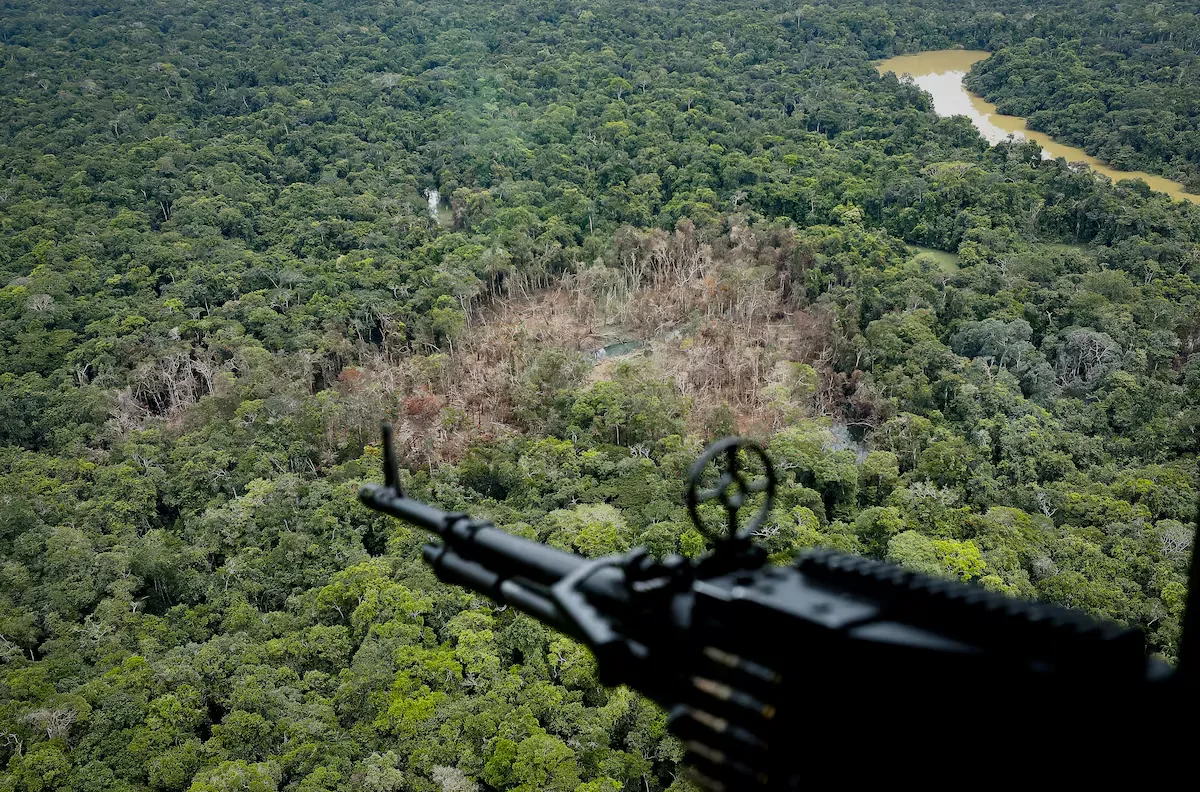
If there is one thing Abelardo de La Espriella has continued from Gustavo Petro’s government, it is the strategy of bombings on armed groups’ camps where minors have died. There are differences, of course. The current president lumped them all under the label of “narcoterrorists” and canceled the main dialogue options; but the bombing attacks on camps remain the same. And the state failure that the death of minors recruited by armed groups represents, also.
In the last three weeks, De La Espriella has ordered three bombings. One against ELN structures in Catatumbo; another against the dissidents of alias Calarcá in Guaviare; and one more, on Sunday, against the dissidents of alias Iván Mordisco. In the latter, according to the president himself, 20 members of that group have died and two minors were recovered. “We are after you, Mordisco. You will not escape. When you least expect it, a bomb will fall on you,” he said in a video. Mordisco has been the bogeyman of three presidents: Iván Duque declared him dead; Petro remained between dialogue and confrontation with him; De La Espriella has already made him his main target.
All three presidents have in their record the death of minors in bombings. During Duque’s four-year term, there were 42; under Petro’s government, it reached 62; in just over three weeks of De La Espriella, according to the Institute of Legal Medicine, there are at least 4. And the data from the last operation De La Espriella mentioned is still missing. In none of the administrations has there been a known preventive and forceful strategy to prevent those minors from ending up recruited. Only under Petro was there an attempt to strengthen the Intersectoral Commission for the Prevention of Recruitment, Use, Utilization, and Sexual Violence against Children and Adolescents in Colombia (Ciprunna). But recruitment—driven by social networks—never stopped.
In fact, a week ago Human Rights Watch stated that the Public Policy for the Prevention of Child Recruitment by Organized Armed Groups and Organized Criminal Groups (GDO), approved in 2018, is outdated “and lacks a clear action plan, a specific budget, and a monitoring system.” And if, as the Ombudsman’s Office has denounced, between 2021 and 2025 armed groups have recruited approximately 1,500 children and adolescents, it is very likely that they are in the camps and at risk of dying.
President De La Espriella has shown, however, a different way of communicating his security strategy. Short and cinematic videos, different from Petro’s long and poorly written messages that diluted the actions. The current president’s brand has been seen when announcing transfers of high-risk criminals to maximum-security prisons or in images of himself signing extraditions, particularly of some criminals who were in peace negotiations with the previous government. What he has not yet shown is what he will do to prevent the vicious circle of child recruitment, which is seen as one of his main challenges.
Other stories
This is a selection of news, reports, or interviews published in EL PAÍS América Colombia:
The multiple internal fights fracture the stability of the Historic Pact
The vote of five congressmen from the Petro faction in defense of Álvaro Uribe unleashes a wave of criticism and questioning within the party.
The xenophobic discourse arrives in Colombia
Editorial. With his call to deport immigrants, De la Espriella breaks an important political consensus.
Social leader couple María Ovidia Palechor and James Flor shot dead in Cauca
Read more ‘La mesa de Hora 25’, live on EL PAÍS
The crime was committed in the early hours of this Tuesday at their home, in the rural area of the municipality of Cajibío, one of the most violent areas of the department.
Doris Salcedo, the artist who melted the FARC weapons: “Goya takes away the heroic character of war”
‘The Disasters of War’, by the Spanish artist, is exhibited in ‘Fragmentos’, the counter-monument born from Colombia’s peace agreement.
Alma Guillermoprieto: “Violence is an obstacle to everything”
The great Mexican chronicler presents in Colombia ‘This Improbable Promised Land’, her latest book of reports.
Uribe’s defense seeks to bring to Congress the investigation of two paramilitary massacres
An unprecedented vote, which united Uribista and Petro congressmen, opens a conflict of competencies over who should investigate the former president for the massacres of El Aro and La Granja, Congress or the Prosecutor’s Office.
Technocracy loses the battle against fanaticism at the start of De la Espriella’s government
At least three people suitable for their positions were appointed and dismissed within days because their stances were not aligned with the far-right executive.