









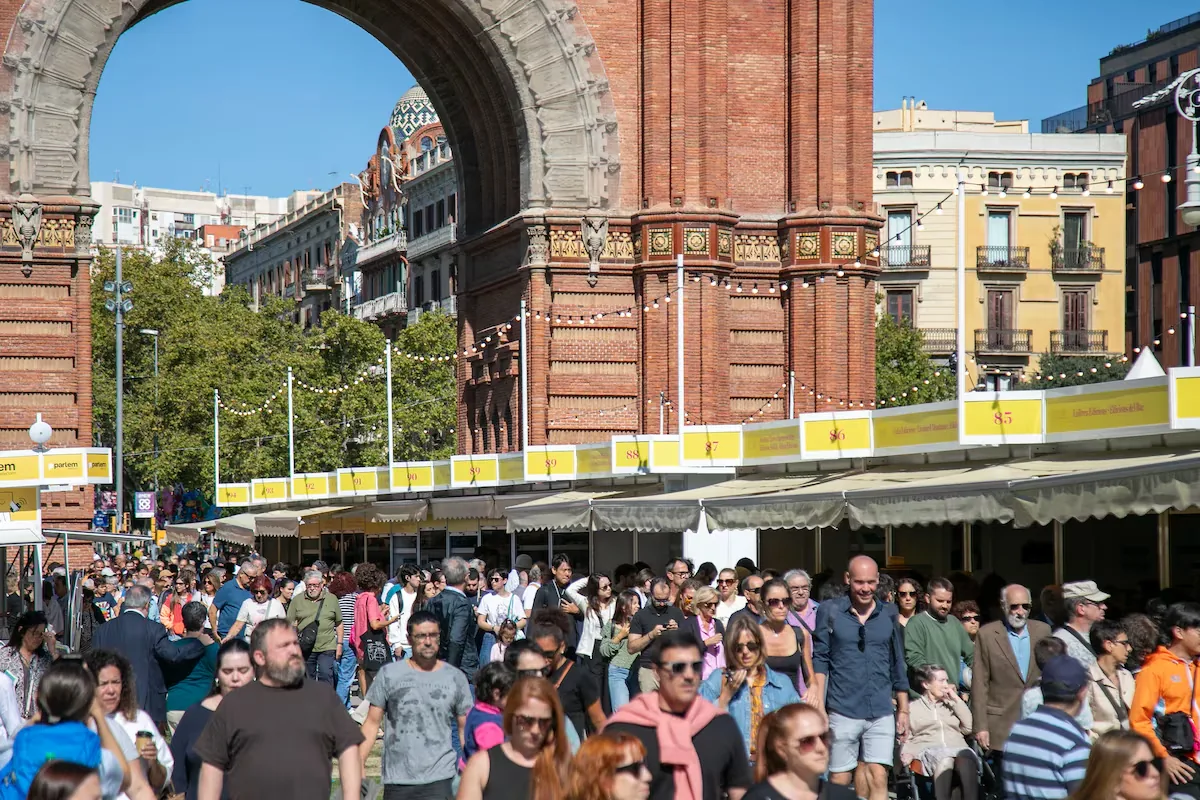
Coinciding with the rentrée literary season, the Setmana del Llibre en Català, the “Sant Jordi of autumn,” presents once again its program: more than 300 activities, most of them to present the editorial novelties of the season. Between September 18 and 27, the fair repeats for the third consecutive year its venue at the Lluís Companys promenade. Cristina Domènech, director of the Setmana, and Oriol Magrinyà, president of the Association of Catalan Language Publishers, emphasize that “this year, more than ever, the language will be at the center, the Setmana wants to address readers in Spanish.” With more than 332 exhibitors (four more than last year), the fair’s aim is to show the “diversity and strength of the Catalan publishing sector.” According to Magrinyà, readers will find everything from current translations of the thoughts of Richard Dawkins and Thomas Hobbes to comics and manga or cookbooks: “That was unthinkable a few years ago, it was necessary to resort to Spanish; now there are no excuses not to read in Catalan.”
The Setmana’s program is twofold: on one hand, it wants to show that editorial diversity, inviting 229 publishers from Catalonia, Valencia, the Balearic Islands, and Andorra to showcase their catalog; on the other, it aims to be a showcase for the editorial novelties of the season. Writers such as Laura Gost, Miquel de Palol, Carme Arenas, Sebastà Perelló, Ramon Mas, Albert Om, Oriol Canals, or the internationals Adania Shibli, Colm Tóibín, or Claire Pollard will participate in dialogues and signings to present their books.
As every year, there will be thematic spaces dedicated, for example, to comics, historical novels, or the rise of recoveries of Catalan women writers from the 1930s. There will also be stages for children’s and youth programming.
The Setmana awards two prizes each year for Career and Dissemination, which this year will honor writers Ramon Solsona and Màrius Serra, respectively. There will also be events dedicated to the winners of other literary awards.
Read more Bombings and child deaths: the only continuity from Petro to De la Espriella
Although the format will be similar to previous years, there will be some novelties. On one hand, the Setmana wants to respond to one of the usual criticisms, which is the fear of some booksellers of being overshadowed at a moment of high sales like the start of the school year. “A pilot plan will be launched to bring the Setmana’s activities to bookstores throughout Catalonia,” explains Magrinyà. Another novelty this year is a space dedicated to showing all the professions linked to the book, which each edition will dedicate to one profession. The first turn will be for librarians. And also in the line of expanding the reading public, Domènech has also highlighted activities dedicated to digital formats of literary dissemination: each day there will be an activity dedicated to a booktoker and also a guest literary podcast recording a live episode from the fair.
Magrinyà points out that, although the sales figures of the Setmana vary each year (mainly depending on the rain), it is a moment of great media exposure for literature in Catalan, which, after Sant Jordi and Christmas, experiences its third best moment of the year.
Both Edgar Garcia, director of the Institut Català de les Empreses Culturals, and Xavier Marcé, Culture councilor of the Barcelona City Council, highlight the virtues of the fair’s location at the Arc de Triomf. It is an accidental venue: in 2024 the Setmana had to move from Moll de la Fusta due to the America’s Cup sailing event, but afterwards it was maintained because it was considered to attract more passing visitors: “This change, along with the coincidence of the fair with La Mercè, has allowed breaking down barriers. Now the fair takes place in festive normality.”