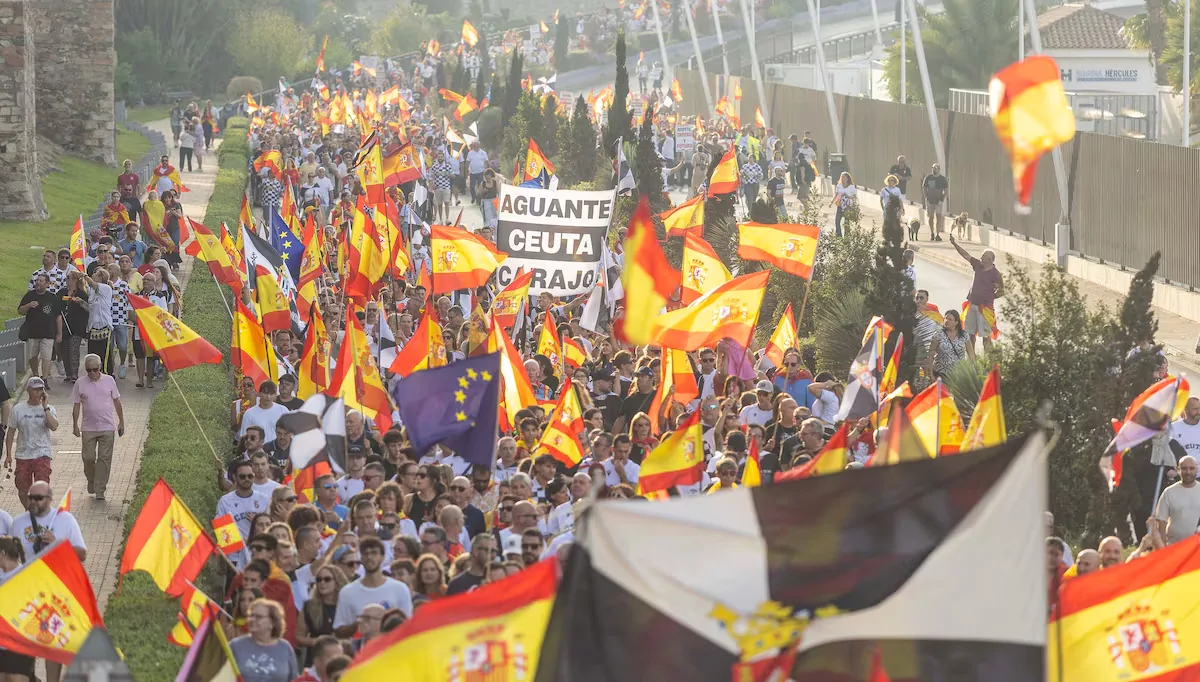
Ceuta took to the streets this Wednesday in a large demonstration to demand solutions that restore normality to a city that has been under heavy migratory pressure for more than a month. The people of Ceuta have been gearing up for a week, with a series of protests and acts of advocacy. But the call for September 2, the day of the autonomous city, was the big bet to highlight the discontent of a city of 83,000 inhabitants that continues to suffer the effects of the massive entry on July 30 and 31 of more than 70,000 people and the presence in its streets of thousands of migrants living on its beaches, parks, or streets, waiting to know what will become of them. The event gathered about 20,000 people, according to data from the Government Delegation, who claimed their own identity and belonging to Spain for at least three hours. Amid strong criticism of the Government’s management, the demonstrators demanded the expulsion of the migrants and that they be defended against Morocco.
The Police report pointing to the role of Moroccan agents in the massive entry of migrants on July 30 and 31 has been very present both in the chants of the people of Ceuta and in the conversations of the demonstrators. The protest route started at seven in the evening, in the area of the Royal Walls, shouting “Where are the reports?” and “United Ceuta will never be defeated.” Before, they had been warming up with “I am Spanish,” “A caballa (colloquial demonym for the people of Ceuta) never surrenders,” and “Invaders, expulsion.”
The organizers of the protest, the Federation of Neighbors of Ceuta and the 21st Century Association, have made an effort to emphasize the apolitical and peaceful nature of the call, which followed a route that did not exceed one kilometer until the reading of the manifesto prepared for Ceuta Day. The president of the city, Juan Jesús Vivas (PP), joined the gathering an hour later. Emotional, he thanked his citizens for their show of unity. “This strength is unstoppable,” he told them. The popular leader also thanked the support and solidarity of the rest of the country with the situation the autonomous city is going through. “Thanks to the Spaniards who tell us we are not alone, who tell us that Ceuta is not for sale, it is defended.” After his speech, the Spanish anthem and the Ceuta anthem were played. The demonstrators announced that they were going to the Government Delegation to convey to the Executive, within their freedom of expression, the same message: that the city must be defended.
The banners called for help from Europe: “SOS Europe Save Us” or asked “Today Ceuta, and tomorrow?”. They also demand an “exceptional legal solution” for the departure of the migrants. After a night of taró ― the dense fog characteristic of the Strait area ― the day was sultry, which did not prevent the people of Ceuta from draping themselves with the flags of Ceuta and Spain, as if they were capes, or as skirts, often both. Or wrapping themselves in them as if they were sarongs. Locals of all ages marched, from adults to children, young and old, and wore, in addition to the flags, t-shirts with slogans such as “Ceuta is Spain,” “Ceuta pride,” or “Ceuta is not for sale, it is defended.”
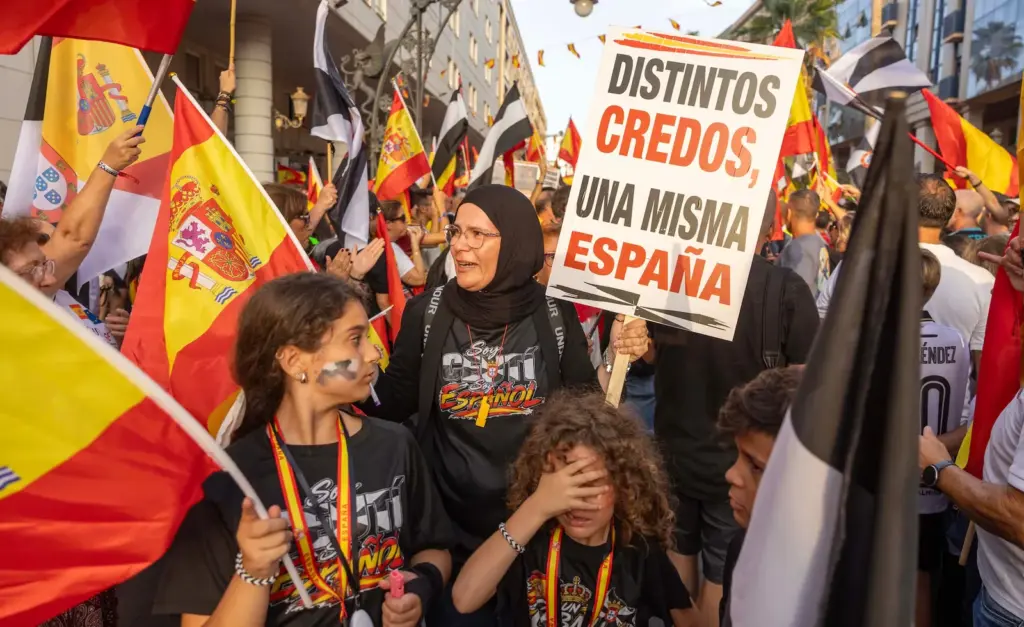
María Dolores, a resident of the Los Torreones neighborhood in El Mixto, explained to her granddaughter that it was the first time she had demonstrated in her 67 years of life and that she had experienced it at 14 years old. “It is so that it can be seen that what they have done is wrong,” she says referring to the Government’s management of the migratory crisis. The woman, who traveled on the 29th to the neighboring Moroccan town of Castillejos, emphasizes that they already saw that day “the mountain full” of people ready to cross. “If we saw it, how are they not going to see it, who with cameras see even the monkeys of Gibraltar?” she wonders, while the granddaughter smiles. “Since this happened, I only go out in the morning, with my husband to shop. They have to provide a solution both for the migrants and for us,” she demands. “I don’t care which party it is, how can they say they have four computers to process expulsions! What a shame!” The woman says her son befriended one of the migrants, who lived on the beach and that the young man had returned to Tetouan after having a very hard time during this month. “They (the migrants) are also victims of Morocco, because they were deceived by being told that here they would have work, that they would not have problems,” she considers. Sitting on a bench, she does not want to follow the Government Delegation because she is afraid that trouble will break out there. “We are not xenophobic or racist, we live in coexistence,” she claims. “But it is just too crowded!”.
One of the most repeated slogans has been unity and not falling into provocations. The different WhatsApp groups in which the gatherings have been organized have been calling for calm for days, in an attempt not to break the image of the city of the four cultures (Christian, Muslim, Jewish, and Hindu) and that no radical, whether from the far left or the far right, provokes disturbances that divert their cry for help. They have also been instructed not to get into provocations, in case they encounter any irregular immigrant during the route.
Read more Morocco shifts the Ceuta migration crisis towards the issue of sovereignty
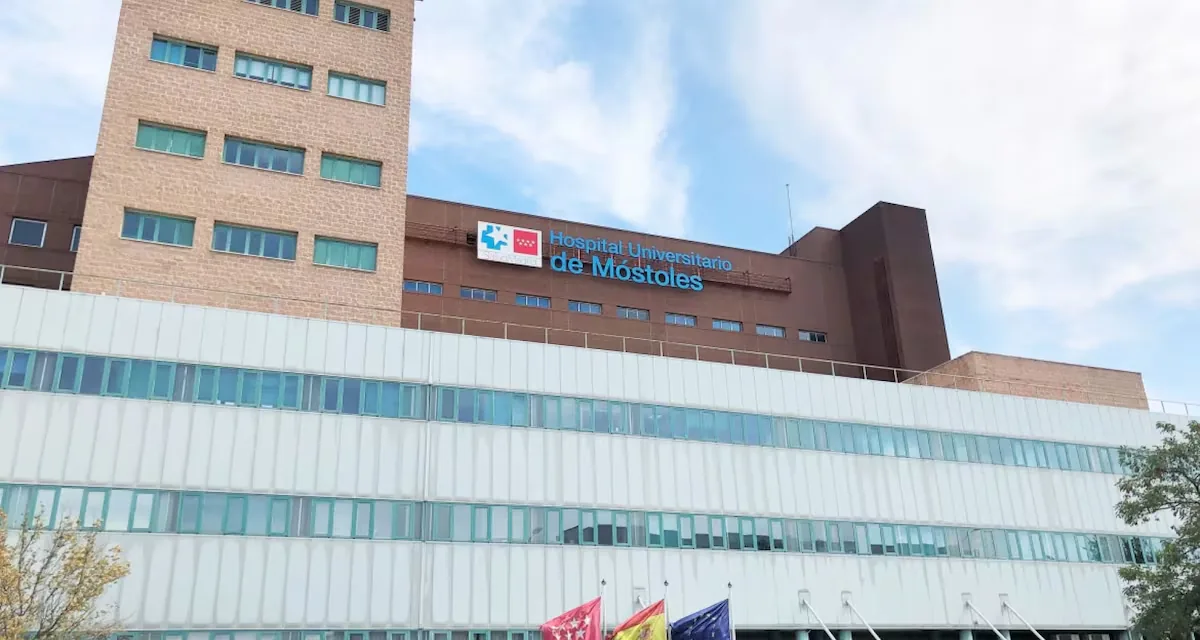
At 6:00 p.m., neighbors from areas heavily affected by migratory pressure such as Loma Colmenar, where an emergency reception center for migrants has been set up, or El Príncipe ― both very close to the El Tarajal border and with a strong presence of Muslim neighbors ― had organized to attend the demonstration. Farida, a Ceutan and Muslim, lives in that part of the city, in the green apartments opposite the university hospital. She says that, in the first days, the migrants moved around the ground floors of her building “like zombies,” that they asked for money and also fought among themselves with knives. “Our husbands went out to the neighborhood to put some order, to scare them away. Unity is strength, but they come back. This is a nightmare,” she sums up. She also criticizes the Government’s management: “Hopefully we have the support of the EU because this Government has sold us out. They should stand up for us because this city is Spanish.” The woman feels that at the beginning of the crisis what was happening in the city was not well reported, but now their situation is being conveyed.
“We come because we are caballas and Spanish, as well as Muslim,” claims Husna, a resident of the Hadú neighborhood, at a moment in the afternoon when the fans begin to pick up speed due to the humidity and the crowd of demonstrators. The woman had met with her sister and they met two friends, one from Loma Colmenar and another from Miramar. “We don’t feel fear, but we do feel overwhelmed. Only once, when I was leaving the gym, I met a boy who was sniffing glue and I got scared. But they are begging everywhere, at the supermarket, on the streets, and there is a stench. Ceuta was a clean city, where life was good,” she explains, about her reasons for protesting.
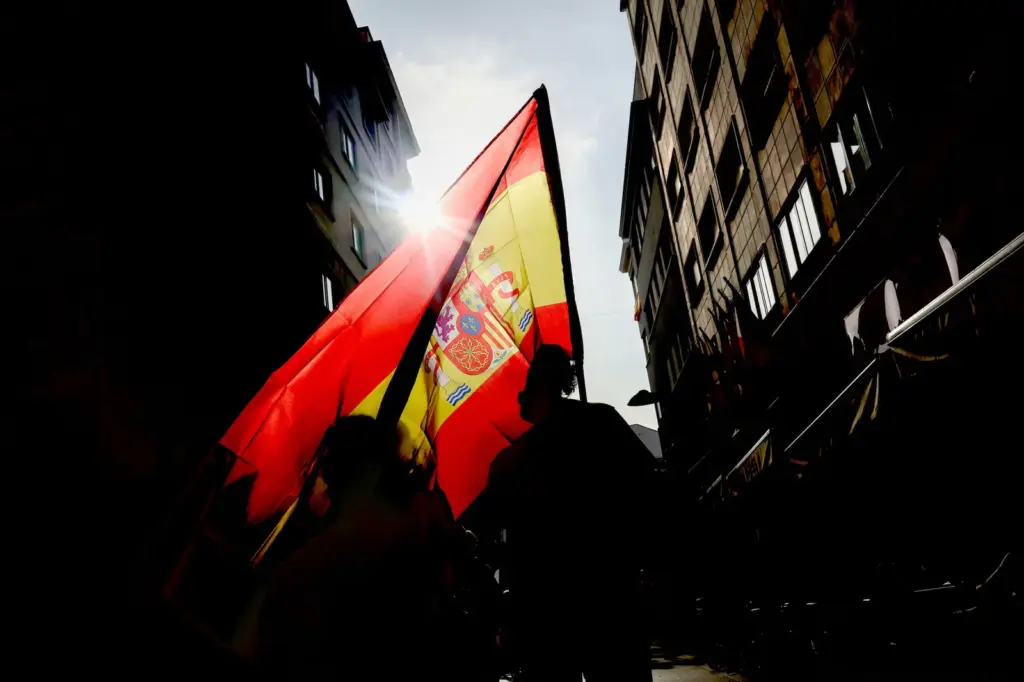
In the previous days, the caballas (colloquial demonym for the people of Ceuta) had been arming themselves with flags of Ceuta and Spain, to the point that bazaars and shops made urgent orders. At noon, the more than 600 attendees who filled the auditorium of the Revellín Theater, where the institutional acts of Ceuta Day were held, had a preview of the city’s advocacy, its own identity, and belonging to Spain. Among the guests were the Minister of Territorial Policy, Ángel Víctor Torres, appointed by the Government as responsible for the unified command to manage the city’s migratory crisis, and the Minister of Migrations, Elma Sáiz, as well as the Government delegate of the city, Miguel Ángel Pérez Triano, who was booed. The three Government representatives stoically endured the demands coming from the audience and also from Tarek Mizzian, nephew of one of the posthumously awarded, Assembly deputy Mustaffa Mizzian. During his speech, the relative of the awardee criticized the “abandonment” of the socialist Government to the city and demanded “diligent measures” so that the migrants still in the city return. “I had to send my wife and son to the peninsula because they cannot go out on the street calmly,” he lamented. The auditorium stood up applauding.
President Vivas assured that he is living “the most difficult of all September 2s” in the 26 years he has been governing. “All our energies must be focused on getting Ceuta out of the ICU, on returning to normality,” he requested. The only way to achieve this, according to the Ceuta Government, is “the return to Morocco of all” the migrants who arrived at the end of July, although he also used a conciliatory tone when he insisted that there is also a humanitarian emergency and that it is necessary to have provisional accommodation spaces for immigrants to fulfill this function, but also that the return takes place “as soon as possible.” The placement of these facilities is one of the issues that has caused the most controversy, either because they take away public spaces from the people of Ceuta, such as sports centers, or because of their proximity to residential areas or schools. Vivas insisted that the people of Ceuta cannot continue living in a “pressure cooker,” fearing to regret an event that has “irreversible effects,” and demanded, in front of the Government representatives, to have “a defined time horizon” to achieve it.
Read more Donald Trump claims that Venezuela is not yet ready to go to elections