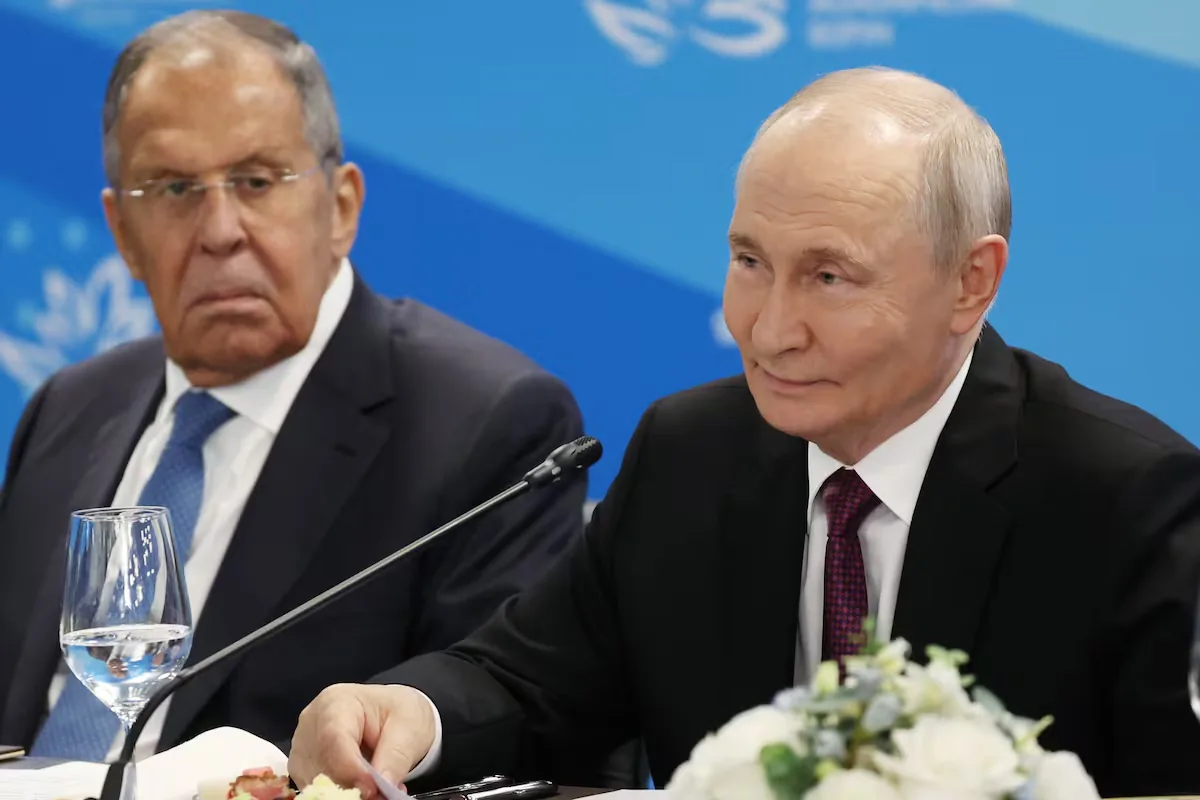
The Kremlin will close the three main branches of the Goethe Institute, the equivalent of the Cervantes Institute for the German language, in response to the closure of the Russian House in Berlin, decreed after Germany pointed to Russia as responsible for a drone attack at Leipzig airport in August. “If we didn’t do it, we wouldn’t respect ourselves,” argued Russian Foreign Minister Sergey Lavrov on Thursday, who predicted in an interview that this “means the end of their cultural presence in Russia.”
The Russian government will lock the doors of this educational institution’s branches in Moscow, Saint Petersburg, and Yekaterinburg, the three largest cities in the country. Two days earlier, the German chancellery ordered the closure of the Russian House in Berlin and the Russian consulate in Bonn, and announced more controls on Russian citizens, more sanctions, and renewed aid to Ukraine including greater cooperation of its intelligence services, and thousands of drones and Iris-T anti-aircraft missiles.
On September 1, Germany accused Russia of a failed explosive drone attack on Leipzig airport this summer. Two suspects with Russian passports were arrested. Two weeks earlier, it also reported the discovery of an arsenal of weapons from Russian secret services in Berlin. These are the latest actions of Russian espionage in an increasing sabotage campaign with which the Kremlin would be trying to destabilize Europe and weaken its support for Ukraine.
Additionally, this week there have been three new sabotages against critical German infrastructure whose authorship is currently unknown. All this on the eve of regional elections in several states of the country, where a rise of the far right is expected.
Lavrov followed the script of President Vladimir Putin by stating that Germany has not presented sufficient evidence. “They found a crashed drone at Leipzig airport and concluded that it resembled those used by Russia. They cannot confirm it, but it is a definitive conclusion. And, based on this assumption, this conjecture, they made this decision,” said the veteran diplomat without mentioning the arrest of two suspects with Russian passports.
On Thursday, the head of Russian diplomacy also assured that the Kremlin will not negotiate with the EU bloc the lifting of its sanctions for a matter of honor. “That will not happen. It is not at all in the nature of our people. We have, so to speak, our own pride. And in the best sense of the word. We do not need anyone’s goodwill at all,” Lavrov declared.
Read more Nvidia acquires Hugging Face for 11.2 billion in one of the largest purchases in its history
However, Moscow does not contemplate either a ceasefire or the existence of a sovereign Ukraine that wants to strengthen its ties with the European Union. “Yes, our people want some peace, but if we let that regime [the elected Ukrainian government] remain, if we stop the fighting, then we would be giving the green light to the resurgence of Nazism in a literal sense, in that quasi-state completely dependent on the West that openly preserves Nazi ideology,” Lavrov stated.
The Goethe Institute is dedicated to the dissemination of the German language worldwide. The organization has survived in Russia since 2023, when Moscow froze all its accounts in response to the same step taken by Germany against the Russian House, due to suspicions that it was evading sanctions imposed for the invasion of Ukraine. Additionally, both institutions lost hundreds of employees due to diplomatic visa restrictions mutually imposed by European countries and Russia since the beginning of the war.
The Russian House in Berlin opened its doors in 1984, in the middle of the Cold War. The countries have so far maintained two agreements about this institution. On one hand, the use of the Friedrichstrasse facilities, sealed in 2013 with a validity of 99 years, and another renewable agreement every five years on the activities of cultural and information centers that would expire in June 2027.
And speaking precisely about the future of languages, Lavrov reflected this Thursday on which languages will prevail in international relations. In his opinion, the influence of Chinese will grow considerably, at least in Russia, but English will remain basic. “English will probably retain its decisive influence in international relations. Yes, it is a legacy of the colonial era, but it also facilitates communication,” the diplomat acknowledged.