
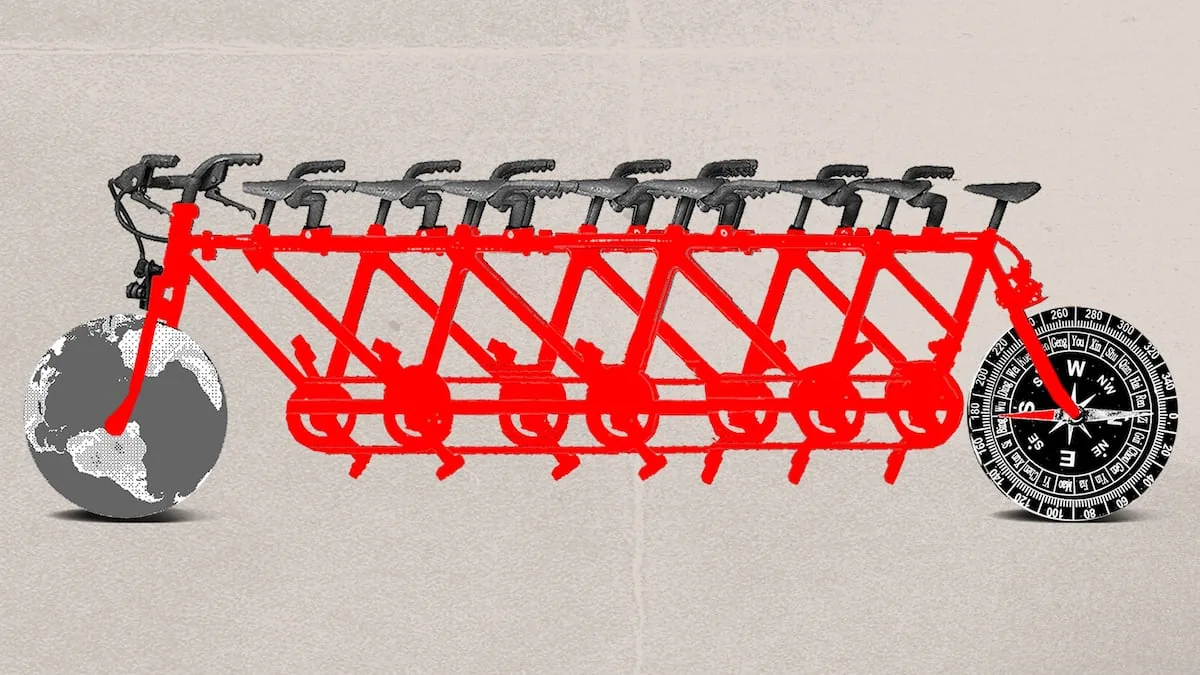
The old international order is collapsing and, in the field of ruins of illegal wars and human rights violations, the new disorder threatens to multiply risks and catastrophes for humanity. The summit of progressive leaders convened this weekend in Barcelona by the Spanish Prime Minister, Pedro Sánchez, has provided some answers in defense of democracy, multilateralism, and equality, although this effort will hardly be effective if it does not expand beyond the progressive camp.
Read more Playing with the language of Ali Smith
What has been known as the rules-based international order, founded at the end of World War II to avoid repeating the horror, did not always guarantee peace. Its main architect, the United States, repeatedly violated it. It was an imperfect order, but it contributed to an era of prosperity and the advancement of democracy, and established norms to which, at least on paper, everyone was subject. Multilateralism was anchored in a legal architecture and international governance with institutions such as the UN and the World Trade Organization, or forums such as the G-7 and the G-20. Everything is coming to an end.
The list is long, and US President Donald Trump is not the only one responsible. But it was Trump who broke the agreement on the Iranian nuclear program, abandoned and scorned the fight against climate change, and undermined NATO with threats to Greenland and doubts about military solidarity. The blockade of the Strait of Hormuz is proof of how the rules of the game are failing. Vladimir Putin’s war in Ukraine, US interventions in Venezuela and Iran, or the UN’s paralysis in the face of massacres in Gaza or Sudan certify the exhaustion of multilateralism. The building was cracked; Trump accelerated the demolition.
The old world will not return, but democracies cannot settle for a return to the division of the world into spheres of influence and subject to imperialist ambitions. On the eve of the Barcelona summit, which for a few days became the capital of global progressivism, Brazilian President Luiz Inácio Lula da Silva called for “redefining” the UN in an interview with EL PAÍS. “In Africa,” Lula da Silva recalled, “there are countries with more than 120 million inhabitants and none are on the Security Council. Neither are Brazil, Germany, India.”
Read more Camila Cañeque’s posthumous novel: a «radical exploration of language»
Europe is called to play a central role in the reconstruction of an international order. Faced with Trump’s threats to destroy their economies with tariffs, the European Union’s pacts with Mercosur, Australia, or India point to other options. The search for coalitions with middle powers represents an alternative. As Canadian Prime Minister Mark Carney said in Davos, “middle powers must act together, because if we don’t sit at the table, we’ll be on the menu.”
Norms and procedures, respect for law, and cooperation are the raison d’être of the EU, but they are not enough in a world of predatory powers. Without robust power to back that order, European influence and the defense of its interests will be limited. Without military, financial, and technological sovereignty, the EU risks becoming a political and military vassal of the US, or an economic one of Xi Jinping’s China. Without a fully autonomous defensive capability from Washington, Europeans will be at the mercy of Putin and his aim to dominate Ukraine.
The message from the Barcelona summit in defense of democracy and international norms against Trump and the reactionary wave should not be limited to the progressive camp. The reconstruction of a just order will be laborious, but it will fail if it is not a common endeavor of all democrats, right and left, in Europe, America, and the world.
Read more Fifty photos to tell half a century of history of EL PAÍS